
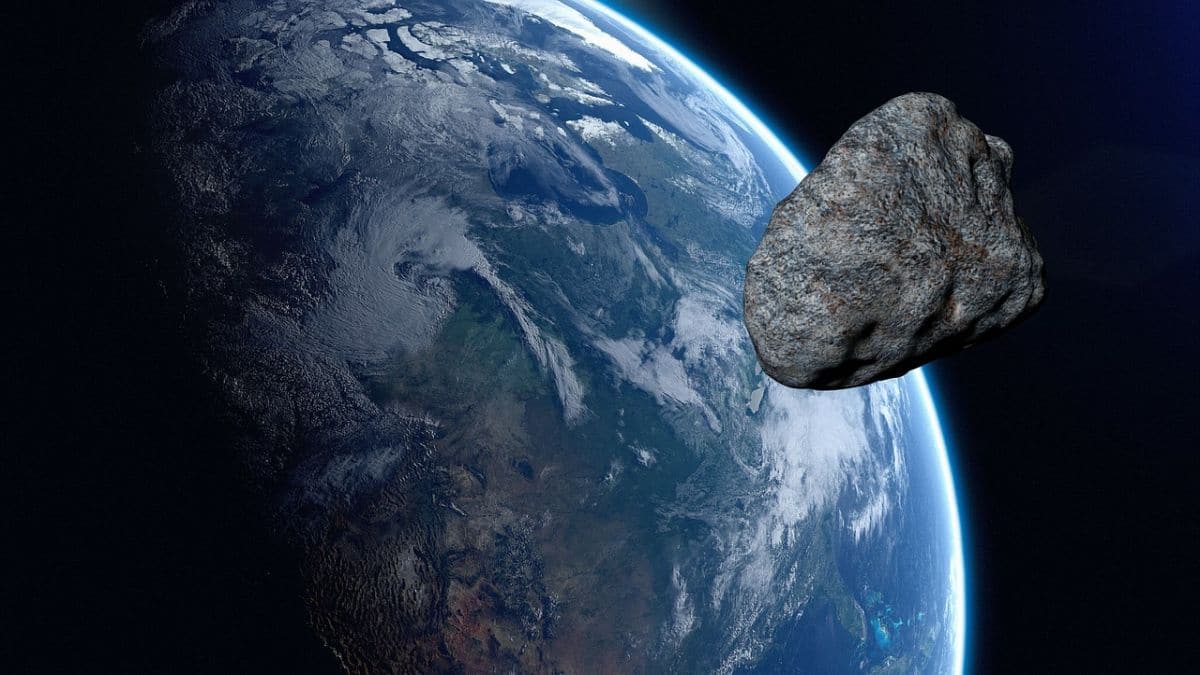
Scientists have finally solved a years-long puzzle. New research reveals that a 160-metre wide asteroid smashed into the southern North Sea, off the coast of Yorkshire, around 40 million years ago, triggering a tsunami wave exceeding 100 metres and carving out the Silverpit crater
After years and years of debate and speculation, we finally have an answer. The Silverpit crater, located 80 miles off the coast of Yorkshire in the United Kingdom, and situated 700 metres below the seabed under the North Sea, was formed when a roughly 160-metre asteroid struck the seabed about 43–46 million years ago.
According to a new study, the asteroid caused a mega‑tsunami taller than the iconic Big Ben surging across the ancient North Sea, causing a crater in the seabed.
STORY CONTINUES BELOW THIS ADAsteroid triggers mega-tsunami
Research led by Dr Uisdean Nicholson of Heriot-Watt University in Edinburgh, with support from the Natural Environment Research Council (NERC), has revealed that an
asteroid about 160 metres wide crashed into the ancient North Sea, near Yorkshire in the UK, roughly 40 million years ago.
The research findings, published in the journal Nature Communications, show that when the asteroid hit the seabed, it produced a violent explosion.
The scientists, who are part of the research, said, “Within minutes, it created a 1.5-kilometre high curtain of rock and water that then collapsed into the sea, creating a tsunami over 100 metres high.”
This eventually led to the formation of the now-famous Silverpit crater that is buried 700 metres beneath the seabed and roughly 80 miles off the coast of Hull.
Incidentally, the tsunami at 100 metres would have been taller than
Big Ben, an iconic landmark in London, which stands at 96 metres.
Scientists note they were able to come about their findings as a result of their research, which combined cutting-edge seismic imaging with samples from an offshore oil well to discover ultra-rare “shocked” quartz and feldspar, microscopic crystals that can only be forged in biolent asteroid impacts.
As Dr Nicholson told Science Daily, “We were exceptionally lucky to find these — a real ‘needle-in-a-haystack’ effort. These prove the impact crater hypothesis beyond doubt, because they have a fabric that can only be created by extreme shock pressures.”
The importance of Silverpit crater
This new research finally lays to rest how the Silverpit crater came into existence. Since it was first identified in 2002, this crater, which is three kilometres wide with a surrounding ring of circular faults spanning about 20 km, has sparked intense debate.
Early research proposed that the crater was created by a high-speed asteroid impact. Supporters of that idea pointed to its round shape, central peak, and surrounding concentric faults, which are often seen in known impact craters.
Others suggested different explanations. Some proposed that underground salt movement distorted the rock layers and created the structure. Others argued that volcanic activity may have caused the seabed to collapse. In 2009, geologists even voted on the issue. According to a report in the December 2009 issue of Geoscientist magazine, most participants rejected the asteroid impact explanation at the time. However, the latest findings now overturn that conclusion.
STORY CONTINUES BELOW THIS AD
Though the Silverpit crater isn’t one of a kind — there are more than 200 impact craters — it offers a valuable opportunity for researchers to study how asteroid impacts shape planetary surfaces. Notably, this crater is nowhere comparable to the Chicxulub crater in North Mexico, which was formed when an asteroid struck Earth, resulting in a mass extinction of 75 per cent of plant and animal species.
Scientists note that studying the Silverpit Crater helps them understand the Earth’s geology and the dangers that asteroids could pose to life on Earth.
As Nicholson told The Guardian, “Silverpit is exceptionally preserved and important. We can use these findings to understand how asteroid impacts shaped our planet throughout history, as well as predict what could happen should we have an asteroid collision in the future.”
With inputs from agencies
HomeExplainersAn asteroid hit the North Sea, causing a tsunami taller than Big Ben. Here’s what happenedEnd of Article