
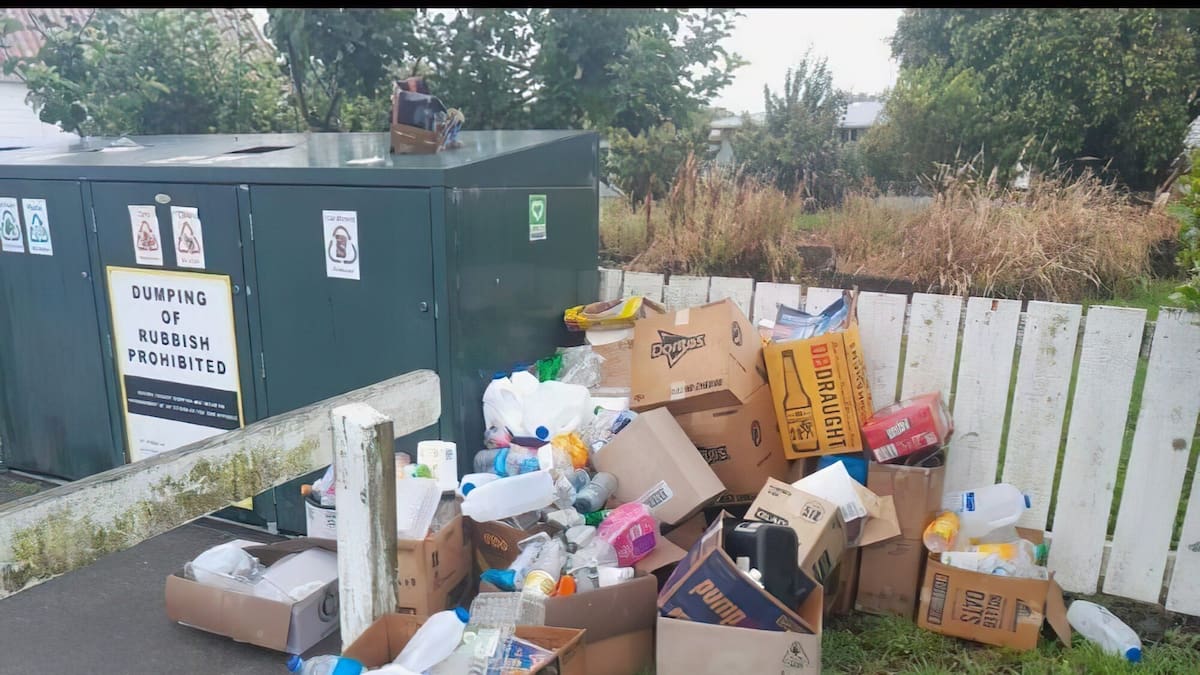
The council said at the time that the site had been “overwhelmed” by the volume of waste, with contaminated and non-recyclable rubbish also left there.
At the March 11 meeting, councillor Luke Pepper said the council would be “giving the middle finger” to Raetihi residents if the bins were removed.
“The community did want it, they did approve it, it was from the ground up,” he said.
“It has to stay there.”
In the meeting’s public forum, former Project Tongariro Waimarino environmental educator Liz Brooker questioned why the bins were ”even in” the council’s annual plan report.
“You know what the community board wants and we’ve been given assurances that you are going to work with us,” she said.
“This is just cherry-picking Raetihi again and using us as a bank.
“This is literally the last thing you can take. There’s nothing left.”
To achieve a 9% rate increase, council officers also recommended not increasing cycleway maintenance ($100,000), road and footpath maintenance ($400,000) and new water treatment plants ($330,000).
The council’s LTP projected a 9% rates rise for its first three years (2024-27).
Ruapehu District Council chief executive Clive Manley.
Council chief executive Clive Manley said achieving a 9% rise meant the council had to “carefully juggle its work programme each year”.
“This has included deferring some projects, maintenance and depreciation spending, leveraging capital subsidies where available, and identifying operational savings while still maintaining services for the community.”
He said maintaining the services and commitments outlined in the LTP – along with accommodating new council decisions – would otherwise have required a rates increase nearer 15%.
Ruapehu Mayor Weston Kirton told the Chronicle that keeping the Raetihi Recycling Station within the 9% rate rise required “fine-tuning” in other areas to offset the cost.
He said he had been pushing for a 5% average rate rise for 2026-27 but that was voted down.
It was one of three options presented to councillors at the meeting, along with 9% and 16.5%.
Council officers did not recommend the 5% option, saying the main risk was the potential financial impact on the council of deferring business-as-usual maintenance.
“I campaigned on 5%, almost in line, if not before, the Government coming out with capping,” Kirton said.
“But I need to respect the fact that the council has now resolved the 9% in principle, and put aside my own feelings.”
Late last year, Prime Minister Christopher Luxon and Local Government Minister Simon Watts said consultation would begin immediately on limiting annual council rate rises to between 2% and 4%, with the cap coming into effect in 2029.
The council will not run a formal consultation process for the annual plan.
Manley said it would still hold meetings to “listen to the community”.
“We’ll present what’s in the 9% and we’ll listen to feedback.”
The annual plan will be signed off in June.
It sets the council’s budgets from July 1, 2026, to June 30, 2027.
Mike Tweed is a multimedia journalist at the Whanganui Chronicle. Since starting in March 2020, he has dabbled in everything from sport to music. At present his focus is local government, primarily Whanganui District Council.