
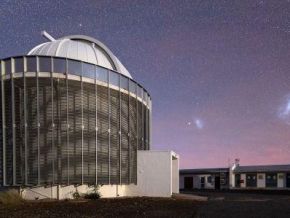
South Africa’s SAAO and the U.K.’s Hartree Centre launched the “Intelligent Observatory” program.
The project will integrate AI and high-performance computing into telescope operations.
The initiative aims to automate observations and strengthen Africa’s role in advanced astronomy.
The South African Astronomical Observatory (SAAO) announced on Thursday, March 12, a strategic partnership with the United Kingdom’s Hartree Centre to launch the “Intelligent Observatory” program. The initiative aims to integrate artificial intelligence (AI) and high-performance computing into the daily operations of national telescopes, transforming facilities that have largely relied on manual processes into autonomous and predictive systems.
The partnership reinforces South Africa’s leadership in innovative astronomy while creating strong opportunities for students and researchers across Africa to engage in advanced, AI-driven scientific work, said Stephen Potter, head of astronomy at the SAAO.
Toward autonomous telescopes powered by AI
At the core of the project is the automation of monitoring and data processing. Using AI, telescopes will be able to monitor themselves, detect hardware failures or weather changes in real time, and adjust instruments to correct atmospheric distortions.
This level of responsiveness is crucial for capturing short-lived cosmic events, such as stellar explosions, which require immediate analysis of raw data to be useful for researchers.
The program also includes the deployment of a digital assistant based on large language models (LLMs). This tool will allow astronomers to instantly access technical reports, maintenance manuals, and scientific archives, including those of the Southern African Large Telescope (SALT). The aim is to free scientists from repetitive administrative and technical tasks so they can focus on discovery and analysis.
A scientific ecosystem undergoing transformation
The initiative forms part of a broader effort to strengthen South Africa’s position as a major astronomy research hub in the Southern Hemisphere. The country hosts the MeerKAT radio telescope, a key component of the international Square Kilometre Array (SKA) project, which is expected to become one of the world’s largest radio astronomy observatories.
These infrastructures generate growing volumes of scientific data, increasing the need for advanced automation and AI-based analysis tools.
Beyond astronomy, the partnership—supported by British cooperation funding—also serves as a laboratory for other industries. Technologies developed for telescope monitoring, such as predictive maintenance and smart sensors, could be applied to sectors including industry, energy, and transportation.
For South Africa, the collaboration not only strengthens its scientific leadership on the continent but also provides young local researchers with advanced expertise in data science and artificial intelligence.
Samira Njoya