
For years, astronomers have faced a stubborn problem: supermassive black holes were already in place less than a billion years after the Big Bang, yet ordinary stellar evolution does not produce such massive objects quickly enough. The new result points to a different route, one involving short-lived, enormous first-generation stars.
According to the University of Portsmouth summary of the work, the evidence comes from the fossil chemical record in GS 3073, a galaxy at redshift z = 5.55. That record, the researchers argue, preserves the signature of stars so massive and so unusual that no known modern stellar population can reproduce it.
A Chemical Fingerprint Unlike That of Ordinary Stars
The central clue in GS 3073 is its nitrogen-to-oxygen ratio of 0.46. According to the paper by Devesh Nandal, Daniel J. Whalen, Muhammad A. Latif, and Alexander Heger, no known stars or supernovae can account for a value that high in this galaxy while also matching its carbon-to-oxygen and neon-to-oxygen ratios.
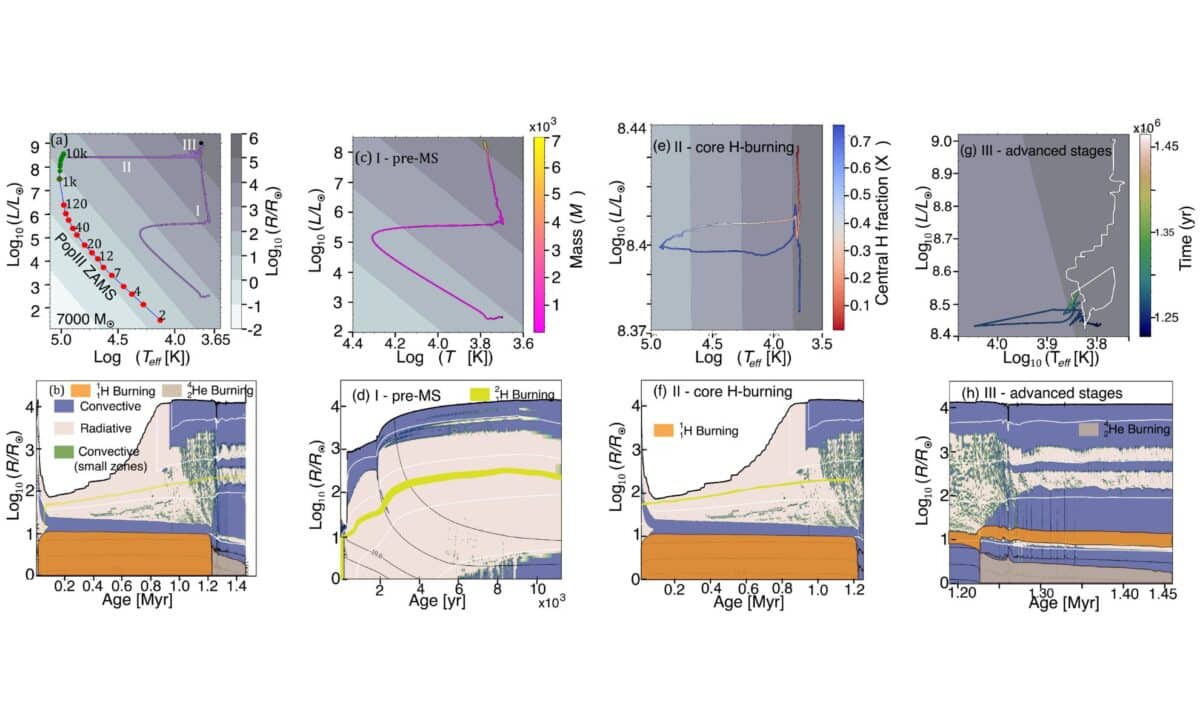 H-R and Kippenhahn Diagrams for a 7000 M⊙ Pop III Star Showing Evolution from Pre-MS to Si Burning.©The Astrophysical Journal Letters
The authors write in the abstract that “the extreme N abundances in GS 3073 can be produced by 1000–10,000 M⊙ primordial (Pop III) stars.” They add that these are “the only candidates” able to explain the observed combination of abundance ratios. That is the key point here, and it matters because the claim is not based on nitrogen alone.
The researchers modeled primordial stars in 1,000-solar-mass steps from 1,000 to 10,000 solar masses using the Geneva Stellar Evolution Code. Their results showed that stars below 1,000 solar masses and above 10,000 solar masses do not reproduce the same pattern. In the paper’s wording, GS 3073 is “the first conclusive evidence in the fossil abundance record of the existence of supermassive Pop III stars at cosmic dawn.”
How These Stars Made So Much Nitrogen
The mechanism described in the study is specific. Inside these stars, helium burning in the core produces carbon. That carbon then reaches the hydrogen-burning shell, where it is converted into nitrogen through the CNO cycle, and convection spreads the nitrogen through much of the star.
 Abundance Profiles of a 7000 M⊙ Star at Core He Burning and Si Burning Stages©The Astrophysical Journal Letters
According to the paper published in The Astrophysical Journal Letters, this sequence is what drives the nitrogen enrichment across the 1,000 to 10,000 solar mass range. The authors describe a “robust sequence” in which carbon from the convective helium core reaches the hydrogen-burning shell, becomes nitrogen, and is then dispersed through the envelope by convective zones. It is a rather neat chain, even if the stars themselves were anything but neat.
Source 1 reports a quote from Devesh Nandal that captures the result in plain language: “Chemical abundances act like a cosmic fingerprint, and the pattern in GS3073 is unlike anything ordinary stars can produce.” In the same statement, he says the galaxy’s extreme nitrogen matches only primordial stars “thousands of times more massive than our sun.”
A Possible Path to the First Giant Black Holes
The study does not stop at chemistry. It also follows the fate of these stars and finds that, once their fuel is exhausted, they collapse into black holes rather than ending as standard supernovae. That matters because GS 3073 also contains an active central black hole.
According to the paper, all 10 modeled stars enter the pair-instability regime late in life, yet even then explosive burning is not expected to reverse collapse because of their enormous mass. In one collapse test for an 8000-solar-mass star, the central 1200 solar masses reached infall velocities of 10% of the speed of light. The authors state that such stars would likely leave behind massive black holes.
SciTechDaily quotes Daniel Whalen saying, “Our latest discovery helps solve a 20-year cosmic mystery,” adding, “With GS 3073, we have the first observational evidence that these monster stars existed.” In the same source, he says these objects would have burned brightly for a short time before collapsing into massive black holes. In GS 3073, the paper notes, the observed active galactic nucleus has a black hole mass of log(MBH) = 8.2 ± 0.4 at z = 5.55, which the authors discuss in the context of growth from such a seed.