
For decades, scientists have wrestled with one of biology’s most fundamental questions: where, exactly, did life begin? The debate spans disciplines, theology, philosophy, evolutionary biology, but in recent decades, hard science has offered increasingly concrete clues. One of the most dramatic came in February 1977, when a team of researchers exploring the deep-ocean Galápagos Rift, located 250 miles north of the Galápagos Islands, stumbled upon something no one expected: hydrothermal vents teeming with biological life, far below the reach of sunlight.
That discovery upended assumptions about where life could exist. Since the vents sat well beneath the euphotic zone, the layer of ocean where light penetrates, the organisms living there could not rely on photosynthesis. They were surviving on something else entirely. A hypothesis began to take shape: perhaps these extreme, heat-driven environments had once produced the “pre-cells” that eventually gave rise to all life on Earth. What the new review does is push that hypothesis further, making the case that it wasn’t just any hydrothermal vent that mattered, it was the ones born from asteroid impacts.
Asteroids as Delivery Men for the Building Blocks of Life
The idea that asteroids contributed to the origin of life isn’t new, but it has gained remarkable traction thanks to a wave of space missions bringing back physical samples. NASA’s OSIRIS-REx mission, along with earlier missions to asteroids Itokawa and Ryugu, has allowed scientists to analyze the actual chemical composition of these ancient space rocks. What they found was striking.
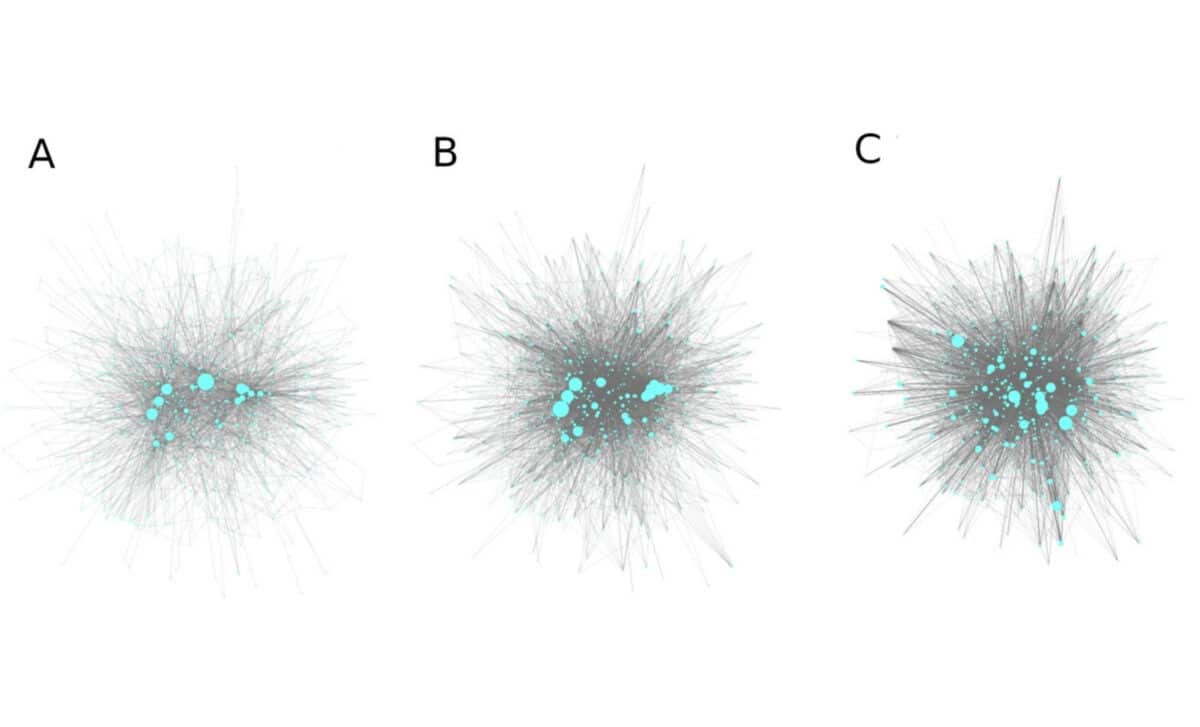 Examples of metabolic networks (gray nodes and edges) and seed sets (blue circles) – © Journal Communications Chemistry
According to a study published in the journal Communications Chemistry, B-type asteroids like Bennu contained all 66 signature compounds necessary to host and support ancient methanogenic and acetogenic organisms. Among these compounds: d-ribose and adenine, both essential for early ATP production, the energy currency of living cells. In other words, even without carrying alien life themselves, asteroids appear to have delivered precisely the right ingredients to get life’s chemistry started here on Earth.
Shea Cinquemani and Richard Lutz, both researchers at Rutgers University and authors of the review, put it plainly in their paper: “Meteors and meteorites may have brought chemical elements and compounds required for life to Earth, and impacts would have exposed buried elements/compounds already present just below the surface.” It’s a two-pronged contribution, part import, part excavation.
Impact Craters as Unlikely Nurseries
Beyond delivery, the impacts themselves may have done something just as important: they built the infrastructure life needed to get started. When a large asteroid slams into a planet’s surface, it doesn’t just leave a crater, it creates a geothermal system. Heat, pressure, and fractured rock combine to generate what scientists call impact-generated hydrothermal vents, structures that circulate prebiotic materials through geological plumbing in a way that ordinary seafloor vents cannot replicate.
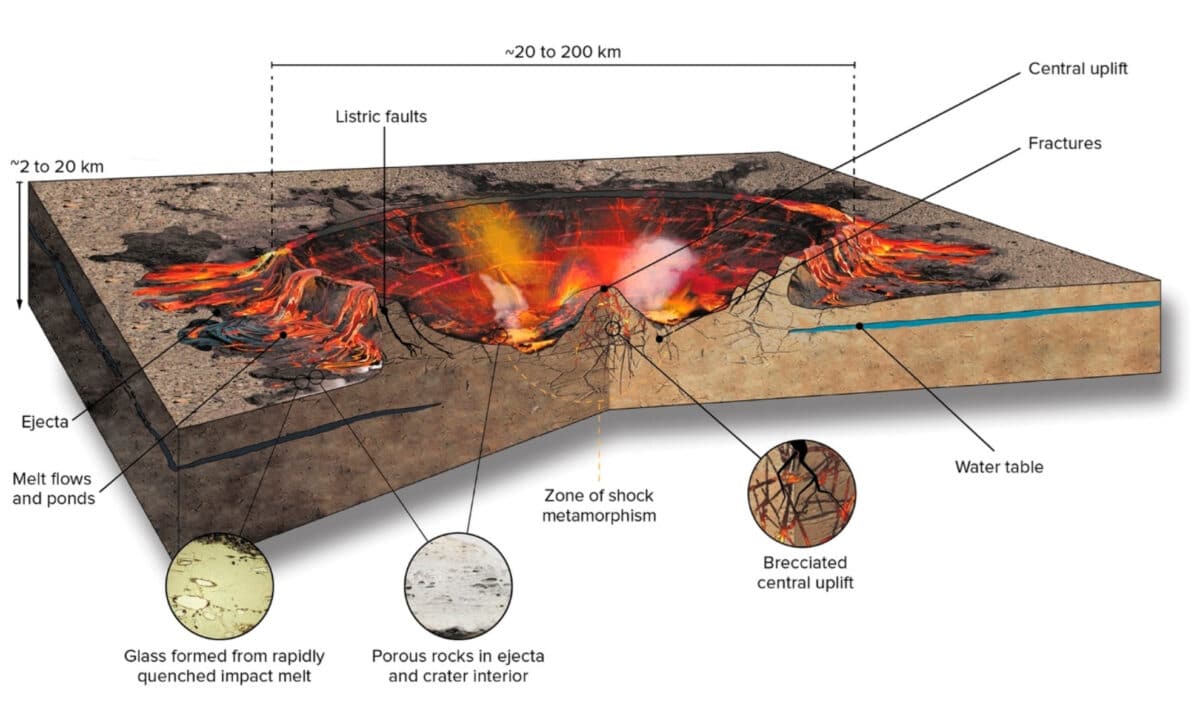 Diagram of the thermobaric phase of an impact crater and its forming hydrothermal vent system – © Journal of Marine Science and Engineering
To test whether these systems could genuinely foster life, Cinquemani and Lutz examined research from three well-documented impact sites: India’s Lonar Lake, the Haughton impact structure in Canada, and the Chicxulub impact crater in Mexico, yes, the same one linked to the extinction of the dinosaurs. Each site offered evidence that large-scale hydrothermal activity had followed the original impact, creating conditions that could support early biological chemistry.
Particularly notable was one detail the researchers highlighted: unique DNA structures had been found in the sediment of an impact-generated hydrothermal vent system. This, according to the study published in the Journal of Marine Science and Engineering, lends weight to the idea that “biotic life could be generated by the heat energy and chemical compositions of impact-generated hydrothermal vents.”
Freshwater Craters and a Simpler Kind of Chemistry
One element of this theory that often gets overlooked is water, specifically, the type of water. When asteroid impacts carve out deep craters, they frequently fill with freshwater, creating isolated lakes rather than merging with the open ocean. That distinction matters more than it might seem.
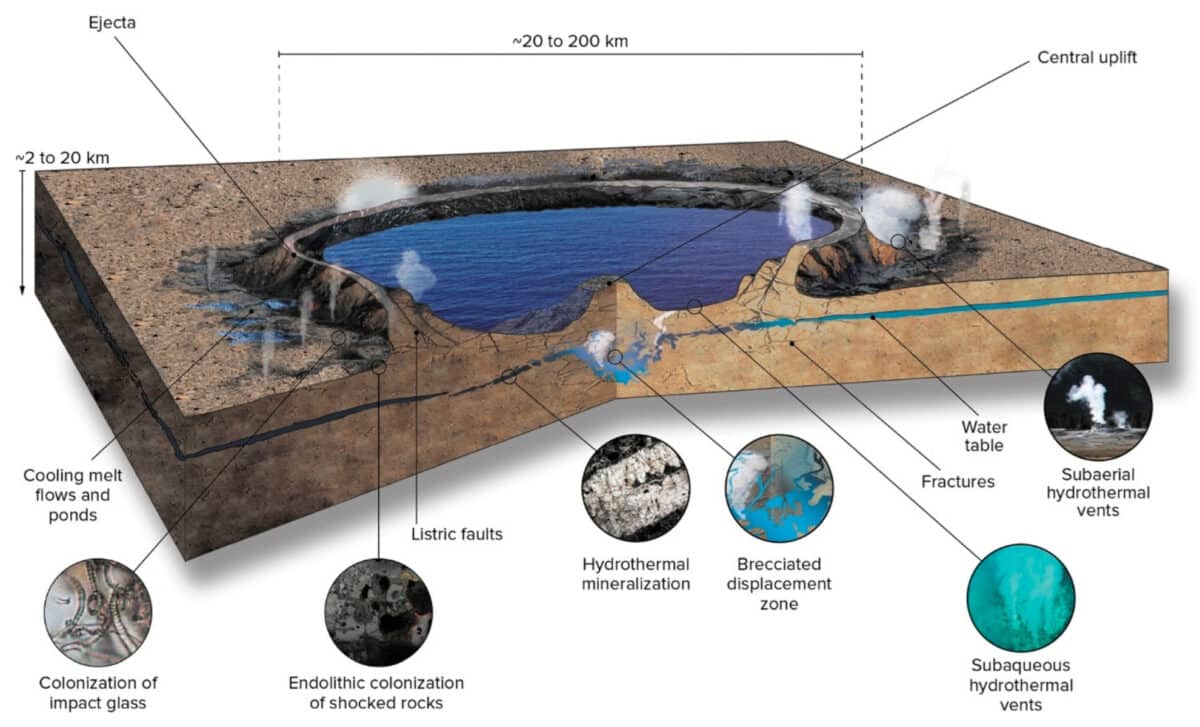 Diagram of the hydrothermal phase of an impact-generated hydrothermal vent system, characterized by the crater lake and the active hydrothermal vent system – © Journal of Marine Science and Engineering
The open ocean, for all its vastness, comes with serious chemical complications for prebiotic chemistry. Salt concentrations, pH variability, and the sheer dilution of organic compounds make it harder for the right molecules to find each other and react. Freshwater crater lakes, by contrast, offer a more contained and chemically favorable environment. As Cinquemani and Lutz note in their review, these impact-generated freshwater systems would have “largely sidestepped many of the tricky chemical aspects of the open ocean.”
It’s a detail that makes the asteroid-impact hypothesis feel less like a dramatic cosmic accident and more like a carefully, if violently, set table. The impacts delivered the ingredients, carved out a protected space, and installed the plumbing to keep everything circulating. “With the intense impacts on Earth’s surface,” the authors write, “geochemical reactions during and following impacts may have been the key to biological beginnings.” If they’re right, life on Earth didn’t just survive a bombardment from space. It may have been born from one.