
The two are currently working together at Kobe and Rennie could contend that the mutual trust and respect they have built, as well as their strategic and tactical compatibility, will enable the new coaching team to hit the ground running.
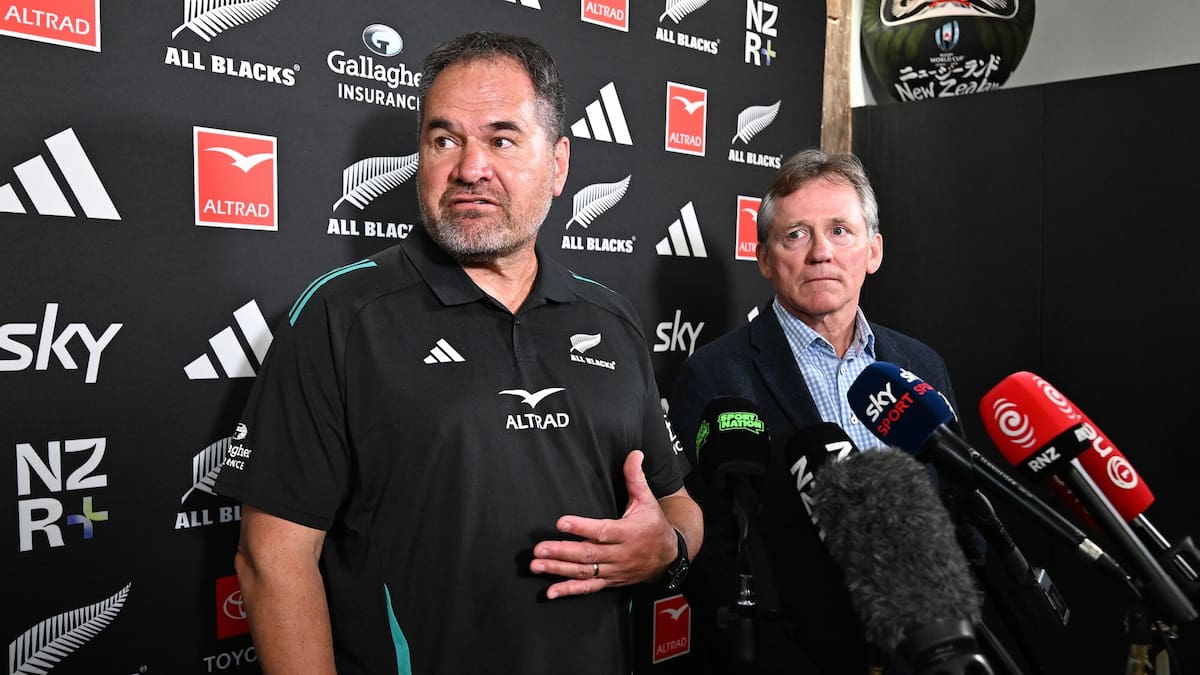
All Blacks coach Dave Rennie is considering his options for assistants. Photo / SmartFrame
The Herald understands that NZR is not troubled by the prospect of having a foreigner in the national team’s coaching ranks, and nor is it sceptical of Blair’s pedigree or opposed to Rennie’s right to choose his own assistants.
But it is conscious that Hansen is respected by many current All Blacks who rate his all-round coaching ability and that it may be profligate to lose his intellectual property and institutional knowledge.
More than three well-placed sources have told the Herald that Hansen scored well in the recent independent review of the All Blacks coaching personnel and set-up. They said there is confidence that if he were handed a tighter, simpler brief of running the attack – as opposed to running both the attack and defence as he was last year – Hansen would be a strong asset.
Blair may have a tight relationship with Rennie, but Hansen has established rapport with the playing group and given the schedule that lies ahead for the All Blacks and how little time the new group will have to prepare, NZR may see the latter as potentially the more valuable currency.
NZR’s push to encourage Rennie to retain Hansen is not part of an austerity drive to avoid a costly pay out, coming just weeks after the national body agreed a circa $1m termination fee with former head coach Scott Robertson.
Assistant coach contracts – most All Blacks employment agreements, in fact – have a clause that allows NZR to terminate the arrangement if the head coach is changed for any reason.
These contracts are believed to have pre-agreed financial formulas that determine the size of the termination payout dependent on how long the agreement still has to run. So while Hansen is only two years into a four-year deal, his financial compensation should he lose his current role, is unlikely to be as significant as has been intimated in some media reports.
The All Blacks coaching team is being rebuilt as the team faces a massive year. Photo / Photosport
Besides, what kills the likelihood of this being an exercise in frugality, is that it would be incongruous with NZR’s wider strategic shift towards ensuring the All Blacks are set up to succeed in a way they previously haven’t been.
NZR has created a new role of high-performance director – one to which the All Blacks coach will have to report and one that is likely to carry a $1m salary – in recognition that the national team drives anything from 80%-90% of the game’s total revenue and it needs to be successful in the international arena if the money is to keep flowing.
It would seem odd, then, that an organisation hoping to become a $7b brand, would straddle the in-coming coach with an assistant he didn’t want, all to save a few hundred thousand dollars.
Rennie isn’t being forced into retaining Hansen – he’s being asked to consider that option and if he decides, after comprehensive due diligence that he doesn’t want to, NZR will sign off on Blair, or whoever Rennie’s choice is.
And this is where NZR is demonstrating, firstly, the courage of its convictions – as chairman David Kirk publicly stated a few weeks ago, the organisation would work with Rennie to appoint assistants – and secondly, a sense of having learned from its past mistakes.
All Blacks coach Dave Rennie (left) and New Zealand Rugby chair David Kirk shake hands at the New Zealand Rugby press conference. Photo / Photosport
For different reasons, the tenures of former All Blacks coaches Ian Foster and Robertson were disrupted by the premature departures of assistant coaches.
In the case of Foster, he had to sack two underperforming assistants – John Plumtree and Brad Mooar – in August 2022.
It was a tough call for Foster to make as he had hand-picked both men. But neither had been his first choice and more problematic still was that he, and rival head coach candidate Robertson, had been required to pitch for the job with pre-chosen coaching teams.
Foster had initially planned to use Jamie Joseph as his forwards coach and Tony Brown on attack, but both were pulled back to Japan by improved financial offers, a week before the board interviewed the two head coach candidates, and so Plumtree and Mooar were late replacements, rather than the best choices.
Robertson, it seems, was allowed to hire his assistants with little scrutiny or oversight, and five tests into his reign, assistant Leon MacDonald left, and then another Jason Holland, didn’t seek a contract extension last year.
What’s playing out here, therefore, is good process and the sort of robust to and fro that defines the best high-performance environments.
Rennie may well get his way with Blair, and if he does, it will be because he’s made a deep evaluation of his options, and determined the Scotsman is the best choice.
Gregor Paul is one of New Zealand’s most respected rugby writers and columnists. He has won multiple awards for journalism and written several books about sport.