
But asked about the shortage of international quality fast-bowling allrounders across New Zealand, Black Caps selector Gavin Larsen outlined planning is already underway for the next generation to come through.
Colin de Grandhomme retired in 2022. Photo / Photosport
“It’s the same question you ask across all skillsets across three formats,” he told the Herald. “You dashboard it, where are the red flashing lights?
“Pace-bowling allrounders has been a glaring gap. Jimmy has been playing a really key role for us. But he’ll be aware that there’s a number of emerging allrounders now that are turning our heads as selectors.
“We’re about to name a New Zealand A team to go to Sri Lanka, that will have three very exciting, young allrounders.
“We’ll be watching their performances very closely.”
Wellington’s Muhammad Abbas looms as a clear standout among those playing domestically, while Auckland’s Simon Keene has already represented New Zealand A.
Further afield, Otago’s Luke Georgeson turned down the chance to represent Ireland to push for a Black Caps place, while the Herald understands Canterbury’s Cameron Paul is another to have been identified as a player of significant potential to play at the highest level.
Muhammad Abbas has been handed a first New Zealand Cricket central contract. Photo / Photosport
The current shortage isn’t entirely unexpected. Allrounders tend to take twice as long to develop than specialist batters or bowlers, given their time in practice is split between two skills.
Making the situation more challenging, though, is the fact that the amount of cricket played in 2026 is making it difficult for allrounders to exist. The workload of both disciplines, repeated day in, day out by a hectic schedule has seen an increase in injuries, with players forced into retirements.
Among the sport’s premier international allrounders, none consistently play all three formats. England’s Ben Stokes saves himself for test cricket, while India’s Hardik Pandya effectively only plays T20s. Andre Russell retired from international cricket last year, having played 142 white ball matches for the West Indies, but only one test.
Workload management, Larsen says, remains arguably the biggest challenge in the game.
“We’ve started a project since I’ve got back addressing that exact point. It’s a very complex cricketing world we live in now.
“We’ve got a lot of bilateral cricket, we’ve got pinnacle events, we’ve got T20 franchise leagues that sit heavily on top of that programme now.
“That means the players’ workloads are stretched in all directions. We’re very conscious that we have to manage our players.
“That might mean having to make difficult decisions, in terms of who we rest and when, and being measured and pragmatic.”
As for New Zealand, the status quo will remain in place for a little while longer. Neesham is now 35. By the time the next T20 World Cup rolls around at the end of 2028, he’ll be 37.
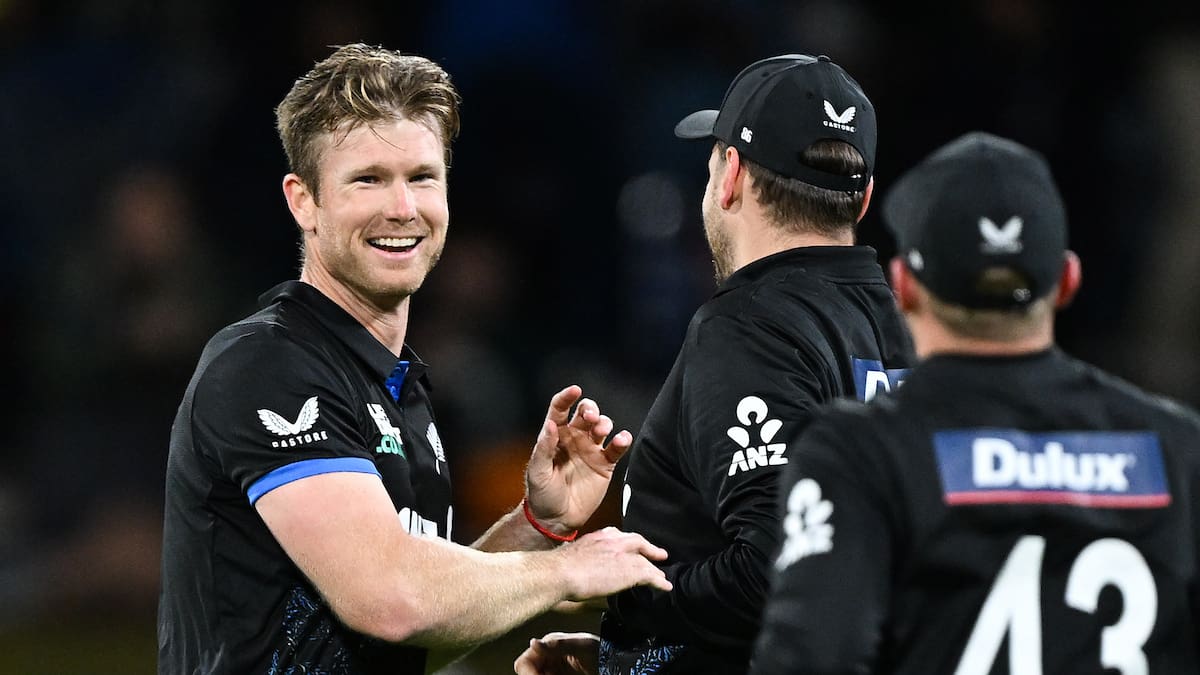
Jimmy Neesham took four wickets in the third T20 International against Australia. Photo / Photosport
And yet, when a weakened Black Caps squad for five T20s against South Africa this month was named, in what chief selector Gavin Larsen described as the start of the cycle towards 2028, Neesham – as well as Central Districts’ Josh Clarkson – was included.
As part of New Zealand cricket’s golden generation of the 2010s, Neesham is starting to wind down his career – and has not held a central contract since 2022.
But considering the Black Caps’ success has tended to come from older, experienced players, Larsen isn’t prepared to draw a line through Neesham just yet.
“Age is just a number,” he said of Neesham. “If you’re playing well enough, performing and shooting the lights out, then you’ll remain in consideration.
“The players all know this; it’s performance-based. Your currency is scoring runs, taking wickets and producing meaningful or match-winning performances for your country or in domestic cricket.
“The incumbents’ job is to keep performing. The pressure is on, we’ve got some really good depth around the country.
“It’s very positive that some of the more experienced, older incumbents around the Black Caps are needing to keep an eye over their shoulder, because they’ve got guys pushing them hard.”
Alex Powell is a sports journalist for the NZ Herald. He has been a sports journalist since 2016.