
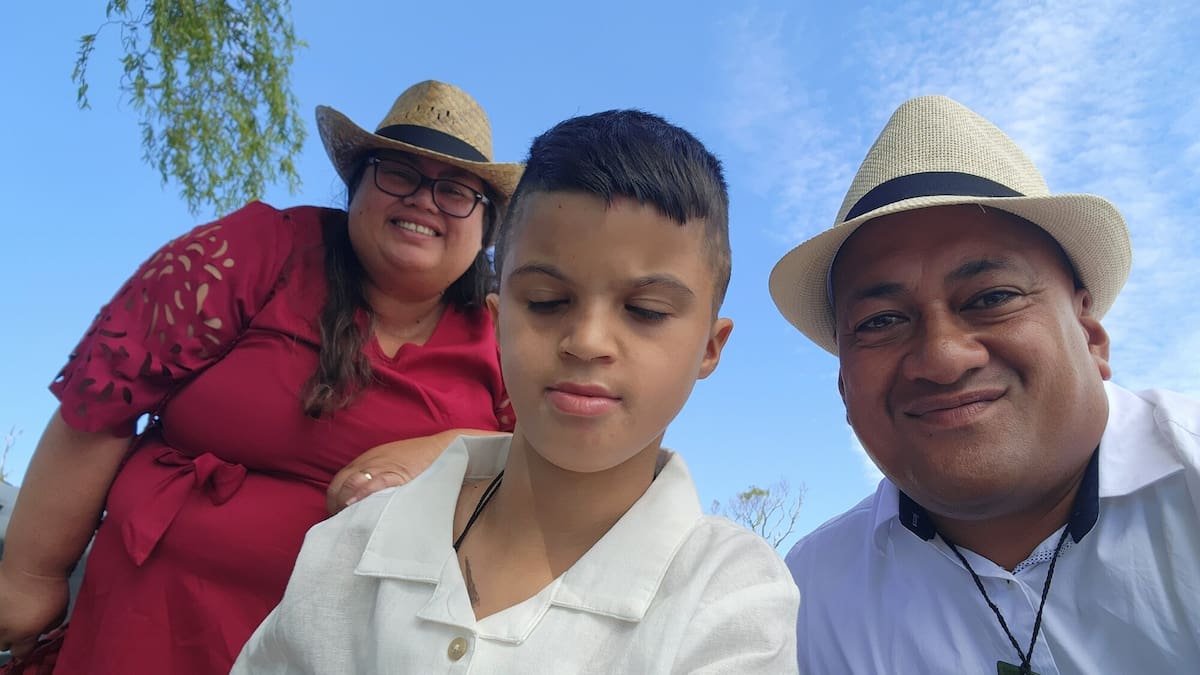
Kaa-rin, who is sharing her story in Rare Disorders Month, wants more whānau-centred support for parents as they receive diagnosis of a condition so rare, prognosis is not known.
Tetrasomy 18p is thought to form in the early development of the embryo. Roy shares it with just two other Kiwis and 550 patients worldwide.
Kaa-rin now knows such genetic conditions can have a range of impacts and not all patients are the same.
Now aged 9, Roy has physical impacts like eating difficulties and low muscle tone which sees him need a wheelchair when tired.
He has intellectual disabilities and was meant to be non-verbal but continues to defy the odds by saying words in English and his father’s Tongan, she says.
Roy Kaumavae jnr, 9, uses a wheelchair when he gets tired but likes to do kapa haka and cycling on an adapted bike.
Kaa-rin says she first gained hope when connecting with other families of tetrasomy 18p children, including an international social media page and talking with a family based in the South Island.
Being able to see pictures of children up to 12 gave her hope her then-baby would live beyond his first few months.
Later, she connected with organisation Rare Disorders NZ, and soon found 300,000 Kiwis have a rare disorder.
She hopes to help other parents receiving an earth-shattering diagnosis so they do not feel so alone.
Life for the Kaumavaes has not been easy. When he was 2, Roy suffered a life-threatening seizure for more than an hour, with doctors considering putting him on life support.
Kaa-rin Kaumavae, pictured centre with son Roy at her graduation, says the support of wider whānau is key.
Kaa-rin says the threat of losing Roy prompted her to move the family from South Auckland to whānau land at Takahiwai.
Allowing Roy to go to his marae, connect with his nans and cousins, and play in his moana and on his whenua has been the best “medicine” for him, she says.
The support of wider family has also been important for Kaa-rin and Roy snr, with aunties encouraging them to stand back and let him be a typical boy.
“No one uses ‘tetrasomy 18p’. It’s just ‘Roy’, just ‘moko’, just ‘cousin’.”
Kaa-rin says she is “beyond blessed” that Roy is taught through Blomfield Special School, initially with a satellite class at Morningside School.
For Roy Kaumavae jnr, being able to connect with his whānau land, including the graves of his grandparents, has been important for his healing.
She enjoys watching him progress both academically and socially, including hearing the students cheer him on when he plays, and seeing him do activities like kapa haka.
This week, Rare Disorders NZ launched its 2026 Voice of Rare Disorders white paper in Wellington, outlining the impact of having a rare condition and urging the Government to deliver on a promised Rare Disorders Strategy.
Kaa-rin says she would like to see more special schools like Blomfield and more financial support for families having to live off one income.
While she has trained as a social worker and works fulltime, her husband is a stay-at-home dad due to Roy’s high needs.
“It’s hard. I love being his mum and I don’t like to say it’s hard, but it’s not doable in these economic times we live in.”
Above all, Kaa-rin says there needs to be more emotional support for parents, especially to awhi them when news of a life-changing diagnosis is given.
Denise Piper is a news reporter for the Northern Advocate, focusing on health and business. She has more than 20 years in journalism and is passionate about covering stories that make a difference.