
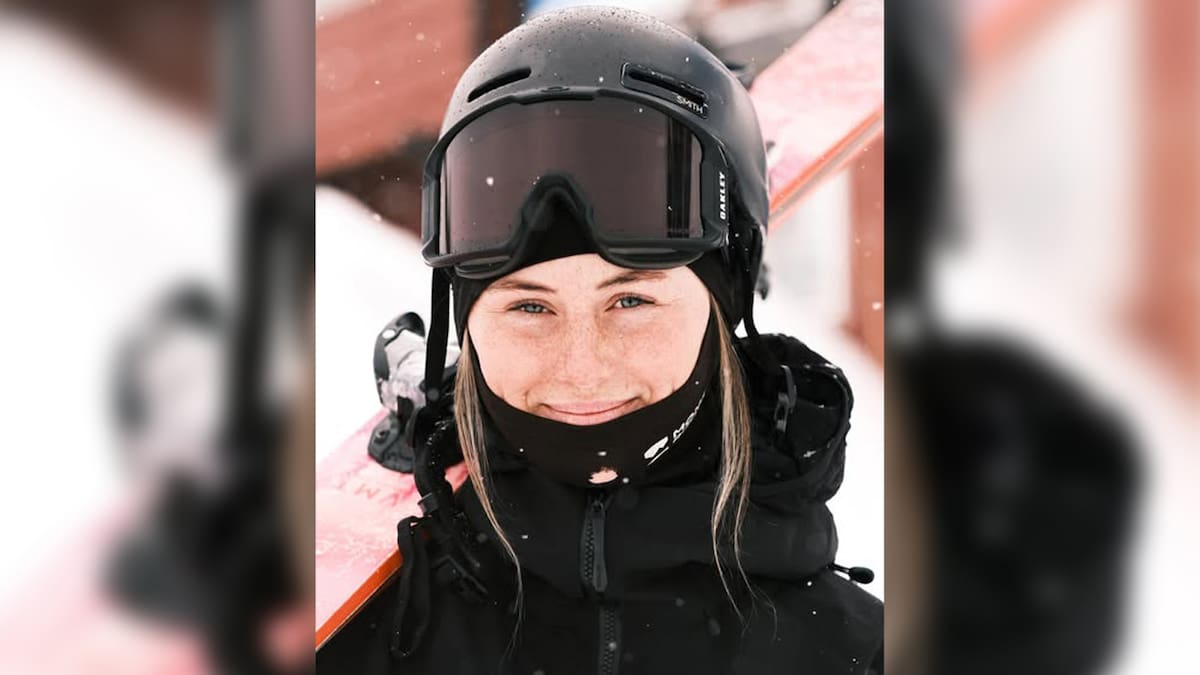
As part of it, I have learned a new word: vilomah, a Sanskrit term for a parent who loses a child. It means “against the natural order”. I did not know this word before March 11, 2024. I wish I still didn’t. On that day, the life of Isabella Skye Bolton, my 21-year-old daughter, was tragically taken in an avalanche on Mt Yotei in Hokkaido, Japan.
Mt Yotei rises in near-perfect symmetry, often called Ezo Fuji for its resemblance to Japan’s most famous peak. Hokkaido is legendary for its powder, but sadly, the same white expanse that delivers euphoria can, in seconds, claim a life.
A photo of Mt Yotei taken by Isabella on Christmas Day 2023.
Isabella loved white powder.
At 17, she wrote an essay at school titled The White Room. It opened with the line: “Day 226 clean.” It read at first like a confession of addiction, obsession or craving, before revealing itself as a love letter to skiing. The “Day 226 clean” referred to the days she had counted since last hitting the slopes. “As soon as I carve that first line … I know things are about to go up,” she wrote. She described avalanche bombing echoing across a range as part of her narrative. It was clever, irreverent, vivid.
It was also prophetic in ways no mother would ever want to contemplate.
In her final yearbook at high school, when asked where she saw herself in 20 years, she wrote: “Sitting in my log cabin located at the base of a mountain range in Canada. Sitting in front of my open log burner, looking over a map of tallest peaks in the world and planning my next summit/ski descent.”
That was not teenage fantasy. It was a blueprint.
Isabella did not romanticise mountains blindly. She studied them. In Year 12, she gained her Level 1 ski instructor’s qualification, and after leaving school, she worked as an instructor at Round Hill in Tekapo.
Later that year, Isabella departed for Canada to spend two years studying for a Diploma in Outdoor Adventure Guiding in Banff, a course that included Avalanche Safety Training and Risk Management and Guiding Leadership. There she began to chart a future that combined her deep respect for mountains with her innate capacity for leadership and care. Isabella returned to New Zealand to work in the snow safety team at Cardrona Ski Resort and had set her sights on becoming an avalanche technician or heli-ski guide.
Isabella Bolton studying in the field in Canada.
When Isabella died, the academy at Banff wrote:
“It is with profound sadness that we say goodbye to our dear friend and alumni Isabella Bolton.
As a community we are grieving but are also reflecting on the special person Izzy has been in our lives. Her connections in Banff and the broader ski community were vast for someone so young. At Timberline, it was her huge personality, creativity, determination and ambition in the outdoors that we will always cherish. As her studies neared completion last winter, her focus began to sharpen on her ultimate goal of becoming an accomplished professional ski guide. An all too rare accomplishment for young women in our industry, and something we knew she would help to change.
One of Izzy’s most unique gifts to us all was the way in which she instilled confidence in those around her. Simply, Izzy made you feel strong. To have a friend like Izzy is an affirmation that you must be doing something right in life. Every young person who is grieving today is a more whole person because of their time spent with Izzy. We know that their experience with her will empower them to continue to lead deliberate lives and find peace in our natural world. Through all those that loved her, Izzy’s legacy will ripple throughout eternity.”
Isabella’s passion for the outdoors, whether it was skiing, waterskiing, hiking, fishing, or simply building huts in the trees with her friends, was matched by her love of animals. Her life was filled with companions – cats, dogs, pet roosters, ducks, alpacas, lambs, and her much-loved horses. When she was home in New Zealand, her dog Millie was never far from her side. This warmth toward animals was not casual; it was an expression of her generous heart, curiosity, and empathy – qualities that shaped every friendship she made.
Isabella and her horse Annie.
She also loved her music.
On our one-hour drives to school, Isabella would lunge for the stereo before I had a chance. We made a deal: She could control the playlist, but I got to choose the first song.
Often, that song was Josh Groban’s You Raise Me Up. I have no idea where I first heard it (don’t pass judgment on my music taste), but it was, and still is, a favourite. Isabella professed to hate it. Yet she could belt out every lyric flawlessly and always promised she would play it at my funeral.
Instead, it was the song I chose to have her carried to her resting place.
On the morning Isabella died on Mt Yotei, I was walking on Rārangi Beach in Marlborough with our dog, Lola, and Isabella’s dog, Millie. Isabella was working as a ski guide in Japan. She had just finished her season. The night before, we had spoken about cherry blossoms and my upcoming visit to Niseko, making plans to come home together via Vietnam in time for my 50th birthday in late April.
When I arrived at the beach, I checked my phone and noticed she had not been online for 19 hours and had not responded to my message the night before. I messaged her to check in, concerned that she had been offline for so long and had not responded to my questions about dates for our flights.
When I returned to the car and still had not heard back, something shifted inside me. Tears came suddenly. A thought formed, fully shaped and unwelcome: Isabella has died in an avalanche.
Isabella and her dog Millie.
I drove home telling myself not to be dramatic. By the time I arrived, the fear had quietened and I cooked one of her favourite meals – home-kill lamb chops, mashed potato, peas, gravy, and mint sauce.
Just as we finished eating, the phone rang.
The voice confirmed what my body had already known. Isabella had been caught in an avalanche on Mt Yotei while skiing with three work colleagues. On this first call, the person on the other end of the phone could not confirm if Isabella was one of the two dead.
I can’t recall how long we waited for the next phone call; it certainly was not minutes and may have been up to two hours. All I remember is screaming, pacing, and having my closest friend arrive to immediately organise the first flights the next morning out of Christchurch to Auckland and then on to Japan.
The waiting was unbearable. When the second call came, it carried the finality we dreaded. Isabella and one other had died. The estimated time of her death aligned almost exactly with the moment I had broken down on the beach.
Isabella was 21 years young.
Isabella celebrating her 21st birthday in Banff, Canada, with her mother, father and friends, the day before her graduation.
A friend drove my husband and me through the night from Picton to Christchurch, where I met Isabella’s father, and together we began our journey to Japan to bring our girl home.
When we arrived in Hokkaido, snow lay deep against buildings and roadsides. The world looked pristine, almost reverent. Isabella was being kept at the police station in Kutchan, in a room off the back garage where snowmobiles and machinery were housed. It was not a formal morgue. It was functional.
And yet, despite the primitive surroundings, it felt more apt than stainless steel and fluorescent lights would have. Isabella had lived in snow. Isabella was anything but high maintenance. She was grounded. She appreciated the simple things in life rather than the glitz and glamour.
For a week, Isabella remained there while paperwork moved through official channels. We visited her in that back room, boots crunching on compacted ice outside, inside trying to mother a child who no longer required mothering.
From Kutchan, Isabella was transferred to a funeral home in Sapporo for another week. Our time in Sapporo was excruciating. We walked the streets because we did not know what else to do. We bought a Pink Floyd T-shirt to bury her in. We longed to bring Isabella home.
Grief abroad has a particular dislocation. You are shattered, but you must function across language, culture, and legal systems. There are death certificates and police reports in Japanese. Coroner documentation. Embalming certifications for international transfer. Airline cargo clearances.
Every signature feels like you’re giving something away. We signed many pieces of paper over those two weeks in Japan that I have no idea what they said; there was no translator, just nodding of heads and gentle bows.
While in Japan, during those waiting days, I walked alone into a snow-covered field. There were moments in grief when my composure fractured entirely. I opened my mouth and howled. Not cried, not wept, howled.
And then something I can only describe as bizarre, and somewhat creepy, happened. Ravens rose from the trees. Hundreds, perhaps thousands of them. They circled and called back, the sound echoing across the white expanse. It felt as though the sky itself answered me.
I did not – and don’t now – pretend to understand it. I only know I was not alone in that field.
When we were finally cleared to bring Isabella home, it felt like another punch in the guts that the Japanese funeral home would only process paperwork for Isabella to come home on China Airways. This added 15 extra hours and two extra stopovers to our journey. Embassies offered to intervene – Air New Zealand had cleared space for us to accompany Isabella directly from Tokyo to Auckland. In the end, fearing that trying to make changes could delay our departure even further, we boarded our first leg to Taipei.
In Auckland, Isabella’s father returned to Christchurch, whilst I went to spend the night with my sister and her family in Auckland, because it was dark and too late to start the next leg of our journey.
Isabella taking a break while skiing in Canada.
That evening, the phone rang.
The call was from the funeral director in Blenheim who had organised for Isabella to be picked up from Auckland International Airport by another funeral home, which was to take her back to its premises for the night and meet me at Ardmore Airport the next morning.
Isabella, however, had not been released from Customs because staff had finished their shift and had not “processed” her. I still do not know where Isabella spent that night in the airport after the lights went out, and I do not want to know. That night, her passport and original death certificate were lost. They’re items I have tried to track down over the past two years but have now given up all hope of ever finding.
The last leg of Isabella’s journey was on a small plane from Auckland to Blenheim; the seats removed from the back to make space for her casket.
I accompanied her.
There is no training for sitting beside your child’s coffin at 10,000 feet. I rested my water bottle on top of the casket during the flight because there was nowhere else to put it. Even now, that detail undoes me – the ordinariness colliding with the unimaginable.
When we landed, I emptied my suitcase on to the grass of the airstrip to hand the funeral director the clothes we had chosen for her burial. It was rushed. Adrenaline keeping me going. One step in front of the other, doing the best we could for our girl.
Isabella grew up in Christchurch, and after she had left home, her stepfather and I moved to Picton. Isabella was buried at Picton Cemetery on March 28, 2024. Her plot overlooks the Marlborough Sounds, where she loved spending time at our bach. It was a small ceremony of around 70 friends and family.
That same day was my last day working on the IReX project – new infrastructure for KiwiRail’s interisland ferries – a project I had worked on for 18 months and expected to carry me into the early 2030s. Instead, I buried my daughter and closed that chapter of work on the same Thursday.
At the celebration of Isabella’s life a week later in Canterbury, the eldest of her three cousins spoke about “the cousins” – a tight, joyful unit of three girls and one boy. She spoke of scootering to the dairy for lollies at Nan and Grandad’s, of pulling all the blankets off beds to sleep on the floor, telling stories, of making lavender bags to sell at the mailbox, of skiing together in Wānaka every winter Izzy was home.
Isabella in her early days on the slopes.
She remembered Izzy reading the French dictionary aloud before the Christchurch earthquake, riding horses into the sea at Purau, sleeping in the stables at Christmas, and daily walks with the dogs when they lived together in Wānaka.
She quoted a message sent from Izzy that they once laughed about: “Time passes and we may be apart, but cousins always stay close at heart.”
Izzy adored “the cousins”. She was their ringleader, idol and instigator. She handed down clothes they proudly wore, convinced them into mischief, and lived in a way that made them believe adventure was normal. The grief of losing an only child is vast; the grief of cousins losing their built-in best friend is another layer of it.
While working at Cardrona Ski Resort, Isabella trained with several search and rescue dogs. She would send me photos of her favourites, and videos of her buried in a snow cave awaiting their rescue. Since losing Isabella, our family have sponsored a search and rescue dog through Search and Rescue Dogs Avalanche (Sarda). The dog’s name is Raven. I did not choose the name. But when I heard it, I felt a shiver run through me.
Cait Hall, Raven, and Jane Broughton. Photo / Jane Dunn Photography
Last winter, I attended a Sarda training day, where I volunteered to be buried. They dug a snow cave and placed me inside. The entrance was sealed, and for 20 minutes I lay beneath the snow, waiting for the dog to find me.
The insulation of snow creates an uncanny stillness and an array of colours. But it was also disturbing. My rational mind knew this was training, controlled, temporary. Another part of me understood that Isabella had once lain beneath snow without certainty of rescue.
Supporting Sarda is not about rewriting what happened. It is about contributing to the chain of rescue that saves others. It is about honouring Isabella’s world, the mountain community she loved, with something practical, purposeful and forward-facing. To raise funds for Sarda, I have created a candle that smells of Japanese cherry blossom and have called it “Bella Skye”. For every candle sold, I have donated $20 to Sarda. In the coming months, I plan to make more to support this amazing organisation and the work it does.
In 2010, a Japanese garden designer named Itaru Sasaki placed an old telephone booth in his garden in Ōtsuchi after losing his cousin. He called it the Wind Phone – a disconnected rotary phone where words could be carried on the wind when they could not travel through wires.
After the 2011 Tōhoku earthquake and tsunami, which claimed more than 19,000 lives, he opened it to the public. More than 30,000 people have since climbed that hill to speak to those they lost.
When I learned of the Wind Phone, it resonated with me. On Rārangi Beach, where I had first felt Isabella’s death before it was confirmed, with the help of my mother and a friend, who is now my partner, I created my own one-way Wind Phone, constructed in driftwood, and with an old party-line phone. A place to stand, receiver in hand, speaking into salt air.
Jane Broughton at the Wind Phone.
I do not stop speaking to Isabella. Society may expect me to. But my love for Isabella does not obey these timelines.
People mean well.
They say, “You are so strong.”They say, “It’s time to find what makes you happy.” They say, “You need a new purpose.”
They say, “Isn’t it time to move on?”
Strength is not something I feel. It is something imposed. Western society is deeply uncomfortable with sustained grief. We prefer arcs of recovery. We want resilience packaged neatly.
But here is the truth: perhaps 75% of the time, if you include the hours I am asleep, I function as I did in the times before Isabella’s death. I work. I build. I speak. I create. But there is not a minute of any day that I do not grieve Isabella. Grief is not a problem to be solved. It is a relationship that continues. Telling a parent to “move on” from their only child is like asking them to move on from breathing oxygen.
The 2025/2026 winter season in Europe and North America has seen a devastating number of avalanche fatalities. Each time I read of another life lost, my stomach drops. And then, almost immediately, come the online commentators.
People who were not there. People who do not always know the terrain, the weather window, the micro-decisions made.People who assume before facts are gathered.
An avalanche is not like the scene of many fatalities frozen behind police tape. Weather alters the scene. Access may be restricted for days. Snowpack layers shift. It takes time to understand what occurred. And there may always be unanswered questions.
Yet social media often becomes a courtroom before the investigation is complete. The fact that behind every headline is a mother, a father, a partner, a child, or a friend whose world has inverted seems to be forgotten.
When you lose your only child, you do not just lose a person. You lose your entire imagined future. People sometimes say, “At least Isabella died doing what she loved. Think of everything she packed into her 21 years.” But an only child is not a chapter. They are the whole book. At 51, I may live a further 30 years or more. That is the statistical reality I face ahead of me. It is not an easy route. It is a road I did not choose.
Jane and daughter Isabella at the Calgary Stampede, Canada 2022.
When I learned the word vilomah, I wondered why it was so foreign to me. Why does a child who has lost their parents have a special name – an orphan? Why does a woman who has lost her spouse or partner and has not remarried have a special name – a widow? The name widow is also Sanskrit and derived from the root “vidh”, which means “to be bereft”. Maybe it is time for us in Western society to adopt the word vilomah into our vocabulary, just as we have widow and orphan.
Being a vilomah means I have received the phone call that is every parent’s worst nightmare. It means I have stood on an airstrip with my daughter’s coffin. It means I have navigated foreign bureaucracies while my heart was breaking. It means I have chosen as one of her funeral songs the song I had made her promise she would play at mine.
On March 11 this year, it was two years since Isabella died.
In those two years, I have lost my daughter. I have lost my job. My father has moved into a dementia unit. I have lost my marriage – we separated 15 months after Isabella died – and I have moved from the home we shared.
Loss, it seems, rarely travels alone.
There is now a Jane from before Isabella died, and a Jane after. There have been days when it has ironically felt like I had stepped back to being in my early 20s again – relationship prospects, children prospects, career prospects, home prospects all open for future outcomes. What had seemed set in stone collapsed in every direction, with the only thing set in stone being the engraving on Isabella’s headstone.
I have changed. Most people would not notice the difference. I still work. I still function. I still laugh. But I do not move through the world in the same way. I no longer thrive in crowds the way I once did. I have a small group of close friends and family, and no longer try to be everyone’s friend, as perhaps once I did. I spend more time with my immediate family. With my nieces and nephew. I want to be present in their futures. I understand, in a way I never did before, how fragile time is.
Several of Isabella’s dearest friends remain in regular contact. They message. They visit. They share milestones. I know I will always be a part of their lives, and they of mine. That continuity matters more than I can explain.
I have a new partner. He understands my grief and is not afraid of it. He does not try to fix it or outrun it. He allows it to sit at the table with us when it needs to.
In the past two years, I have questioned many things. I have Googled topics I never previously considered. Is there an afterlife? Do signs exist? What happens to energy? I do not have definitive answers. But I have allowed myself to ask the questions.
When I wrote earlier that I perhaps function at around 75% of what I would consider to be “normal”, I suspect that percentage may increase with time. Perhaps one day it will be 95%. But there will always be that remaining 5%. Grief does not disappear. I will find a way to cope with that 5%.
Jane and Isabella in Zermatt, Switzerland, when Isabella was around 6 months old and visiting snow for the first time.
Being a vilomah means I received the worst phone call imaginable. It means I sat beside my daughter’s coffin in the sky. It means burying my only child and then rebuilding a life, a new chapter, I did not ask for.
It also means this:
I will say Isabella’s name.
I will light candles.
I will play You Raise Me Up without apology.
I will remember the girl who dreamed of a log cabin beneath Canadian peaks.
The girl who loved animals fiercely.
The girl who adored her cousins.
The girl who filled my columns once as Miss Six, Miss Seven, and Miss Eight – and now fills this article as Isabella/Izzy.
Against the natural order, yes.
Jane Broughton is a former journalist who has written for newspapers and magazines in Britain and New Zealand. She now works as a communications consultant and tender writer and lives in Picton.