
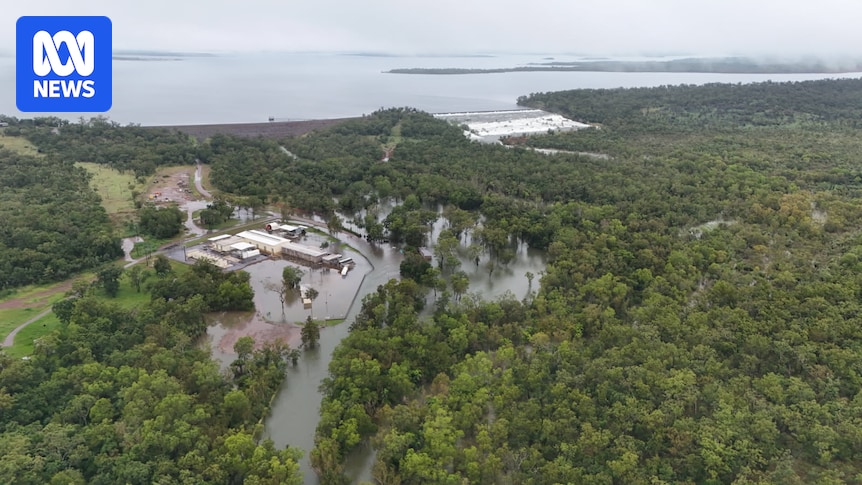
In Australia’s northern capital, on a day when the city was being hammered by heavy tropical downpours, an unexpected message was sent out to the public.
Darwin was being placed on water restrictions after the pump infrastructure powering its main water supply at Darwin River Dam buckled under the weight of a fast-rising flood.
The dam was out of action, and on Monday night the city’s population of about 140,000 was asked to quickly reduce household water usage.
By late Tuesday morning, residents were being warned to boil all tap water for drinking, as the region’s contingency supply was being drawn from rural area bore fields.
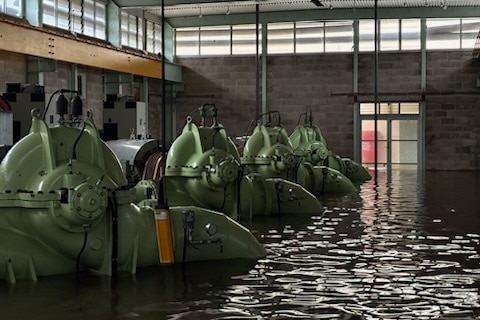
The flooded pump station at Darwin River Dam this week. (Supplied: Power and Water Corporation)
NT chief health officer Paul Burgess said the groundwater brought risks, including “the possibility of contamination from domestic and wastewater treatment and septic systems”.
Bubblers were turned off at schools, restaurants forced to serve only bottled water and kettles pushed into overdrive in thousands of homes across the Top End.
NT opposition MLA Dheran Young, whose electorate includes Darwin River Dam, said he was contacted by “many, many people who have compromised health issues”.

Dheran Young says “people were quite concerned about the lack of clear communication” about Darwin’s water supply. (ABC News: Pete Garnish)
“They were concerned about whether they had drunk contaminated water,” he said.
On Tuesday night, an increasingly urgent message was broadcast to the public, calling on residents to restrict their showers to two minutes and curb all unnecessary usage.
Power and Water Corporation’s (PWC) Kylie Collins said at that point, if water usage levels had not changed by the morning, the bore fields would have been drained within a day.
“We were getting to the point of under 24 hours of water,” she said.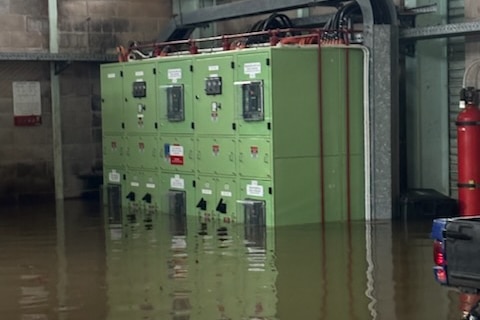
Two of the four pumps at Darwin River Dam were running again by Wednesday afternoon. (Supplied: Power and Water Corporation)
However, Ms Collins said that end result was unlikely, as PWC would have “absolutely gone out with much stronger messaging to bring that down and increase the 24 hours”.
As it turned out, one of the dam’s pumps was repaired later that night, averting the more dire possibilities being posed in PWC’s round-the-clock crisis meetings.
PWC stands by messaging around crisis
The pumps failed at 4:30pm on Monday, but the general public was not told about the incident until four hours later, with some texts sent out, social media posts and a media release.
Mr Young said the messaging should have been clearer and distributed more widely.
“I had the general public calling me concerned about the quality of the water and the lack of information and the confusion of the information [being communicated],” Mr Young said.
“People were quite concerned about the lack of clear communication.”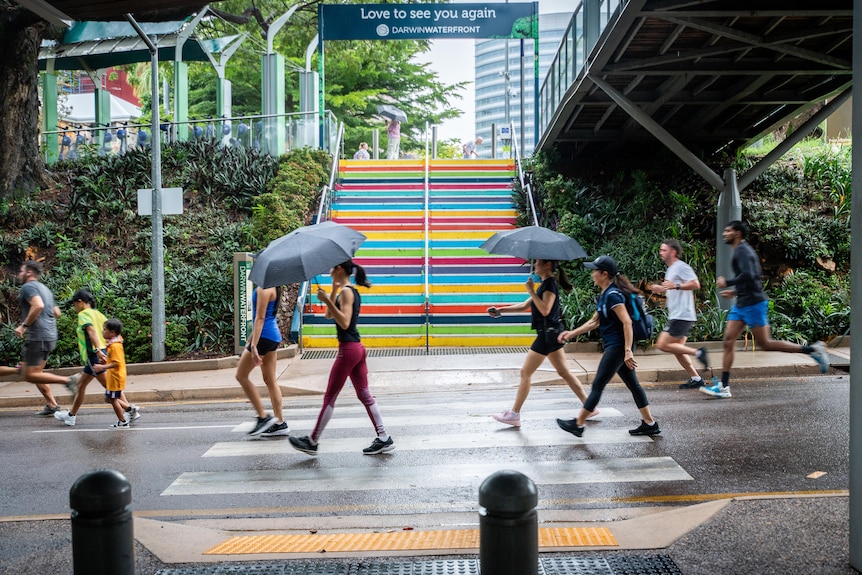
Darwin has received more than 150 millimetres of rain since last Saturday. (ABC Darwin: Pete Garnish)
PWC has stood by its communications response and the lag time in alerting the public.
“We didn’t know what we didn’t know, and we were frantically working through the night to really be able to have clear messaging,” Ms Collins said.
“Messaging about what the issue was and what we wanted to communicate to the community.
“We were very front-footed once we established the immediate situation.”
Ms Collins also dismissed suggestions that the dam’s pumping station should have originally been built at a greater height, to prevent the possibility of being flooded in the future.
“It is not a logical engineering decision,” she said.
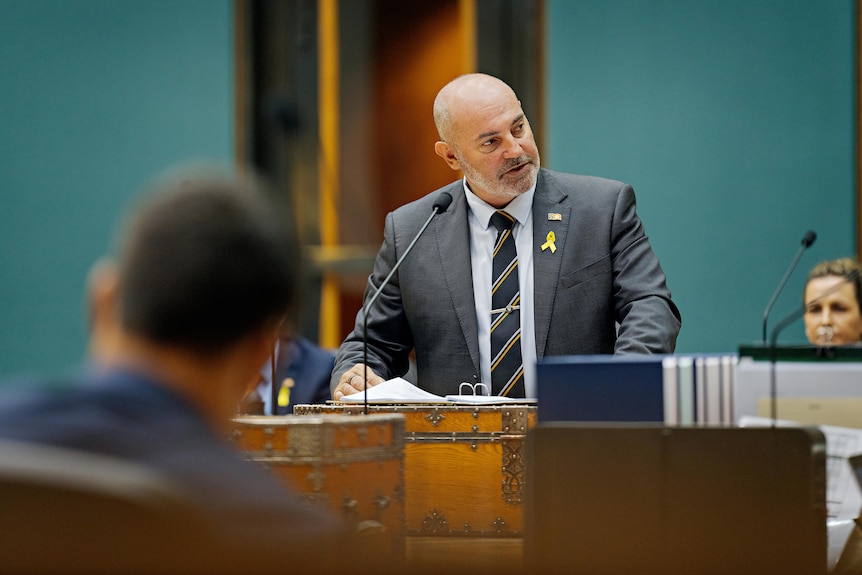
Bill Yan visited the dam while PWC crews were working to fix the pumping equipment. (ABC News: Michael Franchi)
NT Infrastructure Minister Bill Yan, who made a late-night visit to the dam at the peak of the crisis, did not respond to a request for comment.
Back-up water security supplies in the works
Although the taps are now back on at full strength, the vulnerability of Darwin River Dam as the region’s only large-scale water supply was fully exposed this week.
The dam was opened in 1972, and since then it has been the city’s main water source.
But there are plans in place for a key new water supply to come online for the region — a $189 million commitment to return Manton Dam to service later this year.
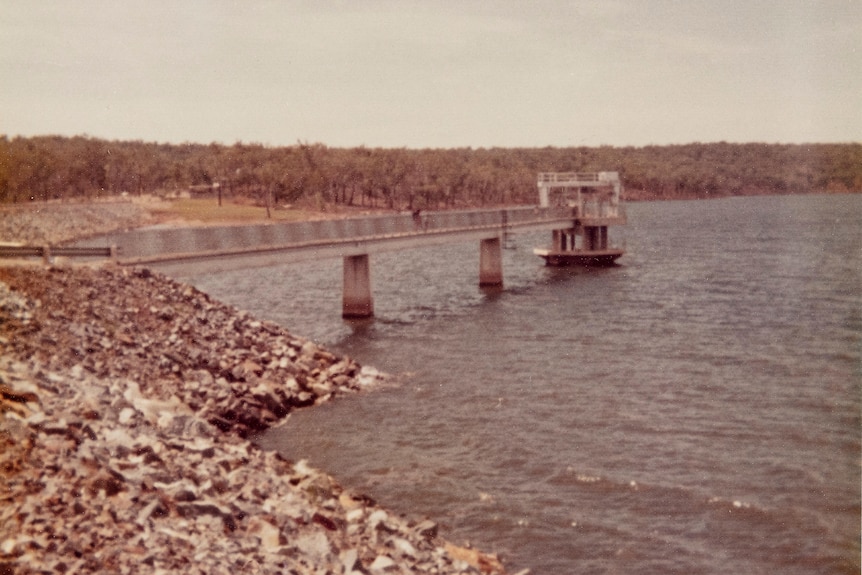
Darwin River Dam has been the city’s main water source since it opened in 1972. (Supplied: NT Library and Archives/Graeme Cheater)
Amateur Fishermen’s Association of the NT chief executive David Ciaravolo, who has been involved in negotiations to get Manton Dam back online, described this week’s pump failure at Darwin River Dam as “unfortunate timing”.
“It was obviously disappointing for everybody, the timing of this, given how close we are to having more water coming online for Darwin,” he said.
“There’s been quite a lot of work going on aimed at securing a future water supply for Darwin that’s been occurring for a number of years, quite a lot of work in the background.”
When it is brought back into service, the World War II-era Manton Dam is poised to supply an extra 7,300 megalitres of water annually to the Darwin region.

David Ciaravolo says the timing of this week’s flooding was “obviously disappointing for everybody”. (ABC News: Roxanne Fitzgerald )
That amount is less than a quarter of the more than 40,000 megalitres extracted each year from Darwin River Dam, with water demand expected to double by 2050.
A bigger, longer-term prospect for the region’s water supply, the Adelaide River Off-stream Water Storage project, has already been in the planning for about 15 years.
But current timelines suggest it won’t be built and online until well into the 2030s.
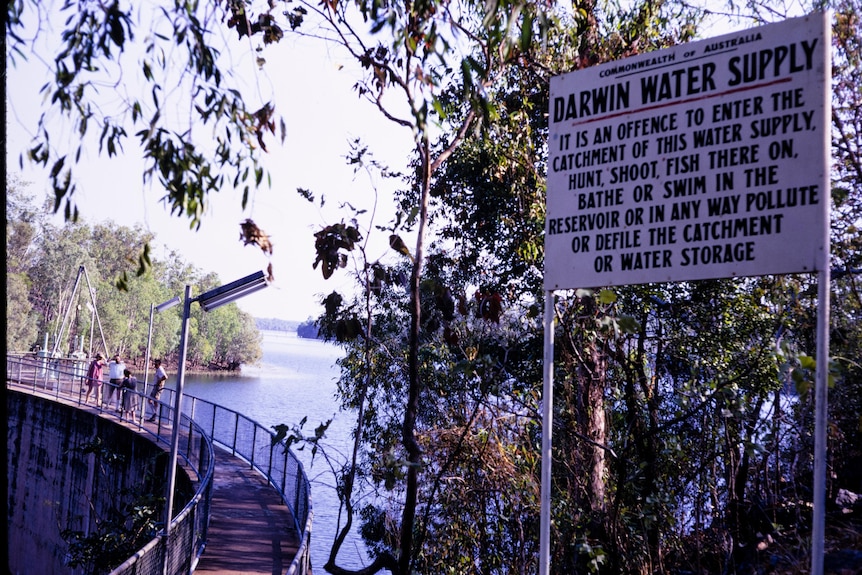
Manton Dam was the main water supply for Darwin before Darwin River Dam came online in the early 1970s. (Supplied: NT Library and Archives/Don Sinton)
In the meantime, with the pumps back up and running and power reconnected, PWC is looking at ways to try to make sure Darwin River Dam doesn’t break down again.
“We will take lessons from it and look into some form of engineering solution,” Ms Collins said.
“That dam’s been in place for 50 years, and we’ve never come across this before.”