
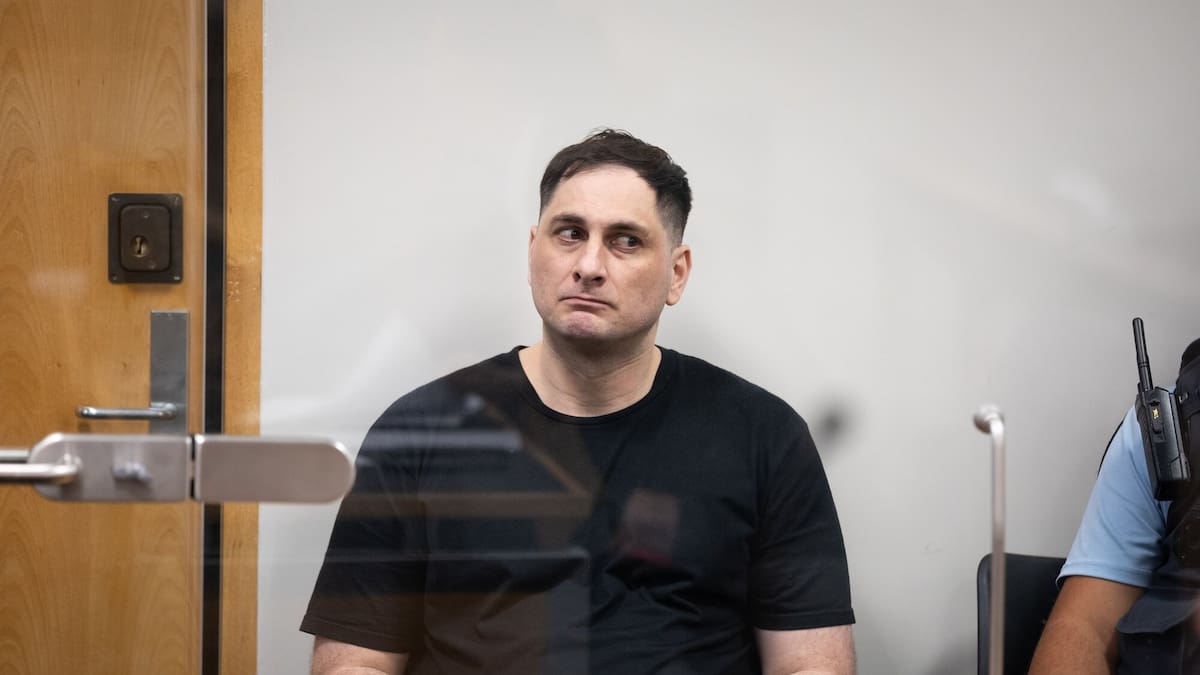
The judge pointed out that Selkirk has been assessed as a high risk of both reoffending and of causing harm to others. He also noted that the defendant had been committing crimes since the age of 26 to support his addiction.
Selkirk didn’t dispute that a prison sentence, this time around, was inevitable.
Legit gun turned illegal
Selkirk’s latest legal woes began in April 2024, when police searched an associate’s Clendon Park home and found a rifle that had been illegally cut down to a pistol.
Just a month earlier, Selkirk and co-defendant Brent Jeremy Allen, 40, had bought the gun off a licensed owner on Trade Me under false pretences. Both men had created their own forged gun licences by stealing the identity of the same victim.
James Selkirk has been sent to prison. Photo / Sylvie Whinray
Selkirk and Allen then set up a fake Trade Me account under the name of the victim to purchase a Stirling M20 Semi Auto 22LR rifle. They emailed the seller a copy of Allen’s fake gun licence.
“On 24 March 2024, Mr Selkirk cut this Stirling rifle down to 320mm in length, thereby converting it from a rifle into a pistol,” the agreed summary of facts states in reference to the manufacturing a firearm charge, which is punishable by up to 10 years’ imprisonment.
“Mr Selkirk then offered to sell this pistol to an associate in Clendon Park in exchange for a combination of Class A and B controlled drugs, including methamphetamine, cocaine and GBL.”
Police discovered the weapon 10 days later.
It appeared the Trade Me scheme hadn’t been Selkirk’s only foray into forgery. When police searched his home months later, they found nine driver’s licences in his bedroom, all of which had the rightful owners’ photographs and details removed.
‘Tuff as doses’
While investigating how the sawn-off firearm ended up in the criminal underworld, police obtained permission to collect phone data from both Selkirk and Allen.
A search through Selkirk’s phone showed that he had also been dealing illegal recreational drug GBL for well over a year.
As an example, police pointed to nine messages sent by Selkirk to different people on a single day in April 2023, all boasting of having “tuff as doses” for sale.
“I got some bad as doses today,” he wrote in another message in July 2024, over a year later.
James Selkirk was on home detention when he reoffended. Photo / Sylvie Whinray
Accompanying the note was a photo of an open courier bag containing multiple 15g bottles falsely labelled “liquid remover” – an “obvious effort”, the judge said, to hide the drug in plain sight.
As a result of the messages, he was also charged with offering to supply a Class B drug.
Officer among identity theft victims
A month before the GBL photo was sent, police had busted Selkirk on a number of lesser – but arguably more concerning – charges that resulted from a vehicle search.
The defendant had been sitting in the back seat of a car at a petrol station on Auckland Central’s Karangahape Rd when police noticed what appeared to be a drug deal between him and the other occupant.
Upon searching his bag, officers found another sawn-off firearm, a police badge, a police wallet containing ID and a building access card. Authorities did not elaborate in court documents or during Selkirk’s sentencing about how he came to have the items.
Unlawful possession of police property is punishable by up to three months’ imprisonment, while unlawful possession of a firearm carries a maximum possible sentence of four years.
Two weeks after that arrest, he used a stolen credit card to purchase over $5000 in photography gear, then used more stolen cards over the next month to repeatedly target Mitre 10 stores and a bicycle shop with over $15,000 in fraudulent purchases.
Lengthy history of fraud
In a separate sentencing hearing in July, Selkirk’s co-defendant mate was sentenced to two years and three months’ imprisonment for a combination of broadly similar charges.
“It’s getting worse,” Judge Evangelos Thomas told Allen at that hearing, referring to illegal guns in the community. “The fear of it is getting worse. The court’s response to it is getting heavier.
“… These are offences from which our citizens need to be firmly protected.”
At Selkirk’s more recent hearing, Judge Bonnar ordered the same three-year starting point that Selkirk’s co-defendant had received before considering deductions and uplifts due to mitigating and aggravating factors.
Judge Stephen Bonnar presides over James Selkirk’s sentencing in Auckland District Court. Photo / Sylvie Whinray
He reviewed a relapse prevention plan provided by Selkirk and certificates of programmes he had taken since being returned to custody. Defence lawyer Jaime-Anne Tulloch noted that he had been described as a “compliant, respectful prisoner” who was “motivated to address his addiction”.
“Mr Selkirk is serious and genuine in terms of addressing his addiction,” she said.
She asked for a lesser starting point than Allen, pointing out that the co-defendant had illegally purchased four firearms while her client was only found to have been involved in possession of two of them. But the judge was unpersuaded, noting that Allen was not charged with altering the guns like Selkirk was.
He agreed with Crown prosecutor Natanahira Herewini that the three-year starting point should reflect the forged documents and manufacturing a pistol charges before adding 20 more months for the drugs, police property and credit card offences.
The judge noted that Selkirk had been charged with crimes on 24 prior occasions between 2010 and 2024, the vast majority for dishonesty-type offending.
Most recently, he had been sentenced to intensive supervision but had the sentence altered to more restrictive home detention after breaching the supervision conditions. He was still subject to the revised home detention sentence when he started committing the crimes for which he was recently sentenced.
The judge allowed 35% in total reductions for Selkirk’s guilty pleas and his efforts at rehabilitation but added 5% for his prior convictions and for having offended while on home detention.
Craig Kapitan is an Auckland-based journalist covering courts and justice. He joined the Herald in 2021 and has reported on courts since 2002 in three newsrooms in the US and New Zealand.
Sign up to The Daily H, a free newsletter curated by our editors and delivered straight to your inbox every weekday.