
When I set out to climb every volcanic mountain in the Auckland field, I regarded it as mission eminently possible. They’re not very big. But there were certain insurmountable challenges.
I adhere to the mantra of no fears for steady men, and worried not one whit about the
physical labours of climbing these “miniature editions”, as the great volcanologist Ernie Searle describes them. The greater challenge was to find the goddamned things. I had mixed results.
In part one of this special two-part psychogeographic investigation, I recorded climbing the obvious maunga, the ones that give naming rights to Auckland – Mt Eden, Mt Hobson, Māngere Mountain, etc. But there are other, more obscure cones on the isthmus. I needed help in locating these minor lumps. I found it in a mysterious chronicle published with the ancient technology of WordPress.
There is only one passing biographical snippet in the Auckland Volcanoes blog maintained for three years, 2012-15, by an unknown author. She writes, “Outhwaite Park (Grafton volcano) is the volcano nearest my work [in fact, Auckland Hospital is founded on a base of basalt bedrock from this very volcano, actually just perched on the opposite side of this long lost crater], so near in fact that I decided to visit there after work one fine sunny afternoon.” You learn more about volcanoes than her identity.
Like myself, the author was suddenly seized with the notion of investigating every volcano in Auckland. She writes, “I grew up in Auckland and spent most of my life here. I’ve always known Auckland was built on 50 -odd volcanoes but never had any compulsion to visit all of them; it had just never occurred to me. So for the next few years [2013, 2014 and 2015], I’ve decided to get out and explore my home town using the geologic features of the landscape as a starting point.”
Pigeon Mountain was still standing, a bit pathetically. It was bare and unloved.
Steve Braunias
It’s a fantastic record, full of keen geological observations. She noted “flattened spheroid little volcanic bombs” and “scoriacious hollows”. On a rock found at Little Rangitoto volcano in Remuera: “Many vesicles (small holes in the rock) would have once contained gases dissolved in the magma, but which burst on eruption.” She also took a great many photographs, wittily captioned, and gave clear directions on how to get to the more obscure maunga.
The author set herself the task of visiting every one of the city’s volcanoes – including their ghosts. On a visit to Styaks Swamp: “Just another obliterated volcano. Styaks Swamp formed inside the explosion crater centred on the intersection of Greenmount Dr and Polaris Pl. There really is nothing to see now … It would’ve been nice to see a little plaque or something to commemorate the volcano that once was.”
On a visit to Te Puke o Taramainuku/ Ōtara Hill: “It’s also gone by the names Mary Gray and Smales Mountain but call it what you want; it doesn’t really exist any more. This is one of the sacrificed ones. Sacrificed for scoria. Sacrificed for land. Sacrificed for progress, businesses and ultimately, the people of Auckland.”
The blog ends at Number 49. What happened? She got so close to completing the entire field of 53. I adore her work, and hope she knows how deeply I appreciated it as I set out to follow in her footsteps.
I was intent on climbing only actual cones, not reefs or around swamps. Part one of this series covered 11 maunga. Here are the remainder. Having tramped up Motukorea / Browns Island (see here), I intend to knock off Rangitoto, too. And I have my sights set on Matukutūreia / McLaughlins Mountain in South Auckland – with the forewarning that just because it’s there doesn’t mean it’s available to climb.
Taurere / Taylor Hill
I loved every footstep of this humble but proud cone in an obscure corner of Glendowie, east Auckland. My unknown guide from Auckland Volcanoes set the scene: “I parked on Cranbrook Pl as I’d heard there was a spring in a field and that is what I found, along with some huge lumps of scoria just sitting in the middle of suburbia.”
From my stop on the 774 bus, I hopped over a stile onto a wet, scruffy volcano, bordered by damp, scruffy homes – one house had a Lion Red blanket pinned over a smashed window as a revealing commentary on Glendowie’s socio-economic climate.
It began to rain and the sky grew dark: magnificent conditions at the summit, which felt raw and elemental, a little world of nature held within a long, wide suburb. Students from Glendowie College had just finished school and walked around the mountain without bad language or screeching, and were respectful to senior citizens on a volcano odyssey. I put some of this down to the calming properties of the maunga.
Ōtāhuhu / Mt Richmond
The cones of Ōtāhuhu / Mt Richmond have been extensively damaged by quarrying. Photo / Alastair Jamieson
More rain, just as welcome, at the summit of this beautiful, spread-out cone in South Auckland. I took the Southern Line train and then the 32 bus to Bert Henham Park, home to the Ōtāhuhu Rovers rugby league club – strange that their crest makes no mention of the volcano right in front of their faces. The summit offered an unexpected view of my neck of the woods in Herne Bay, and a particularly fine glimpse of the paws of Mt Wellington’s lion pose. I visited on a Wednesday afternoon. The volcano was deserted. It felt like bliss, and it came as a shock to arrive at a crowded shopping mall 20 minutes later when I caught the bus to Sylvia Park. All of Auckland seemed to be there: mobs of teenage girls with nose piercings and sunglasses on top of their hijabs, families dining at the foodhall, some lost white people. In the same hour, I had been the only sign of life on a volcano, other than a white-faced heron with its legs wide apart.
Ōhuiarangi / Pigeon Mountain
Ōhuiarangi/Pigeon Mountain. Photo / Supplied
There was something mean and depressing about the summit. There were no seats or trig station; instead, authorities had placed a surveillance camera. Weird to feel watched on top of an unremarkable, ravaged maunga at Farm Cove near Half Moon Bay. Ernie Searle’s disgust at the quarrying of Auckland’s volcanic heritage, as registered in his 1964 book, City of Volcanoes, reached boiling point in his contemplation of Pigeon Mountain: “The commercial value of the scoria has weighed with the community more heavily than the aesthetic value of the hills, and cones that would have given character forever to the districts where they occur have been sacrificed for temporary gain … Man in 100 years has done that nature could not do in 20,000. Unfortunately he can destroy but he cannot replace and in another 100 years the city of volcanoes may have become the city of lost volcanoes.”
Pigeon Mountain, though, was still standing, a bit pathetically. It was bare and unloved. I walked down to the ferry at Half Moon Bay. The boat set off for downtown Auckland. I looked behind me to take one last look at Pigeon Mountain, but couldn’t see it.
Little Rangitoto
A pretty little hillock in deepest Remuera, off the Benson Rd shops where the Polkinghornes used to go for coffee. It’s been quarried all to hell but a nice picnic spot has inherited the maunga, with a flying fox and an interesting scoria wall covered in scarlet pimpernel and ivy-leaved toadflax.
Church Cone
“This is my favourite,” declared the nameless blogger of Auckland Volcanoes. “It’s a gorgeous, well-preserved cone, obviously steeped in so much history yet completely surrounded by industrialisation.” Most of my own favourite volcanoes were completely surrounded by industrialisation. Church Cone, which I reached via the 353 East Tāmaki bus from Botany Town Centre, was hemmed in by Alpha Z Glass, Shower Solutions and Watties. I entered through the gate to the historic St John’s church, built in 1862 with basalt rock mined from the mountain’s lava flows. A tree-lined path to the cone behind the church led through a sorrowful Garden of Remembrance – St John’s founder, Reverend Gideon Smales, had 18 children; 11 died in tragic circumstances. But the summit is now on private property. It’s a working farm. Nosey parkers recently left a gate open and cattle escaped onto the street; the householder had to herd them back in at 2am. I met him on my walk. He gently shooed me off.
Ngā KaPua KohUora/ Crater Hill
Ngā Kapua Kohuora / Crater Hill, Papatoetoe. Photo / Alastair Jamieson
I was turned away again, this time from a wonderland more or less on the corner of main drags Tidal Rd and Portage Rd out the back of Papatoetoe. I got lost looking for it from my bus stop in Māngere, and wandered for an hour past two burnt-out houses towards a storage warehouse. Crater Hill and its trig point was behind electrified barbed wire. Access further along Portage Rd was blocked by the gates of a private quarry. So close but yet no way in; the maunga looked so nice! There were blue crater lakes shining on a hot day in early summer. I communed with the lakes and sent them my best regards.
Puketutu Island
Puketutu Island. Photo / Supplied
Another bust. It took forever to get to – a 38 bus to the airport and a long walk down an industrial street, followed by a long walk alongside a puha-lined oxidation lagoon (sign: “Avoid contact with water”) to a gated island. The volcanic cone was beautifully formed, an object of desire, but locked behind high fences while restoration work is carried out. I called in on the way back for a lime and soda at Holiday Inn Auckland Airport. The lobby was packed: it was the annual FurCoNZ convention, New Zealand’s largest gathering of people who wear fur suits.
Maungakiekie / One Tree Hill
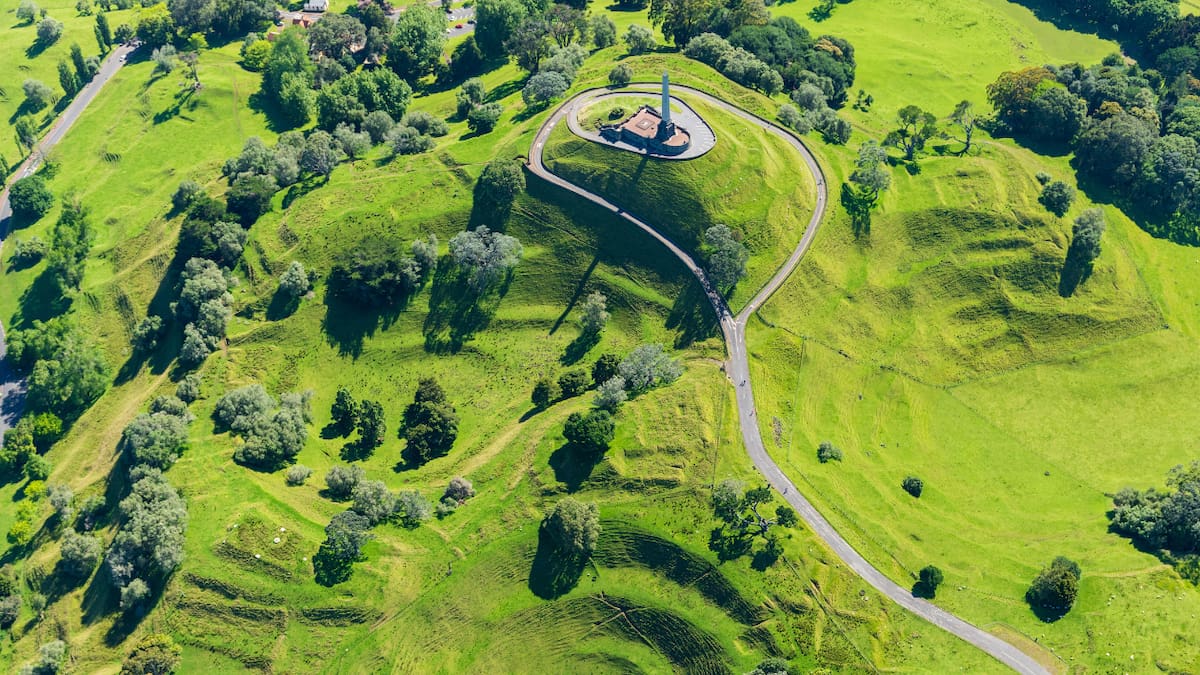
I needed a guarantee of stepping onto the summit of a volcano, so headed to one of the great maunga of Auckland. Metro readers always loyally nominated One Tree Hill as their favourite Auckland landmark, before the tree got chopped down, and before the Sky Tower. It’s still a thing of wonder and its obelisk can be seen nearly everywhere on the isthmus. I approached it from the back entrance of the poignant Royal Oak Shopping Mall (a plastic Christmas tree in the window of the SPCA op shop) and the climb took only 30 minutes – an hour with rests. There were shrieking pheasants, and amusing guinea fowl; jacaranda was in mauve flower; the whole place was crowded, happily so, at the summit and on the fields below, where I tucked into a celebratory mango sorbet and banana milkshake. Twas very heaven.
I recommend walking Auckland’s volcanic field to any traveller wanting a quest, an education, a true feeling for the heat of the city beneath our feet. It contains so much power and danger. The streets and the houses lock it in, like animals in a zoo; to climb its summits and stare into its craters is to connect with the very soul of Auckland.
SaveShare this article
Reminder, this is a Premium article and requires a subscription to read.
Copy LinkEmailFacebookTwitter/XLinkedInReddit