
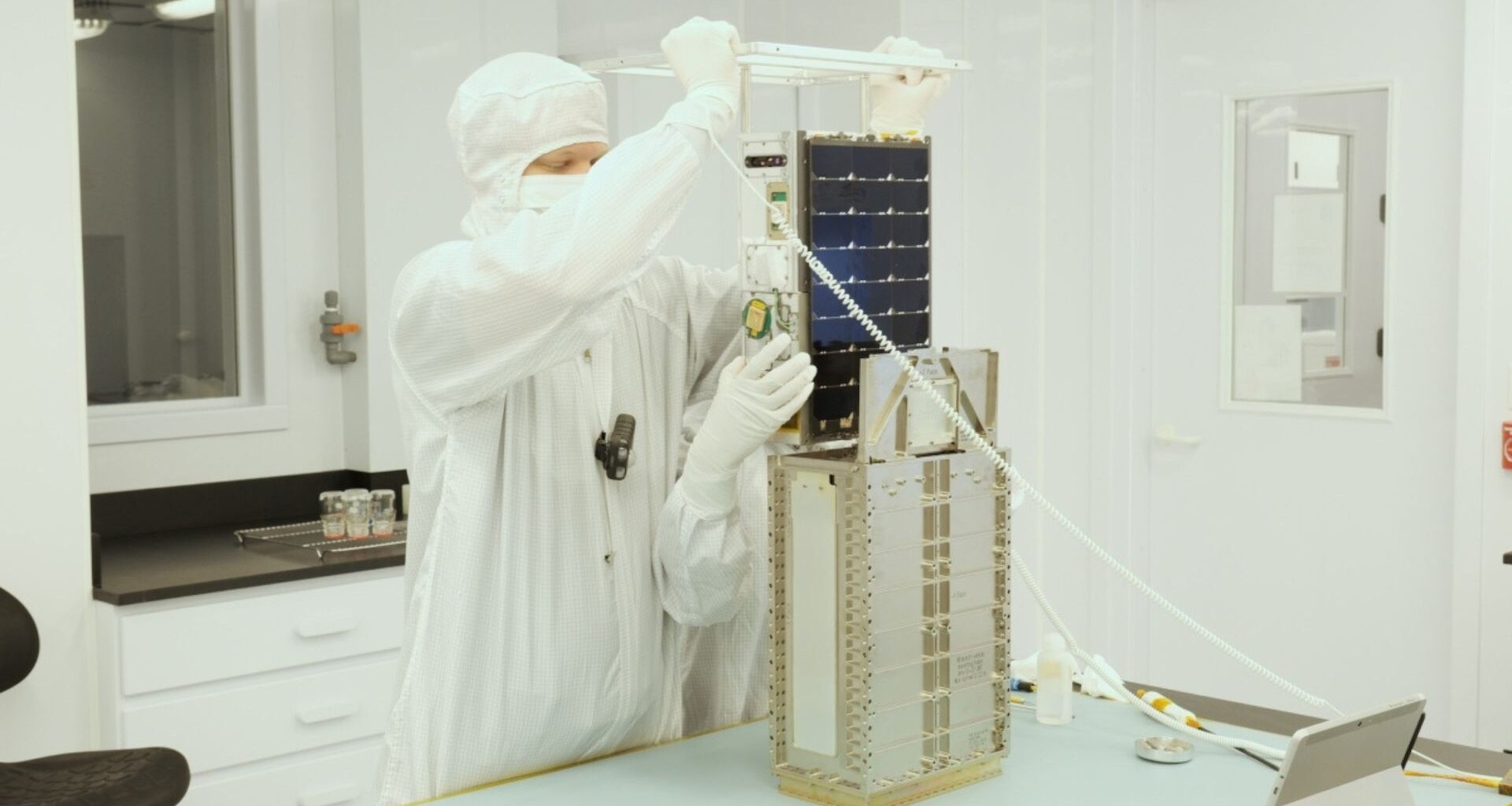
NASA has received the first images from a tiny spacecraft designed to study the stars that host distant planets. The mission, called the Star-Planet Activity Research CubeSat, or SPARCS, will track how stellar activity affects the habitability of nearby worlds.
The first images confirm the spacecraft’s instruments operate correctly in space. Scientists can now begin studying ultraviolet radiation from some of the galaxy’s most common stars.
SPARCS launched on Jan. 11. The spacecraft transmitted its first images on Feb. 6 after engineers completed early checks.
The data has since been processed, marking a key milestone known as “first light.” The event confirms the telescope and detectors work properly in orbit.
First light signals that a spacecraft’s instruments function correctly in space. For SPARCS, the test matters because the mission depends on precise ultraviolet measurements.
The spacecraft is roughly the size of a large cereal box. Despite its small size, it will study a key group of stars.
These low-mass stars contain about 30 percent to 70 percent of the Sun’s mass.
They are among the most common stars in the Milky Way and host many rocky planets.
Watching active stars
SPARCS will study about 20 low-mass stars during its one-year mission. The spacecraft will observe each target for five to 45 days.
Scientists want to understand how often these stars flare and how intense those eruptions become. Stellar flares release radiation that can affect nearby planetary atmospheres.
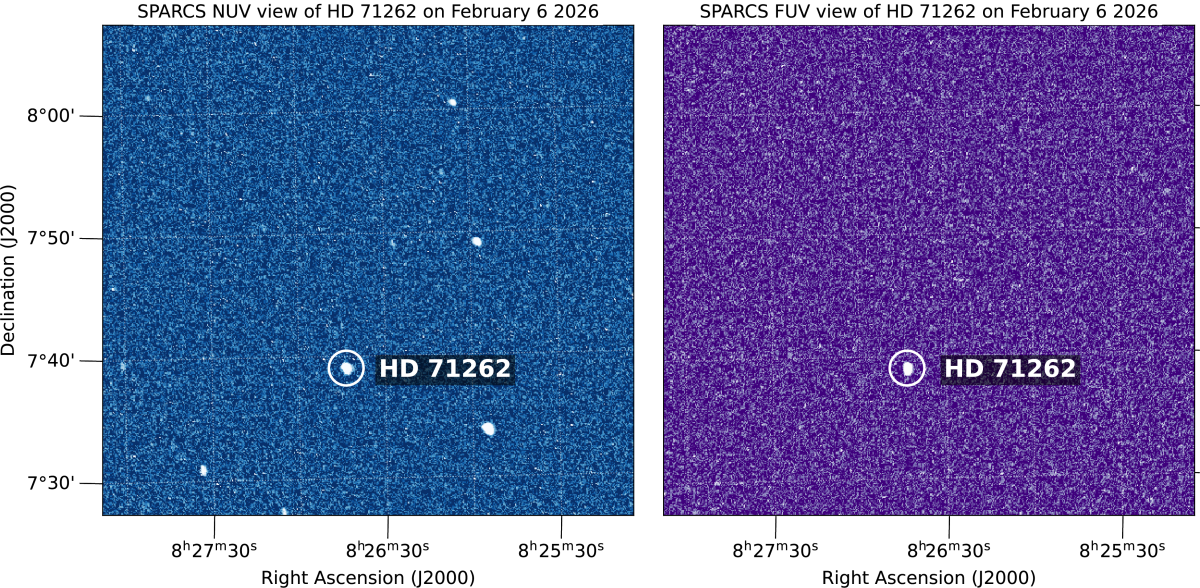 SPARCS captured stars in near-UV and far-UV on Feb. 6, revealing temperature differences, with the star visible in both bands being the hottest. Credit – NASA/JPL-Caltech/ASU
Although these stars appear cooler and dimmer than the Sun, they flare far more frequently.
Understanding the host star helps scientists judge whether surrounding planets could remain habitable.
New ultraviolet technology
SPARCS also tests advanced ultraviolet detector technology developed at NASA’s Jet Propulsion Laboratory in Southern California.
The mission uses a camera called SPARCam. Engineers built it with specialized filters placed directly on sensitive ultraviolet detectors.
“I am so excited that we are on the brink of learning about exoplanets’ host stars and the effect of their activities on the planets’ potential habitability,” said Shouleh Nikzad, the lead developer of the SPARCS camera (dubbed SPARCam) and the chief technologist at NASA‘s Jet Propulsion Laboratory in Southern California.
“We took silicon-based detectors — the same technology as in your smartphone camera — and we created a high-sensitivity UV imager. Then we integrated filters into the detector to reject the unwanted light.”
“That is a huge leap forward to doing big science in small packages,” Nikzad said, “and SPARCS serves to demonstrate their long-term performance in space.”
“The SPARCS mission brings all of these pieces together — focused science, cutting-edge detectors, and intelligent onboard processing — to deepen our understanding of the stars that most planets in the galaxy call home,” said David Ardila, SPARCS instrument scientist at JPL.
“By watching these stars in ultraviolet light in a way we’ve never done before, we’re not just studying flares.” He added that the observations will help scientists interpret the habitability of distant planets.