
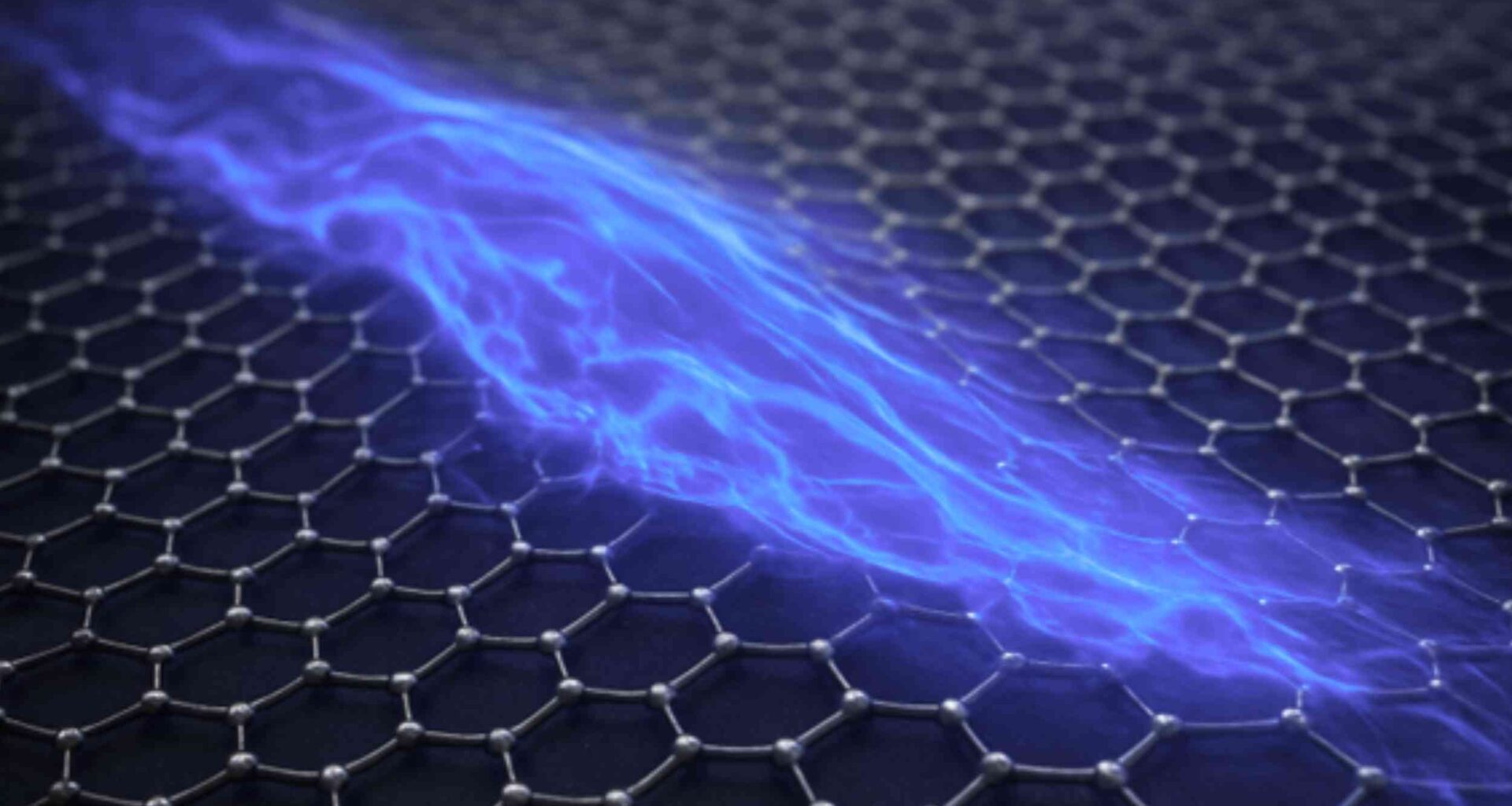
Researchers have found that electrons in graphene can break a long-standing rule of metal physics, separating heat flow from electrical flow by more than 200 times at low temperatures.
The discovery shows that electrons in this atom-thin carbon material can move collectively as a quantum liquid rather than as independent particles.
Electrons, graphene, and physics

Inside ultraclean devices, heat and electrical current stopped moving in lockstep when graphene reached its critical setting.
By measuring both flows at once, Arindam Ghosh at the Indian Institute of Science (IISc) showed that each moved the other way.
Working with collaborators in Japan, Ghosh and colleagues found that the reversal sharpened exactly where collective motion should take over.
That clear split gave physicists their strongest route yet to prove the strange fluid was really there.
In ordinary metals, the same mobile electrons usually carry both heat and charge, so the two flows tend to track together.
Physicists summarize that habit with the Wiedemann-Franz law, a rule saying good electrical conductors also move heat well.
Near graphene’s critical regime, repeated collisions redistributed momentum differently, so electrical flow improved while heat flow peeled away.
That mismatch marked the moment when familiar metal behavior gave way to something far more collective.
At the Dirac point
Everything centered on the Dirac point, the balance point where graphene is neither a metal nor an insulator.
At that setting, electrons and the positive gaps they leave behind crowded together and collided with unusual frequency.
Once those collisions dominated, individual carriers stopped setting the pace and the entire electron population responded together.
That narrow condition created the best chance to separate the rare fluid from ordinary scattering and device noise.
When particles merge
In that narrow window, electrons and holes behaved as one dense, self-organized mixture rather than as separate carriers.
Physicists call this state a Dirac fluid, a liquid-like electronic phase that appears near graphene’s balance point. Because this water-like behavior appears near the Dirac point, the state is known as a Dirac fluid.
Similar motion appears in quark-gluon plasma, an ultra-hot mix of subatomic particles, linking this carbon sheet to far higher energies.
A universal number
Earlier experiments had seen pieces of the puzzle, yet the key electrical value of the flow stayed unsettled.
A paper first reported Dirac-fluid behavior in graphene and a broken heat-charge rule at graphene’s balance point.
Another work then found the special conductivity of this regime, and the new devices pushed it toward the quantum of conductance.
That constant is a basic step size for electrical flow, and landing near it made the new result much harder to dismiss.
How fluidity was judged
The team also asked how much internal drag survived once the carriers started moving as a single fluid.
Physicists call that drag viscosity, the resistance a flowing substance has against its own internal motion.
In the cleanest samples, the ratio came within a factor of four of the minimum expected for a nearly perfect fluid.
That put graphene strikingly close to the low-drag limit that theorists often discuss far from everyday materials.
Why purity mattered
Researchers had chased this state for years because tiny defects usually scatter electrons before collective behavior can dominate.
Even small disorders can push graphene electrons back toward ordinary transport, where individual motion hides the fluid response.
Careful fabrication stripped away many interruptions, leaving the carriers enough room and time to organize together.
That long wait was less about missing theory than about building devices clean enough to let the theory show up.
Graphene electron signals
The same physics that splits heat from charge could make graphene useful in sensors built for extremely weak signals.
When carriers move collectively, a tiny disturbance can redirect the whole current pattern instead of nudging isolated particles.
A study found that graphene’s Dirac plasma changed its resistance dramatically in small magnetic fields.
Those responses help explain why this liquid-like regime could amplify faint currents or detect very weak magnetic fields.
Why graphene endures
Graphene now looks like a practical platform for quantum behavior that usually belongs to particle collisions or astrophysical theory.
Because very different systems can obey the same equations, one carbon sheet can probe black-hole heat rules and quantum information flow.
“There is so much to do on just a single layer of graphene even after 20 years of discovery,” said Ghosh.
That staying power is why graphene remains valuable, both as a scientific puzzle and as a low-cost laboratory platform.
What changes now
Graphene can now serve as both a useful material and a testing ground for quantum matter under exceptionally demanding conditions.
Next steps will likely push toward cleaner devices, broader temperature tests, and sensors that use this collective electronic regime on purpose.
The study is published in Nature Physics.
—–
Like what you read? Subscribe to our newsletter for engaging articles, exclusive content, and the latest updates.
Check us out on EarthSnap, a free app brought to you by Eric Ralls and Earth.com.
—–