
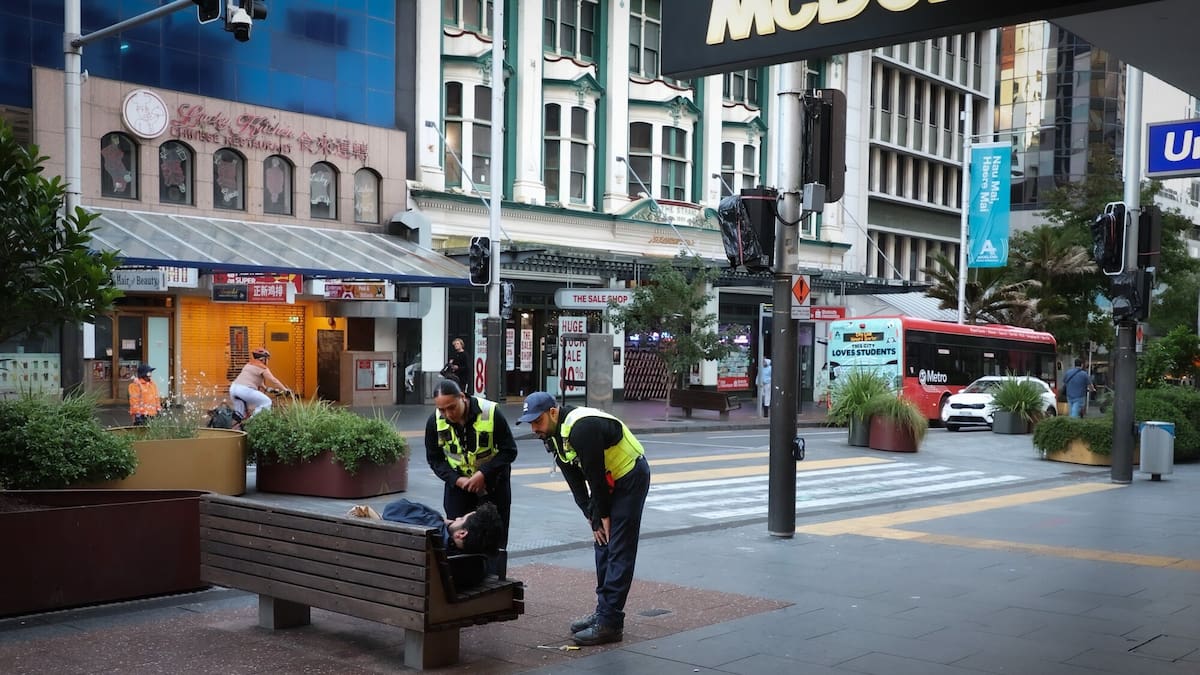
Little movement, more coaxing – who is this character? He is a new face for the council compliance wardens – not a member of the usual street whānau.
What’s his story?
Auckland Council compliance wardens Roimata Farrington (left) and Ansh Parmar begin the morning “wake-up” patrol of rough sleepers on Queen St. Photo / Michael Craig
This is the central city wake-up call. At first, it seems mild, almost like cajoling a teen from slumber.
“Sir. Sir, we’re going to give you about two to five minutes, okay? Is that all right with you? Is that enough time for you to get up? Sir?”
It is patient yet persistent. Experience is at play.
The wardens gather for the morning brief to plan the morning patrol. Photo / Michael Craig
The day began, when the morning light was weak, on the seventh floor of the city council building on Albert St.
Ten community compliance wardens, part of the council’s Community Safety Team, are discussing the challenges ahead, starting with the “wake-up”.
Senior compliance officer Malcolm Heinrich facilitates the brief. The most important information comes from the voice on the speaker of his phone.
A member of the team has monitored the city’s CCTV network overnight and shares what their watchful eyes have seen on the streets.
It’s been a typical night for a Wednesday.
The full briefing is a who‑where‑what description. Nicholas was by Kiwibank, Graham was there. Albert Park, Lower Queen St, Federal St. Drinking. Sleeping.
Many of the rough sleepers are known to the team and, thanks to the cameras, so are their behaviours.
About 25 wake‑ups will be needed in the central city as the workers and shoppers arrive for the day.
Senior compliance officer Malcolm Heinrich runs the morning brief, including a report from CCTV operators who monitor the streets overnight. Photo / Michael Craig
This team are part of the frontline addressing homelessness in Auckland. It is a tough gig, especially with the ethos to avoid using a stick – because it doesn’t work, I’m told.
And on this morning, I will be reminded that everyone has a story, a sad reason why they sleep on grey concrete pavements.
The final instructions as the team rise from their seats – high-vis over slash-proof vests, body cameras and torches attached: “Let’s get ready, let’s go out – be safe.”
Auckland Council compliance wardens Ansh Parmar (left) and Roimata Farrington patrol the central city. Photo / Michael Craig
Around two years ago, as one of the daily commuters arriving into town at the bottom of Queen St, council compliance manager Adrian Wilson would see rough sleepers on benches, in doorways and on the pavement.
“There was a lot of issues back then with increased encampments and homelessness,” he recalls.
“We started the wardens probably 2.5 years ago – it was born out of what we used to have, City Watch, which was a security company that used to go out and do the patrols for us.
“The mayor gave us some funding to expand what we were doing. We went in‑house, no security companies, so we trained our own people, and then we developed this network of compliance wardens in the central city.”
The council now employs 34 wardens covering the city to support a safe environment.
Eighteen are dedicated to the central area, covering shifts from 7am to 10pm – every day of the year.
Council compliance manager Adrian Wilson oversees the Community Safety Team, emphasising empathy before enforcement. Photo / Michael Craig
“They’ve got the patience of a saint, you know, because we don’t have powers, we can’t physically move people, we can’t make them move on or pack up their stuff.
“It’s just that relationship building; some we will know them by their first names and they’ll know our officers by their first names, and they just have that good rapport.
“And they know sometimes they’ll get a bit grumpy. These guys [the wardens] just patiently wait and calm them down and then we get compliance.”
Auckland Council compliance wardens Ansh Parmar (left) and Roimata Farrington on patrol as part of efforts to keep the CBD’s public spaces safe. Photo / Michael Craig
Ansh Parmar and Roimata Farrington are a team this morning, patrolling downhill.
The subjects of their second wake-up, after the man on the bench, are under lumpy fleece blankets over cardboard set up around an empty shop entrance.
“Morena, how are you, sir?” chimes Farrington.
What looked like two people is actually three. They know the drill, though – they’ve been woken by the team before. Farrington even receives a hug.
The process is not fast. There is the waking, the stretching, standing, moving stiff bodies in front of the thickening stream of pedestrians.
Then they have to pack – every day the rough sleepers are moving house, folding blankets and cardboard, filling bags or trolleys and dispersing.
Both Parmar and Farrington are watching closely, seeing ways to smooth this daily transition or assist with problems or maybe help direct where they should go.
“Morning, sir. How are you? Are you okay? Do you need to see the doctor?
“There’s some breakfast up at the Mission if you need. And I believe they offer medical assistance as well if you need.”
Patience – the pair seem to have it in spades today – but there is a purpose to this empathetic approach, Wilson says.
“The patrols are very much about trying to make way for businesses to operate, to try and make sure that the footpaths are clear.
“It’s to assist business to get on with doing their business without being interrupted through obstructions.”
Last year, a Heart of the City survey of CBD business owners was scathing.
Most said homelessness, excessive begging and frightening anti-social behaviour were harming their trade, and that the council and government were not doing enough to stop it.
Afterwards, Wilson spoke with concerned shop owners, identified “hotspots” and increased patrols in those public spaces.
“We did an awful lot of work there patrolling, virtually every hour or so, to make sure it was clear of any obstruction and any nuisance.”
Because the wardens have no jurisdiction on private property, he notes, progress requires multi-agency co-ordination – including Heart of the City’s own safety team and police.
The wardens check on a rough sleeper beside a makeshift bedding area during the morning wake-up round on Queen St. Photo / Michael Craig
It’s not always a softly-softly approach. After all, this team are about compliance and serve the entire city.
Encampments – when tarpaulins or pallets and solid materials are used to build shelters – are not tolerated. Bylaws prohibiting them give the wardens teeth to ensure they are dismantled, Wilson notes.
A makeshift camp had recently sprung up beside the Central City Library. The inhabitants were asked to move, warned to remove their belongings and reminded that the City Mission now offers storage. After a few days, a team arrived and cleared the area, taking away the abandoned rubbish, he said.
Yet even in this scenario, the team, supported by outreach services, were observing, assessing, listening to stories and waiting for the “chink” – when someone says, “help me”.
It might not be the hardcore street whānau, who are usually struggling with mental health or drug and alcohol addictions – although this does happen. It is often the new faces.
What is their story? What led them to the streets?
There’s the one about “Fred”, who was lying under a blanket on a bench in Aotea Square.
It took 10 days of gentle inquiry and approach from compliance officer Gina Woolston before Fred opened up.
It turned out he was a cancer patient receiving chemotherapy. He couldn’t afford rent on top of the transport to and from the hospital, plus he was usually too tired to travel, so he chose to sleep rough.
All he wanted was a bed to lie in.
Gina referred Fred to an outreach provider. He was immediately placed in emergency housing and later got a motel near the hospital for the remainder of his treatment.
He then returned to his flat.
Patience is required as Roimata Farrington encourages a rough sleeper to wake and move on. Photo / Michael Craig
Inside a quirky fold of a building wall stands a length of vertical cardboard set up like a privacy partition. Beside it is an already loaded supermarket trolley.
“Morning, Angela.” Farrington knows this sleeper.
Parmar leans over the partition. “Can you sit up for us, please?”
A passerby from the growing throng quips, “A bucket of wet water does the trick.”
Farrington: “Pardon?”
The pedestrian repeats, “A bucket of wet water does the trick.”
Parmar looks bemused. Farrington kindly rebukes him: “No, no – no one wants to be woken up with water!”
The unknown passerby walks on.
Back to work. “Morning, Angela. How are you? How have you been? Time for your morning coffee now.”
Clearing public spaces and shopfronts so businesses can operate unimpeded is a key part of the morning “wake-up” patrols. Photo / Michael Craig
At the bottom of Queen St, different teams of wardens – some accompanied by outreach workers – cross paths, actioning their own wake-ups.
Having organisations like Auckland City Mission, Lifewise or Kāhui Tū Kaha join the patrols is “an absolute godsend,” Wilson says.
“It’s the best way to find rough sleepers, because you’re going to find them first thing in the morning or last thing at night. So, they [outreach workers] find their interactions with us really useful because we know where the people are, rather than aimlessly going around the city.
“And then they also work on referrals, so if we come across somebody during the day that we want to refer … we contact them, and they can come straight out to that individual.”
Since October, “when the Government were looking to take a lot more action”, this co-ordinated approach has moved about 50 individuals into housing, Wilson says.
A mix of long-term rough sleepers and new faces – like the man from Parmar and Farrington’s first wake-up.
Asked about the Government’s plans to give police “move-on” powers for rough sleepers and excessive beggars, Wilson is pragmatic.
“I used to be a cop, and I always go, I want to see what that legislation looks like. Unless you see the detail, it’s hard to comment.”
Roimata Farrington receives a hug on Queen St. The wardens have to come to know the regular “street whānau” and encourage them to ask for help. Photo / Michael Craig
At the entrance to Queens Wharf, the sun is much higher and hotter, and commuters, cyclists and cars are cross-threading the laneways.
Looking back toward the CBD, Wilson says the homeless situation is not a crisis.
“Yeah, we’ve got 25 here. If you look at all the suburbs of Auckland, you’ve got a lot more, but from a concentration point of view, 25 is not a massive number.
“It’s 25 with, like I say, complex issues and that’s where I think we need to get into the detail and try and give them some support for their individual issues, get them into programmes… I always say, compassion beats compliance every single day.
“If we said they’re breaching a bylaw and put them before the court, we’re gonna be 18 months down the line before it’s heard. That’s not addressing the here and now.”
Roimata Farrington enjoys the role of the compliance wardens because it’s a chance to help those who most need it. Photo / Michael Craig
Auckland has its daytime rhythm; it’s time to return.
“So, we’ll follow up on Angela, Graham – the guy at McDonald’s,” Farrington says.
Parmar nods, and the pair retrace their measured steps.
Along the way, it’s friendly – they are known, and they know people.
“How are you? You been good?
“I haven’t seen you in a long time. It’s good to see you.”
Angela is gone. Graham is gone.
“I like helping people,” Farrington explains.
“They are our own people as well, you know, like Māori – and because I’m Māori, I want to help my people … but everyone, actually. Everyone.”
It is now close to 9am. The wake-up call is the first part of a compliance warden’s shift.
Parmar has been in the role for two years and wasn’t sure what to expect at first.
“It was nice to see if you could just bring a smile to somebody’s face – helping the community and keeping everybody safe.”
In front of McDonald’s, Queen St is in full flow, and the bench is empty.
The city is awake.
Mike Scott is an award-winning visual journalist with more than two decades of experience telling stories across multiple media platforms.
Sign up to The Daily H, a free newsletter curated by our editors and delivered straight to your inbox every weekday.