
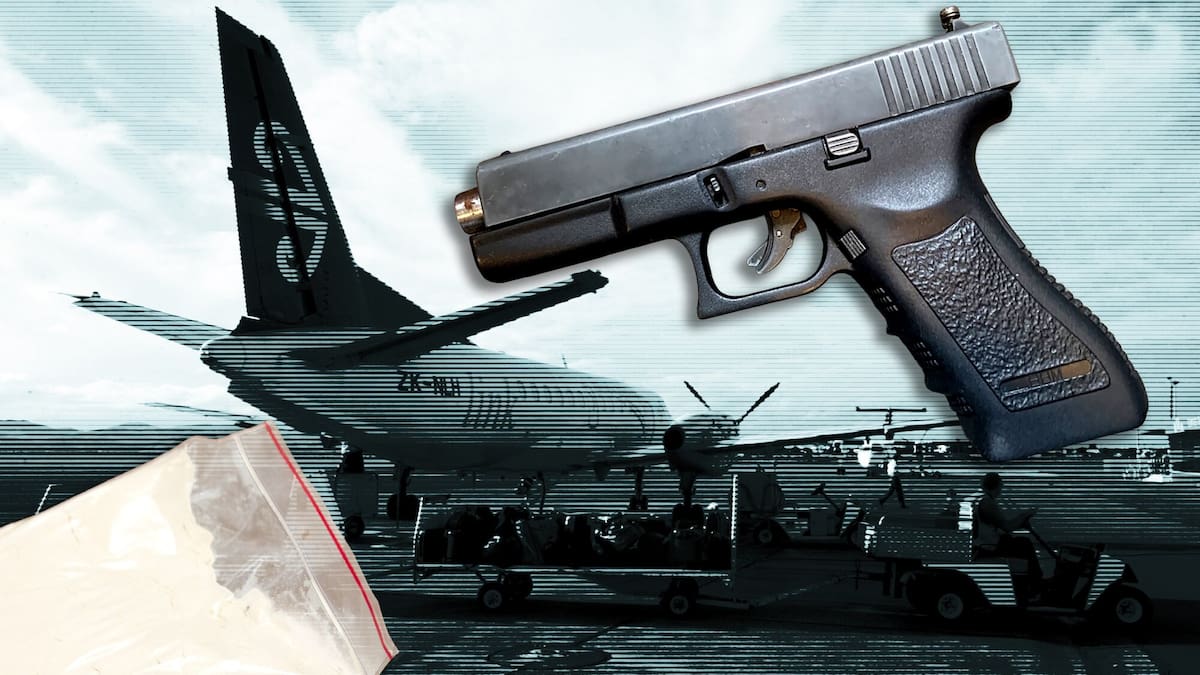
Over the past five years, dozens of airport workers have been arrested and hundreds of kilograms of drugs seized in a series of covert investigations.
But the concerning revelation that firearms have been smuggled in the same fashion raises questions about how criminals continue to arm themselves, despite new laws making it harder to divert guns into the black market.
The six handguns were found by accident after a bungled smuggling attempt on an early morning flight from Los Angeles in January 2024.
Air New Zealand baggage handlers, Hausia Vaiangina and Allen Faletolu, had tried to surreptitiously remove two bags from the aircraft but were deterred by the presence of other airport staff.
Fearing that they would be caught, the pair abandoned their plan.
The backpacks were later unloaded onto the luggage carousel in the arrival hall at Auckland International Airport.
The “unaccompanied luggage” was x-rayed and Customs removed six pistols, manufactured by Smith & Wesson or Springfield Armory, and 18kg of cocaine.
The guns were in good condition and fully functional.
A joint investigation by Customs and the police, Operation Soar, revealed Vaiangina and Faletolu were involved in other drug imports between December 2023 and April 2024.
Vaiangina was also involved in drug imports with a former Air New Zealand baggage handler called Puapii Mokotua.
The largest of these was nearly 60kg of methamphetamine.
Mokotua was a familiar name to the Operation Soar investigators.
He had been sacked by Air New Zealand after being arrested in an investigation in 2021, Operation Selena, which exposed several networks of corrupt baggage handlers at the airport.
Customs seized six pistols which had been smuggled with 18kg of cocaine through Auckland airport in January 2024 with the help of corrupt Air New Zealand baggage handlers. The subsequent investigation, Operation Soar, led to numerous drug importing charges. Photo / NZ Customs.
However, Mokotua was released on bail and able to keep importing drugs into the country because of his relationship with Vaiangina, who still worked at the airport.
When Vaiangina’s home in the Auckland suburb of Clover Park was raided in August 2024, police found $100,000 in a shoebox and another $20,000 in a small bag.
Bundles of cash totalling $15,000 were discovered in Faletolu’s bedroom. He told detectives that he received $40,000 for each successful drug import.
Police also searched a car being driven by another Operation Soar target.
Detectives found $375,000 in a duffel bag and another $319,000 in a white cardboard box.
In August 2024, Mokotua was sentenced to seven years in prison after pleading guilty to the Operation Selena charges of importing 24kg of methamphetamine.
The 27-year-old is likely to be facing another long term of imprisonment when sentenced on the Operation Soar offences, including the 60kg meth import, in June.
Vaingina, 26, and Faletolu, 30, will be sentenced in April after pleading guilty to various drug importation offences.
The pair had also been prosecuted with illegal trafficking of firearms.
But the charges were later dropped, as the police could not prove they knew that firearms (rather than drugs) were in the backpacks.
Air New Zealand did not respond to a request for comment.
Dominic Adams, Customs’ investigations manager, said organised crime groups are persistent in attempting to exploit individuals to smuggle illicit goods into New Zealand.
While the vast majority of people working at the border act with integrity, Adams said the “insider threat” at the border was real.
“While firearms smuggling remains far less common than drug smuggling, any attempt to illegally import weapons is treated as extremely serious and deeply concerning,” Adams said.
“It highlights the greater willingness to use intimidation, firearms and other violence, or coercion, to achieve their outcomes.”
The attempted smuggling of pistols through Auckland airport is a rare example of firearms being imported illegally into the country.
But the case does raise questions about how gangs and organised crime figures continue to obtain firearms after the introduction of stricter gun laws.
More than $500,000 was discovered when Operation Selena arrested 24 people for smuggling drugs through Auckland International Airport, including gang members and Air NZ baggage handlers. Photo / NZ Police
For many years, police had believed that most firearms in criminal hands were stolen from legitimate gun owners.
This point had frustrated some in the firearms community, who said there was little data to back up the claim and instead believed that organised criminal groups smuggled guns from overseas.
But until Operation Soar, there was only a single known incident of firearms being smuggled into New Zealand.
This was when two pistols were found with 110kg of methamphetamine concealed inside golf cart batteries in 2019.
After the Christchurch terrorist attack, a nationwide crackdown on illegal firearms led police to identify retail diversion or “straw buyers” – a tactic where licensed firearms owners sell guns to criminals – as a much bigger problem than previously thought.
Numerous investigations in recent years have led to prosecutions of prolific “straw buyers”, such as former Hells Angel Kishor Singh, caught supplying firearms to gangs and other criminals.
Since then, the establishment of a national firearms register and tighter record-keeping obligations for private sales of firearms have made it harder to divert guns into the black market without getting caught.
Despite the concerning discovery in Operation Soar, police still believe that “straw buying” is the most common way for criminals to obtain firearms.
“While information is occasionally received suggesting illegal importation of firearms, the seizure of illegally imported firearms is rare,” said Detective Inspector Albie Alexander, of the National Organised Crime Group.
“With the increase in accountability on [firearms licence holders] for their firearms purchases, it is almost certain that [organised criminal groups] will investigate alternative sources if obtaining firearms becomes more difficult via diversion. Smuggling would be a possible alternative to be considered.”
Another potential source of illegal firepower in the criminal underworld are 3D printed guns.
Last year police Operation Bismarck targeted an alleged Auckland syndicate manufacturing and supplying 3D printed firearms to gang members and other criminals. Photo / NZ Police
Plans to manufacture 3D firearms almost entirely out of plastic – save for a few metal components – can easily be found online.
Prosecutions for manufacturing 3D-printed firearms are relatively rare in New Zealand, although in recent years, police officers have started to find homemade guns more frequently.
There were 95 confiscated in 2025 although Alexander pointed out that was less than 1% of the total number of firearms seized by police.
Jared Savage covers crime and justice issues, with a particular interest in organised crime. He joined the Herald in 2006 and has won a dozen journalism awards in that time, including twice being named Reporter of the Year. He is also the author of Gangland, Gangster’s Paradise and Underworld.