
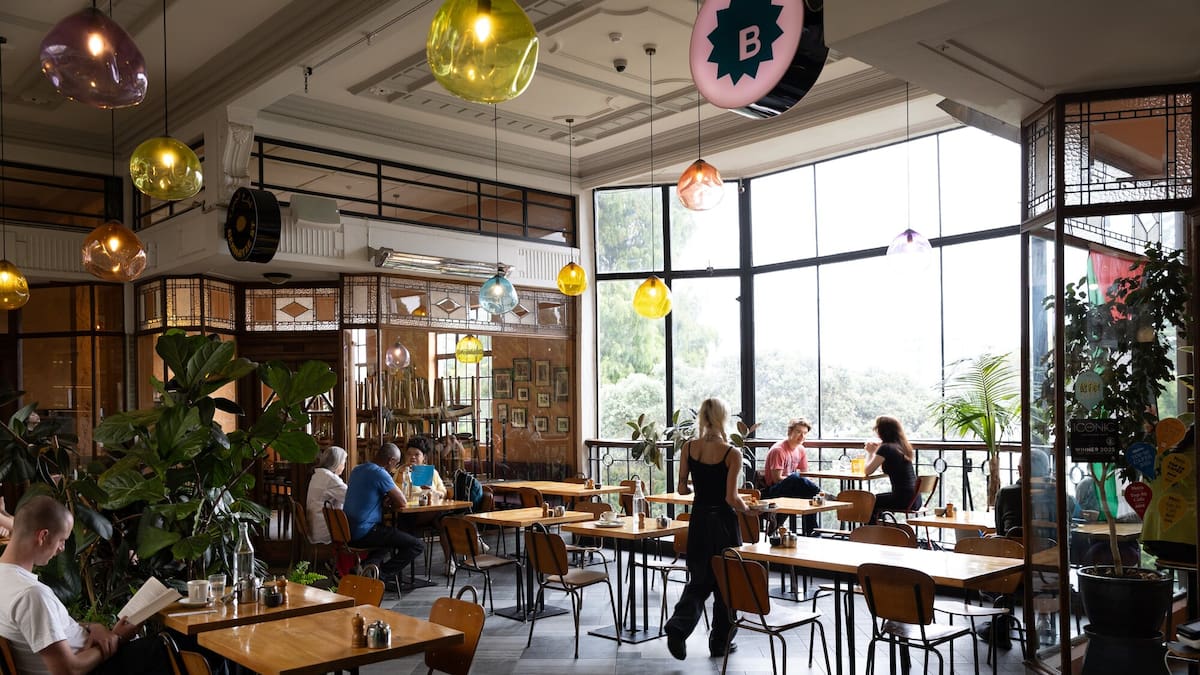
“Everyone used to come into town to meet on a Friday night. People didn’t have the big shopping malls then.
“We grew our hair long – the poobahs of Auckland weren’t into that one – and every pub had a band in it.”
Pat Menzies Shoes opened in Canterbury Arcade on Queen St in 1975 and is still in business there today, expanding to include a Converse concept store on the other side of the arcade.
Fashion has evolved since then, along with the dress code for bars that turned away anyone wearing jeans, even designer ones.
But 50 years on, Pat Menzies Shoes still fronts the heritage-listed Canterbury Arcade, which was designed in the late 60s by Peter Beaven, then one of New Zealand’s most prominent urban architects.
Menzies, who’s now 78, sold out seven years ago, although his daughter Michelle has stayed with the business.
Over the decades, it’s broken his heart to see the evolution of mega malls and the rise of online shopping suck so much life out of the inner city.
The closure of Smith & Caughey’s last June topped off a rough few years for Queen St, which has struggled with Covid lockdowns, a huge increase in rough sleepers, and disruption around the City Rail Link. Construction for that began in 2018.
So the news that a $5 million facelift is planned for Queens Arcade, another historic shopping strip a few blocks down, is being seen as a much-needed vote of confidence in what was once Auckland’s Golden Mile.
A $5 million refurbishment project is planned for Queens Arcade, which connects Customs St (the frontage pictured here) with Queen St.
Opened in 1929, the L-shaped arcade connecting Queen and Customs Sts closes at the end of this month for a refurbishment designed to reposition the two-level precinct as a “luxury retail and wellness destination”.
A yet-to-be-announced premium anchor tenant has been signed, with a grand reopening scheduled for November.
The makeover follows the successful redevelopment of St Kevin’s Arcade on Karangahape Rd, with 1920s leadlight windows overlooking Myers Park.
There are also renewed signs of life at the Strand Arcade on Queen St, which has emerged from an unloved, almost derelict state.
A category 1 historic place, the grand Italianate-style arcade was rebuilt in 1909 after being destroyed by fire and is described by Heritage New Zealand as having “outstanding aesthetic significance”.
However, in 2023, more than two-thirds of the shops were empty, with one space left unoccupied for 15 years.
Tenor Ridge Ponini and soprano Katherine Winitana at a rehearsal for Opera in the Strand, a free concert staged as part of NZ Music Month.
After a 21-month “revitalisation programme” by the Auckland Council, featuring the likes of pop-up art exhibitions and free Opera in the Strand performances, occupancy rates had risen by 85%.
Gone, too, was the whiff of urine and the graffiti that previously covered the walls..
Recent additions to the arcade include Slow Koi, a serene coffee and matcha brew bar inspired by Japanese tea culture, and Addis, an Ethiopian cafe.
Activation principal Barbara Holloway, who spearheaded the programme, is a long-time cheerleader for the central city (she lives up by the University of Auckland law school) and spent 11 years as town manager for the Karangahape Rd Business Association.
She’s seen a growing appetite for “experiential shopping” beyond cookie-cutter chain stores and sterile shopping malls.
It’s a trend she believes character destinations like the Strand can capitalise on by taking a more diverse and innovative approach that supports young entrepreneurs.
Barbara Holloway says innovative projects in heritage arcades like the Strand can fill a growing demand for “experiential shopping”. Photo / Michael Craig
“To be successful in retail now, you have to morph, and you have to get on point,” she says. “We had young people coming for queers in safe spaces, and we had older people coming for the opera who hadn’t been into the city for years.
“If I want some new towels, I’ll probably buy them online. If people are going to shop in person, they want more.”
The resurgence of interest in heritage spaces comes too late for lost treasures already bulldozed in the name of progress. Timaru’s Royal Arcade, circa 1880s, is one of only a handful of vintage shopping arcades that survive today.
Victoria Arcade, which opened in Auckland’s Queen St in 1885, was described as “a symphony in red brick” and “absolutely heroic” by conservation architect Jeremy Salmond. It was demolished in 1978 to make way for the Bank of New Zealand’s corporate headquarters.
Just a few blocks away, His Majesty’s Theatre and its ornate adjoining arcade – built in 1902 and featuring a glass-roofed promenade – were controversially flattened 10 years later, despite public opposition. A hotel and apartment complex is on the site now.
Since it opened, Queens Arcade has been owned by the Davis family, who have strong generational links to the city.
Sir Ernest Davis, a former Auckland mayor and brewing magnate, donated Browns Island to the citizens of Auckland and funded construction of the lighthouse on Tiritiri Matangi Island.
In 1950, his nephew, Eliot Davis, commissioned the Art Deco Mission Bay fountain as a memorial to his son.
The Trevor Moss Davis Memorial Fountain at Auckland’s Mission Bay. Photo / Alex Burton
Property manager Ian Wright, who has worked on the Queens Arcade refurbishment project for the past five years, says the family are committed to retaining the building long-term.
“From the beginning, the message has been that this will remain a legacy asset,” he says. “We’re not going to redevelop and build office towers or do a deal with a hotel.”
Originally designed by architect William Swanson Read Bloomfield (Ngāti Kahungunu), the arcade features pillars made from polished Whangārei marble, one of the key heritage elements that will be retained.
Believed to be the first person of Māori descent to qualify and practise as an architect in New Zealand, Bloomfield also designed the Spanish Mission-style Lopdell House in Titirangi (originally a hotel, its ground-floor cabaret was kitted out with a dance floor).
In 1980, alterations to Queens Arcade removed office levels from its Queen St frontage and added a glazed atrium, which will be fitted with new panes of glass.
In a nod to the past, a new logo has been created, replacing the trademark silhouette of Queen Elizabeth II with her great-great-grandmother, Queen Victoria.
Property manager Ian Wright has been working on the Queens Arcade project for the past five years. Photo / Anna Heath
In the project’s initial stages, Wright conducted extensive research into the history of Queens Arcade and its surrounds, digging out the original building plans at Archives NZ in Wellington, sourcing old black-and-white photographs, and scouring the Papers Past website.
“We had pretty much no electronic files at all,” says Wright, who is still keen to trace any other archival material, including film footage and newspaper articles.
“What’s happened over time has been very piecemeal, with stuff just tacked on. So it’s meant getting down in the basement and going up into the ceiling, tracing water lines and working out where to put isolation points.”
As part of his research into the origin and evolution of shopping arcades, Wright went on a recce trip to Australia to visit half a dozen heritage sites, including Melbourne’s Royal Arcade (built in 1870) and Sydney’s Strand Arcade (1892).
According to what he’s gleaned, the lineage of the modern shopping arcade dates back to early 19th-century London, where Lord George Cavendish commissioned Burlington Arcade in Piccadilly in 1819.
Wright says this established a new urban retail typology: a covered, curated promenade separating commerce from the disorder of the street.
“They were boutiquey small; you probably had your bootmaker and your candlestick maker. And I suspect some of those arcades then became safe and secure and warm places in cities like London, where it would have been horrible in wintertime on the strip retail.”
The arcade model spread rapidly across Europe and the British Empire. In Australia’s gold-rush era, they became a symbol of prosperity, reflecting the Victorian fascination with glass roofs, mosaic floors and decorative ironwork.
Sydney’s Queen Victoria Building, which opened in 1898, expanded the concept to occupy an entire city block – “a cathedral of commerce” that foreshadowed modern shopping malls.
Wright says Queens Arcade belongs to a second wave of arcade design, where retail became integrated into multi-storey commercial buildings and the exuberance of the Victorian period gave way to “inter-war refinement”.
The current makeover, by JCY Architects, will open up the ground floor by stripping out the escalator and installing fresh lighting.
A rendering of how Queens Arcade will look when it reopens in November.
A number of the small, 25sq m shops will be reconfigured to create significantly larger retail spaces, while the upper level will become a health and wellbeing hub.
Wright returned from Australia with a database of photographs he has used as reference points. However, property managers view architecturally designed buildings with a more critical eye.
“There were a whole lot of gargoyles and old clocks and things poked around the top that look interesting, but often they’re filthy dirty,” he says. “I go into buildings, even brand-new ones, and think, how are you going to clean or fix that?”
There’s a far more crucial aspect than design trimmings when it comes to how people judge shopping centres, anyway. “Do you know what that is?” asks Wright. “The toilets.”
Heritage architect Jane Matthews, who consulted on the Queens Arcade project, says resource consent is required for changes to scheduled historic buildings and applications are considered on a case-by-case basis.
The overall aim is to retain heritage values, balanced against requirements for use that evolve and change over time.
“That might be ensuring heritage fabric and features are retained, with changes kept to a minimum as far as possible, or it might be recovering the qualities of a place by removing later alterations that have obscured them.”
A particularly successful heritage development is The Tannery in Christchurch, where the original 19th-century structure now houses a boutique retail complex.
In Wellington, the Old Bank Arcade was a late 90s makeover of the Bank of New Zealand on Lambton Quay. Opened in 1901 as the bank’s head office, the near-derelict building was restored by the same company that had transformed the Queen Victoria Building in Sydney.
Auckland property developer and former Shortland Street actor Paul Reid runs The Icon Group, which owns St Kevin’s Arcade on Karangahape Rd and Elliott Stables.
Jungle 8 owner Paul Wong with PhoZilla noodle soup at the Vietnamese-style street food eatery in Elliott Stables. Photo / Jason Oxenham
An inner-city food hall that operates out of an Edwardian warehouse, the Stables was given a $2 million makeover in 2023, skewing its mix of eateries towards Asian street food.
Reid, who says St Kevin’s Arcade is currently looking for a top-notch barber, believes the City Rail Link will have a “massively positive impact” on both sites and their surrounding neighbourhoods when it finally opens this year.
The imminent opening of Faradays, a luxury $30m department store, is also good news for the seaward end of Queen St, where Cartier is set to join the likes of Gucci, Dior and Louis Vuitton. Queens Arcade is right across the road.
While opinions are divided on the ethics and efficacy of the Government’s new move-on orders aimed at controlling the homeless community, Ian Wright is optimistic about Auckland’s return to a “strong, economically viable CBD”.
The revamped Queens Arcade will feature digital screens showcasing stories and images from the building’s often colourful history. In 1943, America’s first lady, Eleanor Roosevelt, visited the Servicewomen’s Club upstairs.
“It holds a lot of memories,” says Wright. “People will often say, ‘I used to go to the tearooms’. And before it became the arcade, it was a butcher’s and bacon shop.
“New Zealand doesn’t have many of these grand old buildings. That’s why this one is special.”
Joanna Wane is a senior lifestyle writer with an interest in social issues and the arts.