
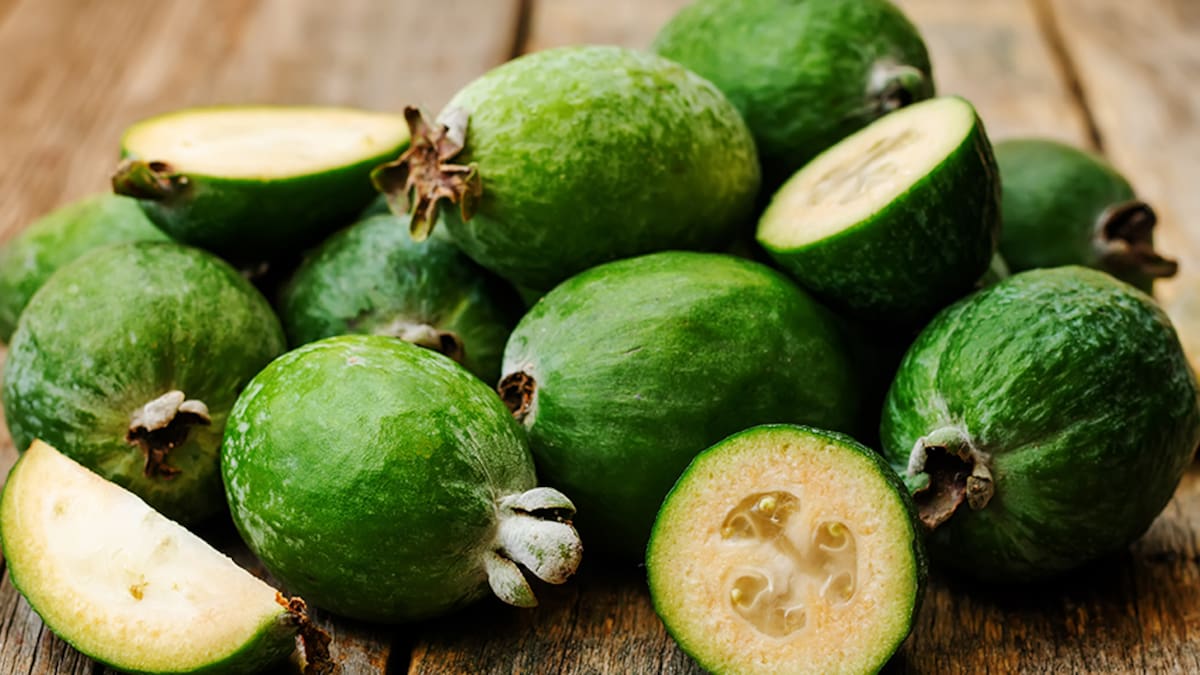
Last year, I wrote about the great feijoa divide and received all sorts of mail.
Photos of overflowing trees. Recipes. Offers to “drop some around”. And a surprising number of messages typed entirely in capital letters informing me I had no tastebuds and possibly no soul.
Which got me thinking.
Is it time we stopped arguing about the feijoa and started recognising it for what it truly is?
Our national fruit.
We can manage three official languages. Surely, we can cope with two official fruits.
The kiwifruit is taken, but I would like to formally nominate the “New Zealand fruit”.
The fruit formerly known as the feijoa.
Now, before you choke on your cheese roll, yes, I am aware it did not originate here.
It comes from the mountains of Brazil, Uruguay and Argentina.
It arrived on our shores like many backpackers, with a passport and a slightly exotic back story.
But let’s not pretend that has ever stopped us.
The kiwifruit was once the Chinese gooseberry.
We renamed it, claimed it, marketed it, and now it sits proudly in supermarkets around the world wearing a little sticker that says Zespri like it was born in Te Puke.
The pavlova? Well. We all know how that story goes.
We did not stake our claim strongly enough, and the Australians saw an opportunity.
I am not saying they stole it, but they stole it. And we cannot afford to let that happen again.
The feijoa, the New Zealand fruit, is already more Kiwi than most of us.
They fall from trees in suburban backyards like clockwork.
They appear in plastic buckets outside rural gates with the word FREE scribbled in vivid.
And they’ve become an unofficial currency, the exchange rate sitting at roughly four feijoas to one lemon.
Which is exactly why it deserves national fruit status.
You either scoop them straight from the skin with a teaspoon like a civilised human, or you stand at arm’s length making a noise normally reserved for cats and furballs.
What’s wrong with this photo? That’s not a giant feijoa. Photo / Bevan Conley
That kind of passion is nation-building stuff. The passion that put a beekeeper on the $5 note.
So how do we formally recognise it?
First, we need an oversized one.
Every respectable New Zealand icon has a large roadside version.
We have the giant carrot, the giant gumboot and the giant sheepdog.
Somewhere in this great land, there is a small town that needs an Instagram boost and a reason for people to pull over.
Let us give them a giant feijoa, a New Zealand fruit.
The build cost does not have to be outrageous. I am thinking a repurposed grain silo painted green, maybe with a slightly cartoonish face to make it more lovable for the feijoa haters.
The selfie potential of a giant feijoa, the New Zealand fruit, alone would give Tourism New Zealand a hashtag.
And while we are at it, why stop at a giant roadside monument?
What about feijoa perfume? Eau de Feijoa. Fresh. Fruity. Slightly confusing. Do I love it or do I hate it?
Love it or hate it, it works 60% of the time, every time. One spray and you will either attract admirers or clear a room.
If we can turn mānuka into honey gold and market it to the world as liquid treasure, surely we can give the green grenade its commercial moment.
And then there is music.
I would like to formally call on Sir Dave Dobbyn to re-release a version of Slice of Heaven dedicated to the New Zealand fruit, formerly known as the feijoa.
That green glow over my horizon, she’s a slice of feijoa, slice of heaven.
Autumn sunlight on my horizon, she’s a slice of feijoa, yeah.
And the album cover would look like the Velvet Underground cover, but instead of an Andy Warhol banana, it would feature a Dick Frizzell feijoa.
That might even work as a flag, but I will leave that to Sir John Key.
There will always be those who question the texture.
Those who say it has the gritty feel of an ice cream dropped in the sand at the beach and, if gifted a bag, immediately begin planning who they can regift it to.
So, whether you are stockpiling them in the freezer or quietly perfecting the art of the strategic regift, let us at least agree on this.
They are as Kiwi as jandal tan lines. As Kiwi as an honesty box at the gate.
As Kiwi as a bucket of fruit you did not ask for but somehow feel responsible for turning into muffins and gifting back to the original giver as a thank you. Now that is a complex exchange.
Which is exactly why now is the time. The time to stop arguing. The time to stop pretending it is just a seasonal inconvenience.
The time to officially recognise the feijoa as the New Zealand fruit.
Trademark pending.
Glenn Dwight is the studio creative director – regional at NZME and an occasional writer for The Country.