
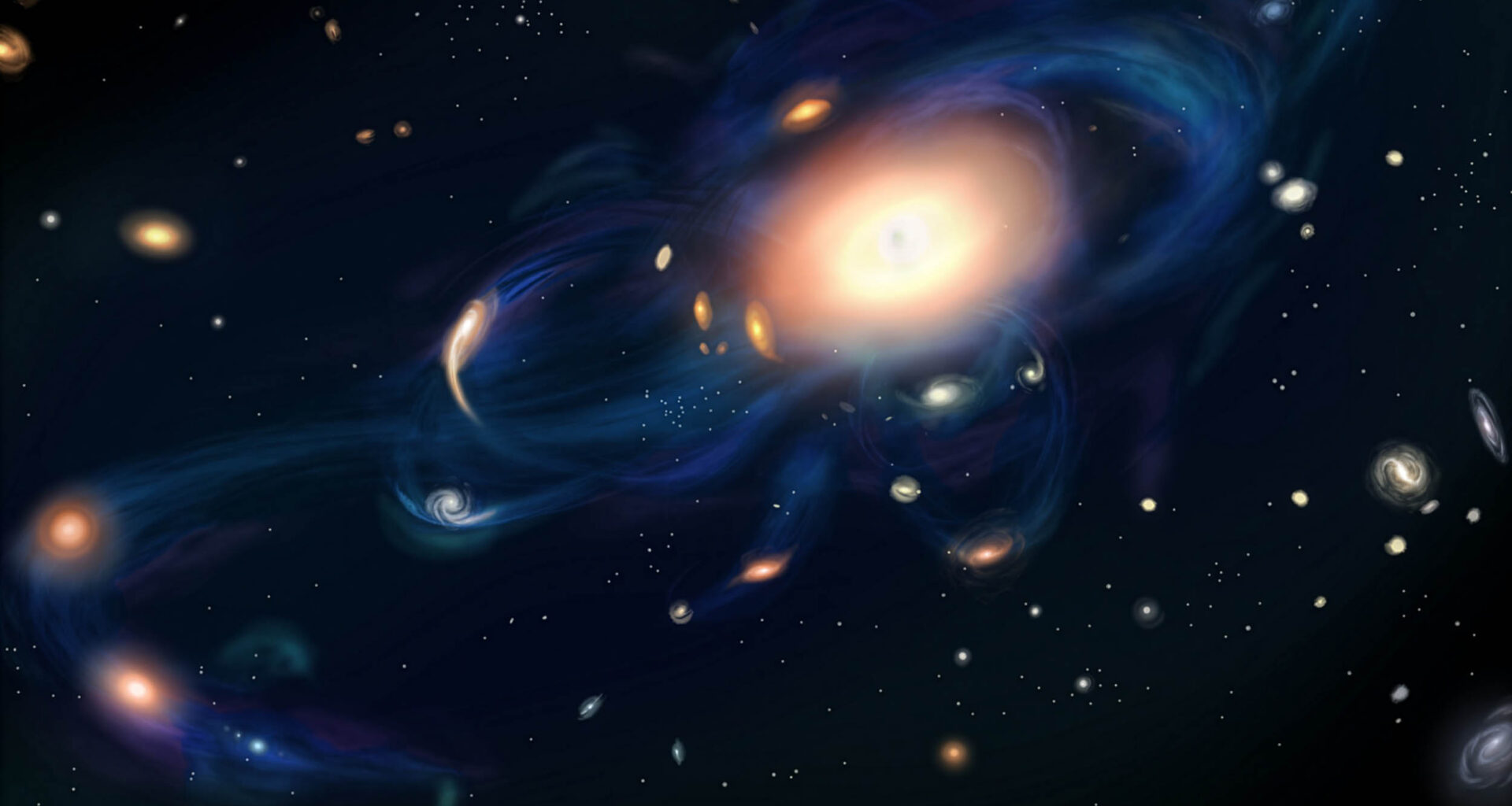
Gamma-ray bursts rank among the most powerful explosions in the universe, often flashing for less than a second while releasing enormous amounts of energy.
Astronomers usually trace these brief bursts to the collision of two neutron stars – the dense remnants left behind when massive stars explode.

But a newly studied burst appears to have formed in an unusual cosmic setting. GRB 230906A, a short gamma-ray burst first detected in 2023, points to a faint galaxy embedded within a long stream of torn stars and gas.
By analyzing that debris field, researchers at Pennsylvania State University showed that the burst aligns with material stripped from interacting galaxies.
That alignment places the explosion inside a tidal tail – a ribbon of stars and gas pulled far from their original galaxies by powerful gravitational forces during a merger.
The unusual location suggests that the same galactic collision that created the debris may also have set the conditions for the stellar merger that produced the burst.
Identifying GRB 230906A
The gamma-ray burst lasted only about 0.9 seconds, releasing an intense flash of the universe’s highest-energy light.
Astronomers usually link short bursts like this to the merger of two neutron stars – the incredibly dense remnants left behind when massive stars explode.
These stellar corpses can orbit each other for millions or even billions of years before finally spiraling together.
A major breakthrough came in 2017, when astronomers detected both gravitational waves and a weak gamma-ray burst from the same neutron-star merger.
That discovery confirmed the connection between short gamma-ray bursts and these violent stellar collisions.
Since then, bursts like GRB 230906A have become valuable clues that help astronomers trace where pairs of neutron stars once formed and eventually crashed together.
When neutron stars collide
The gamma-ray flash is only the beginning of what happens when neutron stars collide.
The merger also produces a kilonova, a brief but powerful glow created by hot debris blasted outward during the impact.
As that debris expands and cools, radioactive decay drives the formation of heavy elements through a process known as the r-process, in which atomic nuclei rapidly capture neutrons and grow heavier step by step.
Observations of the 2017 neutron-star merger showed that this process can create newly forged elements such as gold and platinum.
GRB 230906A may reveal another pathway by which those elements spread far from where they were created, reaching the outer regions of galaxies.
GRB 230906A’s hidden home
At the position of the burst, astronomers found a galaxy so faint that it almost escaped detection.
Months after the explosion, the Hubble Space Telescope finally captured a clear image of the tiny galaxy. Earlier optical and radio observations had found nothing bright enough to confirm the burst’s origin.
Because the galaxy is so dim, its true distance remains uncertain. It could belong to a nearby galaxy group or sit much farther away in the background.
Either possibility highlights an important lesson: the true home of a powerful cosmic explosion can sometimes remain hidden in plain sight.
A crowded galaxy group
The faint galaxy does not sit alone. Instead, it lies within a crowded group of galaxies located billions of light-years away.
Spectroscopic measurements showed that several nearby galaxies share the same distance, confirming that they belong to the same physical group rather than simply appearing close together in the sky.
One of the larger galaxies in this group trails a long stream of stars and gas stretching roughly 600,000 light-years into space.
Astronomers call this structure a tidal tail – a ribbon of material pulled away when gravitational forces during galaxy encounters tear stars and gas from their original homes.
That dramatic environment suggests the burst may be tied to the turbulent history of galaxies interacting and colliding.
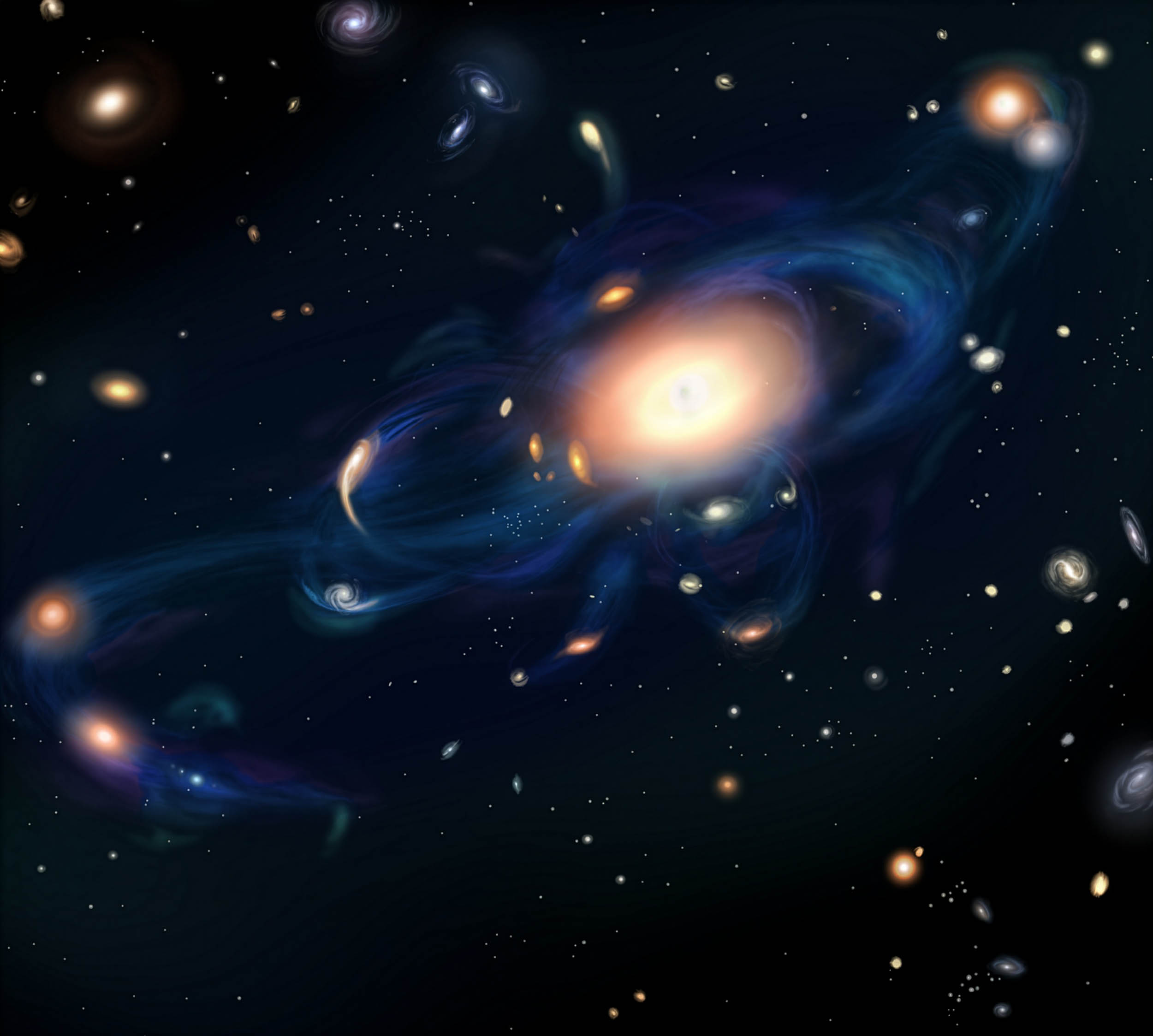 Using NASA’s Chandra X-ray Observatory and Hubble Space Telescope, researchers pinpointed a short gamma-ray burst to a faint galaxy that appears to be part of a larger group of galaxies about 8.5 billion light-years away. This group is undergoing a cosmic merger — galaxies colliding and interacting and stirring up star formation. Credit: Illustration by Maria Cristina Fortuna/NASA/Chandra X-ray Center. Click image to enlarge.New stars in tidal debris
The debris created during galaxy collisions does not remain empty for long. Gas trapped in tidal tails can cool and collapse, forming entirely new stars.
“This could be an indication that tidal interaction between galaxies can trigger star formation,” said study co-author Simone Dichiara, an assistant research professor at Pennsylvania State University.
The researchers estimate that the earlier galaxy collision may have triggered star formation roughly 700 million years before the burst occurred.
That time span is long enough for a pair of stars to evolve, collapse into neutron stars, and eventually spiral together until they merged in the explosion observed as GRB 230906A.
Heavy elements escape galaxies
Tidal tails are thin and only loosely bound by gravity. Because of that, debris from a later stellar merger can spread outward instead of remaining trapped inside a galaxy.
In this kind of environment, newly created elements may escape into the circumgalactic medium, the vast halo of gas surrounding a galaxy.
“This could provide a natural explanation for why we see an enhanced rate of production of heavy elements in the halo of interacting galaxies,” said Dichiara.
This idea could help explain why some very old stars far from galactic centers contain unexpectedly large amounts of heavy elements.
Chandra pinpoints the burst
Pinpointing the burst’s location required extremely precise measurements. Early X-ray observations provided only a broad region of sky where the burst might have occurred, making it difficult to identify the correct host galaxy.
NASA’s Chandra X-ray Observatory dramatically improved that precision by shrinking the burst’s location to a tiny patch of sky. That sharper position pointed directly to the faint galaxy embedded within tidal debris.
Without that improved accuracy, astronomers might have linked the explosion to a brighter nearby galaxy and drawn the wrong conclusion about its origin.
The case highlights a common challenge in astronomy: the easiest object to see is not always the true source of a cosmic event.
Lessons from GRB 230906A
Better spectral observations will help decide between the competing distance estimates, because light from the host galaxy still holds the clearest missing clue.
The James Webb Space Telescope could potentially read the faint galaxy directly, while future X-ray missions may measure the burst’s distance using fingerprints left in its afterglow.
Fast, high-resolution X-ray spectroscopy, the researchers argue, could determine the burst’s true distance even when optical data fail completely.
For now, GRB 230906A stands as both a discovery and a caution about how much the universe can still hide. The event turned a faint galaxy and a torn-out stellar stream into evidence that cosmic wreckage can both create and disperse heavy elements across space.
Further observations should reveal whether astronomers witnessed a nearby cosmic oddball or a much earlier explosion from the distant universe – helping refine how these powerful bursts are mapped across cosmic time.
The study is published in the journal The Astrophysical Journal Letters.
—–
Like what you read? Subscribe to our newsletter for engaging articles, exclusive content, and the latest updates.
Check us out on EarthSnap, a free app brought to you by Eric Ralls and Earth.com.
—–