
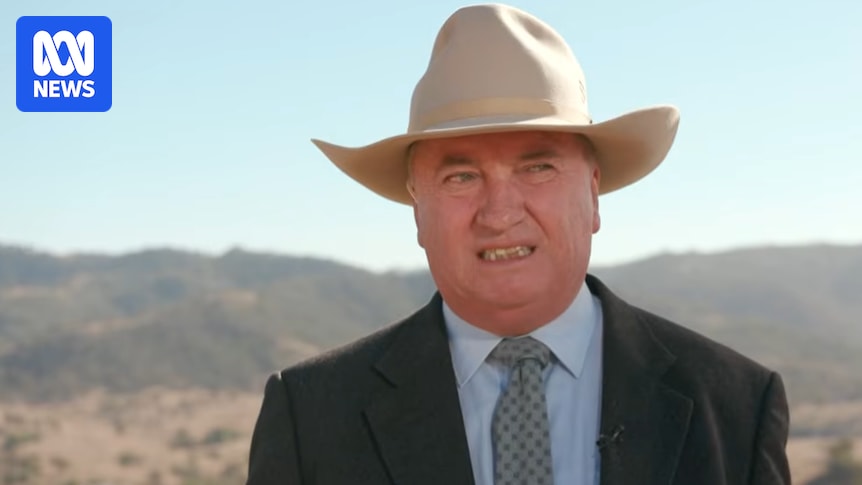
Former deputy prime minister Barnaby Joyce says he regrets not doing more while in government to secure fuel reserves, as Australia grapples with supply shortages triggered by wars in the Middle East.
Fuel prices have risen sharply amid uncertainty over Iran’s blockade of the Strait of Hormuz and Treasurer Jim Chalmers today flagged the flow-on impact could see inflation peak “somewhere between the mid-to-high fours” depending on the duration of the conflict.
The government released about six days’ worth of petrol and five days of diesel from its emergency stockpile as part of an internationally coordinated response to the shortage, the first time it had used the reserves since Russia’s invasion of Ukraine.
Iran war live updates: For the latest news on the Middle East crisis, read our blog.
Mr Joyce, who last year defected from the Nationals to One Nation, accused the government of having no plan to deal with the crisis but acknowledged the reserves were lower under the Coalition.
“I remember having the argument when they were talking about putting it [fuel reserve] in Texas, I hope I’m not disclosing cabinet, saying ‘I don’t think that’s going to work’,” he told ABC’s Insiders today.
“It was trying to comply with the IEA [International Energy Agency] in a sneaky way, and it didn’t work.”
How are rising fuel costs or supply issues affecting you or your business?
Share your insights to help inform our journalism.
In 2020, the Coalition government announced it would take advantage of historically low fuel prices and establish a strategic fuel reserve on American soil to meet the 90-day minimum required by international agreements.
Then energy minister Angus Taylor argued it was an “extraordinary” opportunity but Labor said situating the reserve overseas would do little to minimise concerns Australia was vulnerable to international disruptions.
“The first thing about doing something stupid is not acknowledging it and continuing to do it,” Mr Joyce said on Sunday.
Loading
“Now, the Coalition at the time did something stupid. Right now, they’re not going to do anything about it. The Labor Party can’t say, ‘Well, it’s your stupid decision’ … how about you just get your refineries going again.”
The One Nation MP said he believed Australia should be rationing fuel supplies and should send a ship to the Strait of Hormuz, after United States President Donald Trump called on other countries to help secure the key trading route.
It is understood Australia has not received a request from the United States for naval support.
“You have to be part of a global effort if you are part of a beneficiary of it being resolved,” Mr Joyce said.
Volatility reason to go further on reforms: treasurer
As of Friday, Australia held 36 days’ worth of petrol, 29 days’ worth of jet fuel, and 32 days’ worth of diesel — above the minimum requirements established by the government in 2023.
Mr Chalmers on Sunday said Australia had “more than enough fuel as it stands right now” as he warned of “a lot of volatility and a lot of unpredictability” in the global oil market.
“We’ve seen in the last few months that the global oil price has gone from around $60 to $120. The last time I looked last night, it was trading a bit over $100,” Mr Chalmers said.
“And so that’s obviously having implications at petrol bowsers right around the world.”
Expert analysis on the Middle East:
Treasury has modelled a number of scenarios based on “realistic assumptions” about the conflict, he said, to forecast the likely impact on domestic inflation.
“If we were putting pencils down on those forecasts today, we’d have inflation peaking somewhere between the mid to high fours,” he told Sky News.
“But there’s a little way to run yet and the biggest variable, the source of the most extraordinary volatility in our forecast … is really how long this drags out for.”
In an analysis prepared for the government, and seen by the ABC, the Treasury predicted headline inflation will be 0.5 percentage points higher in the June quarter of 2026 if the crude oil price averages $US100 a barrel for three months.
But Mr Chalmers said the volatility was not cause to hold back on broader tax reform in the upcoming May budget and instead “a reason to go further”.
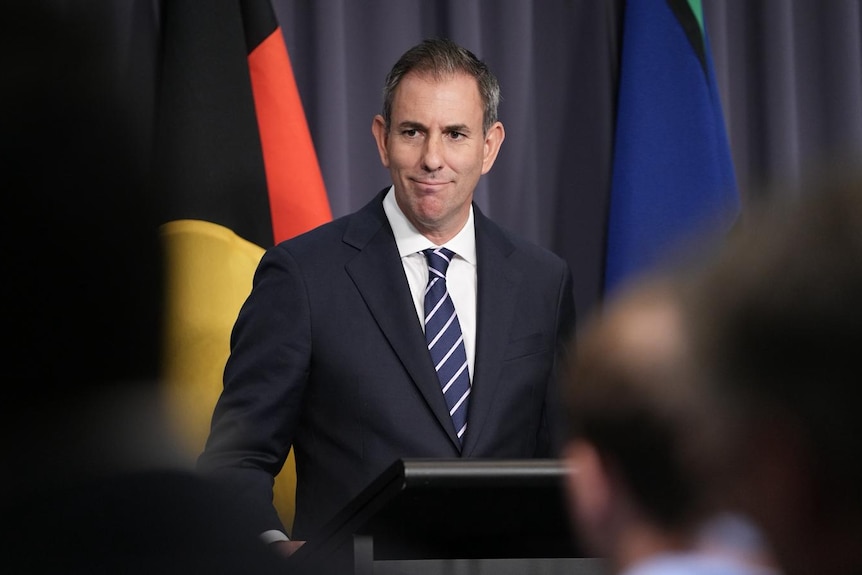
Jim Chalmers says the global uncertainty is a reason to go further on the government’s reforms. (ABC News: Matt Roberts)
“I’ll be working up a number of reform packages for this budget and they’ll be focused on savings, they’ll be focused on productivity,” he said.
“We’ll work through these issues in the usual considered and methodical way, recognising that we’re in the midst of another period of very substantial international economic uncertainty.
“That will weigh heavily, not just on our economy, not just on our budget, but also on the deliberations that we undertake in the next couple of months.”
Nationals leader Matt Canavan, who replaced David Littleproud this week, accused the government of failing to set up the economy to withstand international shocks.
“The problem here is not that the inflation rate is increasing, that’s clearly going to happen with the oil crisis we’ve got,” he told Sky News.
“The government has not been saving for a rainy day. And the rainy day has arrived, and we don’t really have a roof over our head.”
Loading…