
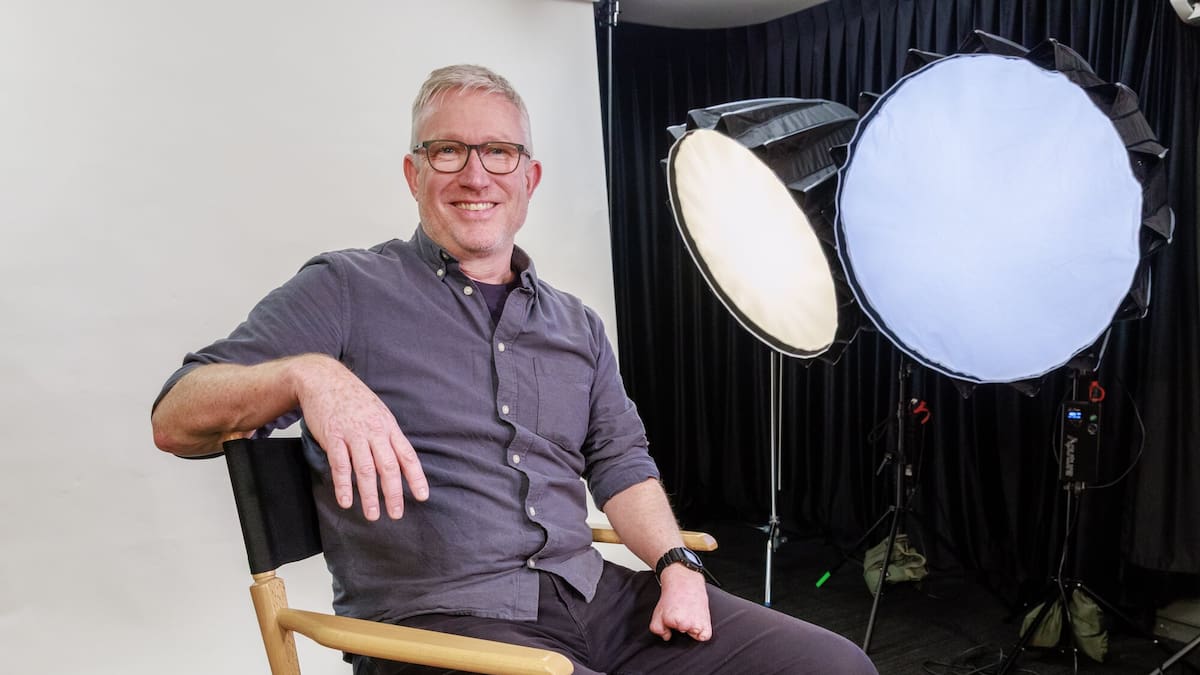
“It put this little gentle chip on my shoulder where I was like, ‘I have to prove to everybody that I’m better. Anything I do, I’m going to be better than anyone else’. That was really important to me, because I felt like I was always compensating and so it made me that way, which drove me, which is the benefit.
“But it was also detrimental in that it turned me into this perfectionist who never felt that anything was good enough.”
Throughout his 30s and 40s, Barrett would get home from work each day feeling like he’d come up short.
“I would put in a huge amount of physical effort in terms of hours and beat myself up every night,” he says.
These days, it’s a different story. The 52-year-old is able to look back on those experiences and give his younger self grace.
“I can see the things that didn’t work for me, the things that hurt me about it. I feel sorry for that old me sometimes when I think about it, but I also am grateful and now I give myself credit.
“That’s a lovely place to be because all of a sudden, I’m not having to prove myself, I’m not having to work longer hours than everybody else. I don’t beat myself up anymore,” he says with a smile.
In the past, the smallest mistake would torture him for weeks.
Now, “I can make mistakes and be okay about them within 10 minutes”.
Long hours were the norm at Wētā in the early days, Barrett says, but now there’s a bigger focus on crew wellbeing. Photo / Mark Mitchell
In the early days Wētā was “a little bit like the Wild West”, Barrett says. “Ridiculous” hours were the norm – he recalls averaging 93-hour weeks on his first film as animation supervisor.
“When I got there, it was all about the films, and there was an amazing bunch of people who would give their entire lives over to making the work, and there wasn’t a huge amount of structure in terms of management.
“We did amazing work, but it was hard work, and without that structure it was difficult for people to see their career paths.”
Today at Wētā FX, he says there’s better structure, bigger production teams and a stronger focus on crew wellbeing.
Working at Wētā was never the plan for Barrett. During his school years at Cashmere High in Christchurch he had a very different vision for his life.
“I was going to be the greatest painter the world has ever seen,” he says.
“I drew from an early age and I just loved painting. At my parents’ house they just let me have at it, and the floor and the walls and even the ceiling had oil paint on them.
“I painted my way into art school in Christchurch.”
Barrett has worked on the Avatar and Planet of the Apes franchises, as well as countless other films. Photo / Mark Mitchell
But he didn’t become a painter. Instead, he majored in sculpture and got a job with Christchurch sculptor Neil Dawson. After a few years painting, welding and helping build Dawson’s works and install them around the world, Barrett decided it was time for another change.
“This was Neil’s career that I was very grateful to be a part of, but it was his career and I felt like I needed my own.”
Barrett was in his late 20s when he enrolled at what was then Christchurch Polytech. He was there to study graphic design but he “stumbled” into the world of visual effects when a tutor showed him 3D computer animation for the first time. When he saw what it could do, he knew he’d found his calling.
“I’ve always loved film, but I’ve always been a drama buff. I’d seen Toy Story, but I didn’t really know how they’d done it.
“I just fell in love with it so hard, I knew that was what I was meant to be doing.”
He switched to the 3D animation programme, where his new classmates were already halfway through their end-of-year film project. But Barrett got enough work done in the last half of the year that he got offered his first job.
“So I never got my qualification. I was due to go back for another couple of semesters the next year, but I got my first job in Wellington and that was enough for me. That was the goal.”
He jumped in boots and all. His first job under the Wētā umbrella was at Workshop before moving to Wētā Digital, which is now known as Wētā FX.
A couple of decades on, he’s a senior animation supervisor and a Bafta and Academy Award winner for his work on James Cameron’s Avatar: The Way of Water. This year, he won the best special visual effects Bafta for Avatar: Fire and Ash, alongside Joe Letteri and Eric Saindon; the trio are also nominated for the visual effects Oscar, with the ceremony taking place on Monday.
Joe Letteri, Eric Saindon and Daniel Barrett on the Bafta stage.
In nearly 20 years at Wētā, he’s worked on countless films – many Kiwis probably don’t realise just how many, though we’ve likely seen his work.
“The films like Avatar, there’s a bit more recognition, a bit more understanding of Peter’s [Jackson] films as well, people understand Wētā does that,” Barrett says.
Then there’s the Marvel, Planet of the Apes and Fast & Furious franchises – Barrett was part of the team tasked with digitally recreating the late Paul Walker for Furious 7, which he calls “a strange honour”.
But rather than list his achievements, Barrett prefers to dwell on how “incredibly lucky” he feels to have worked on movies he’s proud of.
He led animation on The Water Horse – a film that’s particularly special because it was one his kids could watch when they were little. A poster of it hangs in his office.
His daughters are now 14 and 17, his son is 19. When he was working on The Way of Water, they weren’t too interested. It made it easy for Barrett to work on it from home without worrying about sharing spoilers.
“When it came out, I guess they became interested. And then [with] their social media algorithms, they ended up in this little echo chamber of Avatar and all of a sudden, Dad was this star and they were all really excited,” he recalls with a chuckle.
“So when [the latest Avatar film] came around, I had to be very careful. I couldn’t have anything on screen because they just wanted to know [what happens].”
Varang, played by Oona Chaplin, in Avatar: Fire and Ash. Photo / 20th Century Studios
These days, the way Barrett watches his films is different, too. He’s able to enjoy them instead of fixating on the details.
“There might be things that are in there that I wanted to fix and then I might see the odd other thing that I missed. These are the little things. I am able to have that conversation with myself these days, like, no one’s going to see that. So I think on the third watch of [Fire and Ash] I watched it as a film probably for the first time, which was lovely.”
On director James Cameron’s films, Barrett’s job is to ensure the actors’ work translates in digital form; a highlight on Fire and Ash was working on the character Varang, played by Oona Chaplin.
“That’s what floats my boat and gets me up in the morning, bringing those fantastic performances from the actors through on to the characters.”
It’s tools down on Avatar for now. Cameron has said the future of the franchise depends on the success of Fire and Ash.
“Jim has the script and I believe that certain elements of it have been shot. Everybody’s waiting to see how the box office does … but ultimately it’ll be up to Jim,” Barrett says.
Barrett loves being able to help bring characters to life through animation. Photo / Iva Lenard
In the meantime, since work wrapped up on Fire and Ash late last year, he’s taken time off. And for someone who works with the type of technology that he does, Barrett’s hobbies are all rather analogue: photography, fishing, reading.
“I’ve always loved birds, so I take photos of birds … this summer me and the girls got a kitten. I’m a dog guy who got a kitten and has just fallen head over heels for him. I spend most of my time taking photos of him,” he laughs.
On Monday, it will be Barrett posing for photos as he walks the red carpet at the Academy Awards in LA.
“It’s a super fun thing to do the awards and to travel and meet people in the industry. I’ve always considered that a great honour and I understand how lucky I am to be one of the four who get nominated for these awards.”
But he’s quick to widen the focus.
“There are 2500 people that worked on [Fire and Ash], 1200 at Wētā [alone] that worked on it. Everybody puts so much into it and we don’t do it for awards or recognition, but it’s always really lovely when that does happen for the team, and I’m super honoured to get to represent the wider team.”
And perhaps the international spotlight will help remind the world of New Zealand’s talent.
Attracting film-makers to Aotearoa is “a tough game”, Barrett says.
“We remain grateful that the Government continues to offer incentives to film-makers to come here … I think having the incentives that we have, and then also as a facility having the reputation that we have, continues to bring the films to us.”
It’s something Barrett is personally “really grateful for”.
“It’s meant that I can stay here in my little bolthole in Miramar and have a lovely life… and do really fun stuff.”
Bethany Reitsma is a lifestyle writer who has been with the NZ Herald since 2019. She specialises in all things health and wellbeing and is passionate about telling Kiwis’ real-life stories.