
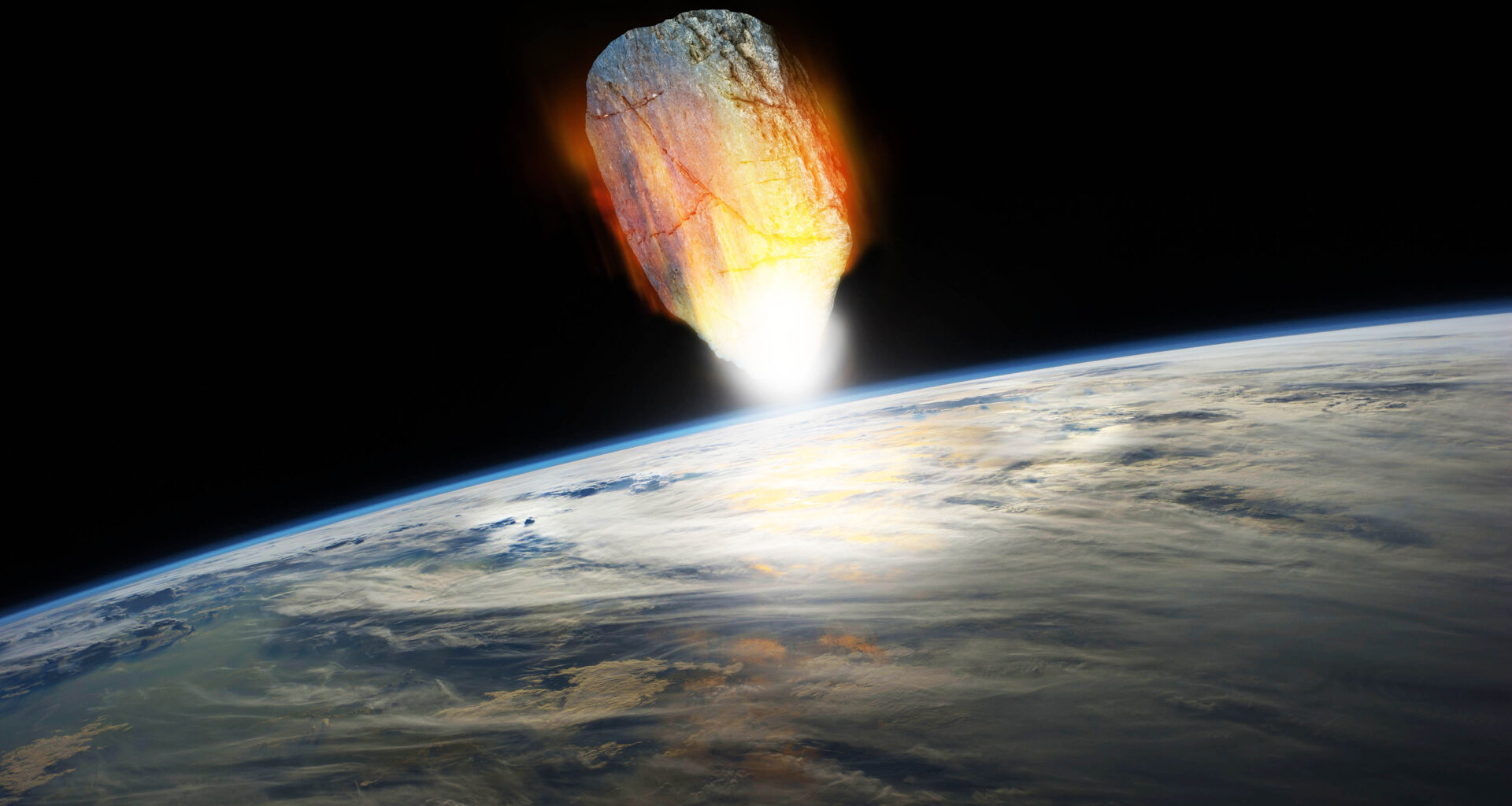
Scientists have found that a buried crater beneath the North Sea, named Silverpit, was created by an asteroid strike more than 43 million years ago.
The discovery resolves a decades-long geological dispute and reframes the seabed as the preserved aftermath of a violent ancient impact.
Silverpit proof below the seabed

Deep below muddy sediments about 80 miles off England’s east coast, Silverpit appears as a bowl with raised center and ringed faults.
Using sharper 3D scans, Dr. Uisdean Nicholson at Heriot-Watt University matched that pattern to damage only a high-speed impact.
His team then recovered rare shocked grains from nearby drill cuttings, giving the crater the hard proof earlier arguments lacked.
That combination closed the question of origin, but it also pushed scientists to reconstruct the violence of the strike.
Seismic Silverpit data
Fresh seismic data, sound-based images of buried rock layers, redrew Silverpit as a 1.9-mile crater, not the larger structure once proposed.
Around its middle sat a raised block of rock, while an outer zone held smaller pits and broken faults.
Curved fault patterns pointed to a low-angle arrival from the west, showing the space rock did not hit straight down.
Those details mattered because crater shape records motion, letting the seabed preserve direction as well as damage.
Shock in crystals
Old oil-well chips gave the strongest answer when microscopes found shocked quartz, quartz scarred by impact pressure, beside the crater floor.
Another tiny grain of feldspar carried the same kind of microscopic stripes, leaving ordinary Earth processes with nowhere to hide.
“We were exceptionally lucky to find these – a real ‘needle-in-a-haystack’ effort,” said Dr. Uisdean Nicholson, associate professor at Heriot-Watt University.
“These prove the impact crater hypothesis beyond doubt, because they have a fabric that can only be created by extreme shock pressures,” said Nicholson.
Timing the strike
Tiny fossil remains in sediments dated the event to 43 million to 46 million years ago, placing it in the middle Eocene.
Computer models then showed that a rocky body about 535 feet wide could carve the observed hole in seconds.
In the best fit, the impactor hit shallow water at about 33,500 miles per hour and opened the cavity within 12 seconds.
That speed explains why Silverpit formed a true impact crater instead of a slump, vent, or sinkhole.
Water in motion
Moments after impact, excavated water and rock surged upward and then rushed back into the hole with enormous force. The team inferred a tsunami that rose more than 328 feet above the surrounding water.
Nearby scars and small craterlets suggested that falling blocks and returning water reshaped the surface over minutes to hours.
Silverpit preserved not just the strike itself, but the messy aftermath that followed when the sea reoccupied the crater.
Rarity below waves
Marine impact craters almost never stay recognizable because ocean floors recycle, bury, and deform evidence faster than most people realize.
Silverpit now joins a short list, with around 200 confirmed impact craters on land and about 33 beneath oceans.
Until recently, Nadir Crater off West Africa stood alone as the only confirmed example mapped this completely with 3D seismic.
That rarity makes Silverpit more than local geology, because preserved seafloor impacts offer one of the few ways to test hazards.
Why doubt lingered
Geologists first spotted Silverpit in 2002 while examining oil-industry surveys, and the find split opinion almost immediately.
Soon afterward, a published interpretation argued that deep salt movement, not impact, shaped the structure.
Because the older images were patchy and some key features looked ambiguous, that alternative explanation stayed alive for years.
Better coverage finally changed the balance, turning a long-running geological argument into a cleaner test of evidence.
Chalk under pressure
Beneath the crater, chalk behaved in a way that makes Silverpit stranger than a simple crater in soft sediment.
Heated rock in the center underwent devolatilization, when minerals release gas, flattening the uplift and leaving pits behind.
Model estimates suggest that missing chalk volume could represent a burst of carbon dioxide mixed with steam and broken rock.
These chalk features need drilling to confirm, but they hint that marine impacts can trigger secondary eruptions after the first blow.
Lessons from Silverpit
Impacts from objects bigger than about 330 feet are rare, yet they remain large enough to cause regional damage.
Silverpit gives scientists a real-world case for checking how fast craters collapse, how tsunami waves return, and how sediments fail.
“We can use these findings to understand how asteroid impacts shaped our planet throughout history,” said Nicholson.
That makes this old scar useful far beyond the North Sea, because future hazard planning depends on getting past impacts right.
Silverpit reads as a complete sequence, from incoming asteroid to shattered rock, flooding water, gas release, and burial beneath mud.
The crater no longer stands as a curious shape on seismic maps, but as one of Earth’s clearest marine impact stories.
The study is published in Nature.
—–
Like what you read? Subscribe to our newsletter for engaging articles, exclusive content, and the latest updates.
Check us out on EarthSnap, a free app brought to you by Eric Ralls and Earth.com.
—–