
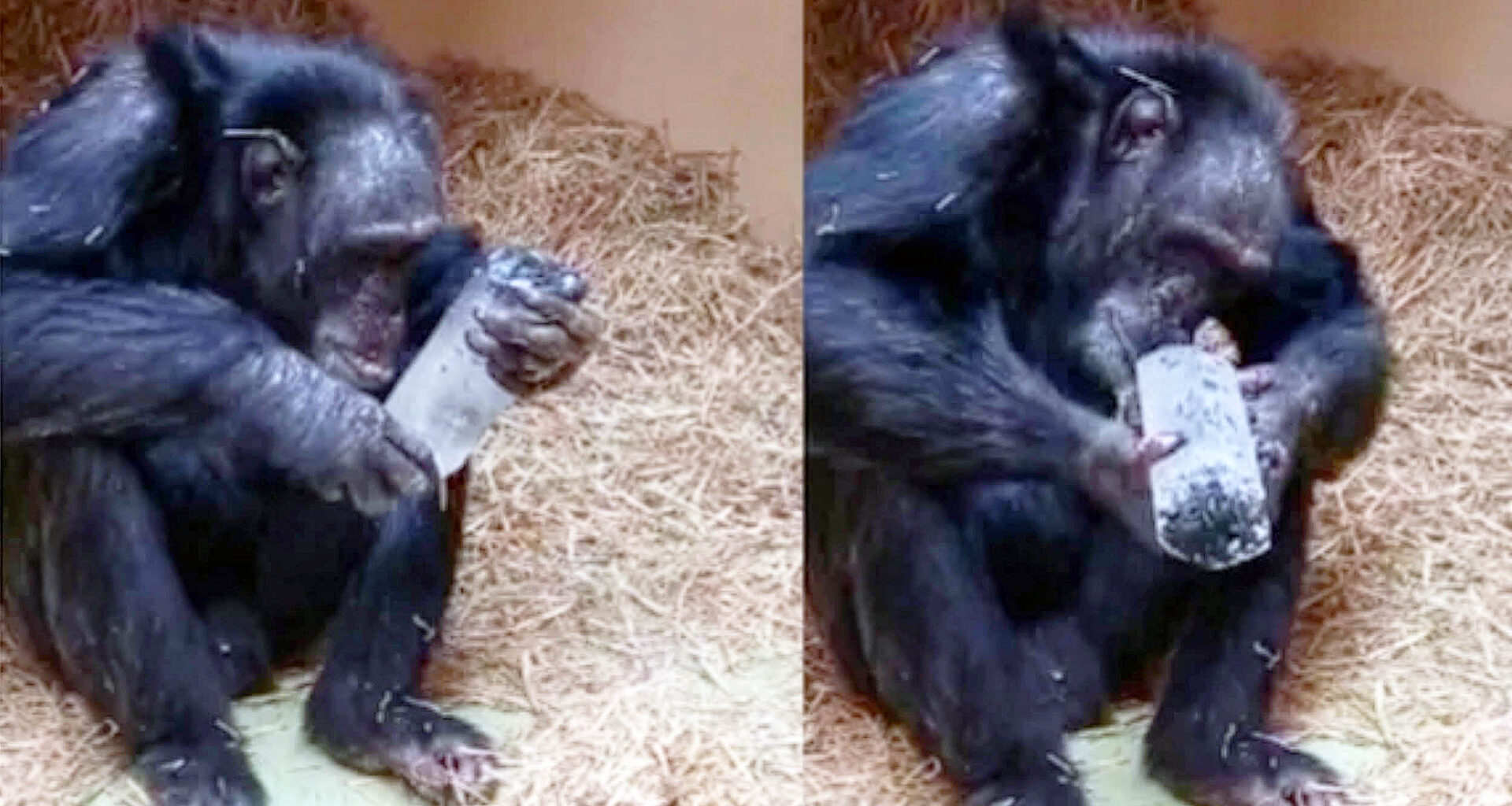
Scientists have discovered that chimpanzees consistently choose crystals over ordinary rocks, selecting and closely inspecting them when both lie within easy reach.
That attraction mirrors a behavior documented in human ancestors who collected similar stones long before they had any known practical use.

On matching pedestals near Madrid, a 14-inch clear crystal stood beside an ordinary rock of similar size.
Watching the animals interact, Professor Juan Manuel García-Ruiz of the Donostia International Physics Center (DIPC) documented that the chimps focused their attention on the crystal while quickly abandoning the rock.
Handling continued long after the first inspection, with several individuals lifting the crystal, turning it in their hands, and carrying it into their sleeping quarters.
The chimpanzees seemed drawn to qualities in the crystal itself, raising the question of which features captured the animals’ attention.
Hours of careful inspection
Close handling mattered as much as selection, and the researchers noted long stretches of staring and grip changes.
Holding a crystal at eye level let light pass through, making inner lines and sharp faces easier to compare.
“The chimpanzees began to study the crystals’ transparency with extreme curiosity, holding them up to eye level and looking through them,” García-Ruiz said.
Hours of quiet inspection made the crystal more than a toy, and it set a pattern worth testing again.
Chimpanzees quickly sort crystals
Later, smaller crystals entered the yard mixed into rounded pebbles that looked dull and ordinary.
Within seconds, chimps pulled crystal pieces from a pile of 20, even when several crystal shapes appeared together.
A chimpanzee named Sandy carried pebbles and crystals in her mouth to a wooden platform where she separated them
“She separated the three crystal types, which themselves differed in transparency, symmetry, and luster, from all the pebbles,” García-Ruiz said.
Such quick sorting suggested a rule in the chimp’s mind instead of a random grab for bright objects.
Links to human behavior
Across both experiments, the DIPC team found that transparency and shape guided the chimps’ attention as their choices were tracked over time.
Allowing light to pass through a crystal creates crisp edges and reflections, cues that encourage slow inspection and turning it in the hands.
Flat faces and straight lines also stand out in forests and savannas where most natural objects curve or branch.
Interpreted as a response to surfaces and transparency, the chimps’ preference links to older human behavior without suggesting identical motives.
Why crystals stand out
Unlike most stones, a crystal can grow with repeated faces, giving it a tidy geometry that rocks rarely show.
Scientists describe this structure as polyhedral, meaning it has many flat faces and sharp edges that form naturally without human shaping.
In early human landscapes, trees, clouds, and animal bodies offered curves and branches, so crisp angles looked unusual.
If crystals trained attention toward straight patterns, they might have nudged how minds learned to sort and compare forms.
 Chimpanzee named Toti attentively observes the quartz crystal during Experiment 1. Credit: García-Ruiz et al., 2026. Click image to enlarge.Early humans and crystals
Long before jewelry, people still carried crystals home, leaving them in shelters alongside bones, ash, and tools.
Archaeologists describe those collectors as hominins, our close human relatives in the ape family, across sites spanning 780,000 years.
A paper published in 2021 described crystals at a rockshelter in South Africa’s Kalahari from 105,000 years ago.
Because the nearest known source lay away from the rockshelter, the crystals look like chosen objects, not cave debris.
No scrape marks or drilling holes explained why people saved crystals, so practical work did not drive the effort.
Chimps that are influenced by humans
Human-raised chimps can be enculturated, shaped by daily contact with people and objects, in ways that wild apes are not.
Nine adults in two groups carried the crystal, mouthed smaller stones, and kept returning even after the novelty faded.
“Some may find the transparency of crystals fascinating, while others are interested in their smell and whether they’re edible,” noted García-Ruiz.
Wild tests will matter, because the same crystal cues might compete with food, rivals, and predators in natural life.
Wild chimpanzees and crystals
Future work at DIPC can track which individuals guard crystals, share them, or abandon them, instead of treating groups as one mind.
Testing bonobos and gorillas could show whether crystal interest sits across great apes or stays specific to chimp life.
Comparing wild and sanctuary groups would also separate learned curiosity from a deeper bias toward straight edges.
Seen across chimps and archaeological sites, crystals look like objects that pull attention even when they do nothing.
Better evidence from wild apes could show whether that pull reflects shared instincts or a human-trained habit.
The study is published in the journal Frontiers in Psychology.
—–
Like what you read? Subscribe to our newsletter for engaging articles, exclusive content, and the latest updates.
Check us out on EarthSnap, a free app brought to you by Eric Ralls and Earth.com.
—–