
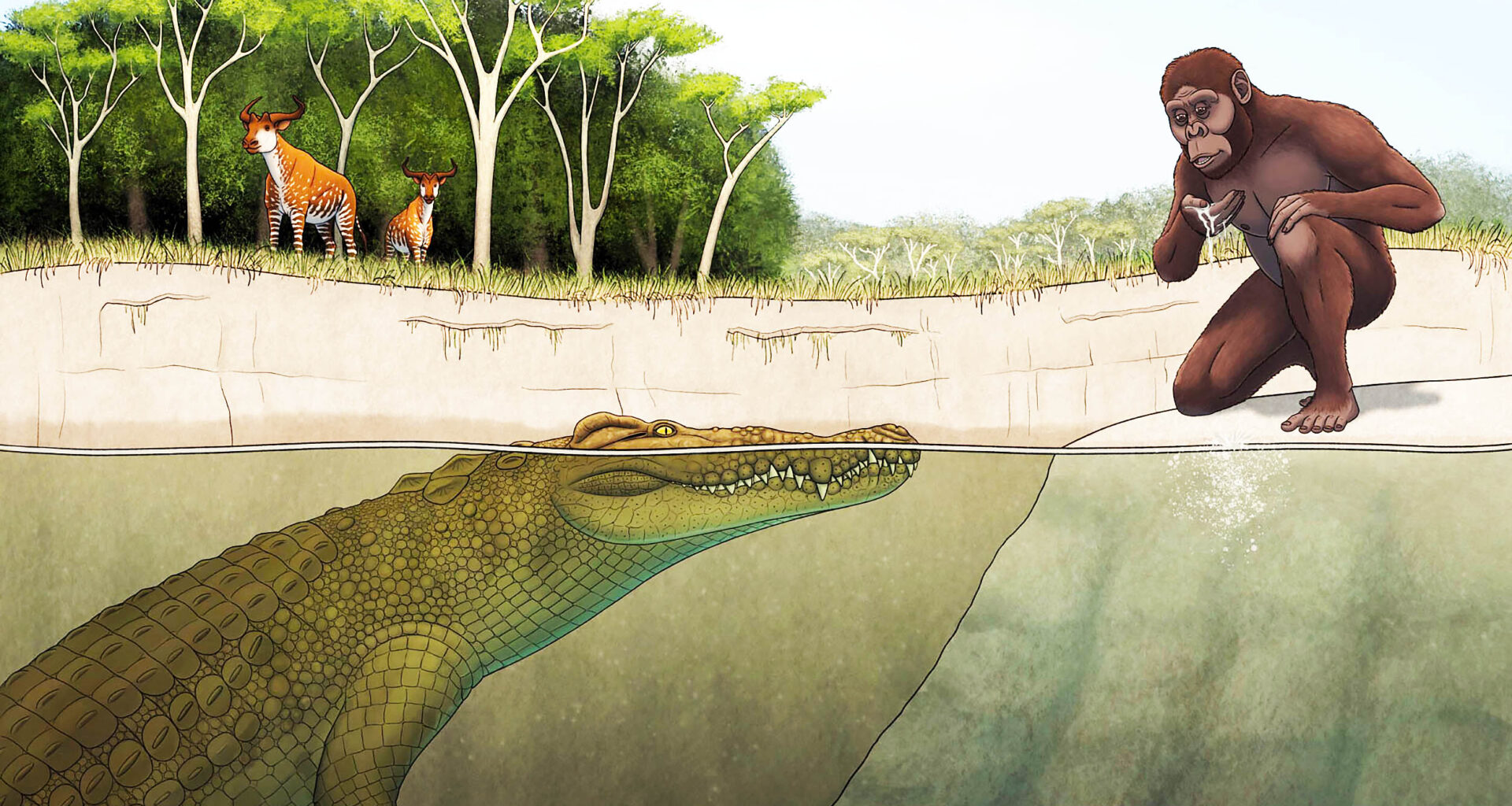
More than three million years ago, the world looked very different from today. Early human relatives walked across the African landscape in search of food and water. Rivers and lakes were important places for survival. However, those same waters could hide a deadly danger.
Scientists have discovered an ancient crocodile that may have hunted early humans such as Lucy’s species.

A research team led by the University of Iowa recently identified the crocodile as a previously unknown species.
The reptile was named Crocodylus lucivenator, meaning “Lucy’s hunter.” The name references Lucy, one of the most famous early human ancestors ever discovered.
Crocodylus lucivenator lived with Lucy
Lucy lived about 3.2 million years ago and belonged to the species Australopithecus afarensis. Scientists discovered Lucy’s skeleton in Ethiopia in 1974.
The discovery became one of the most important finds in human evolution. Lucy showed that early human relatives learned to walk on two legs long before the human brain became larger.
The newly named crocodile lived during almost the same period. Scientists estimate that Crocodylus lucivenator lived between about 3.4 million and 3 million years ago.
This means that Lucy and the crocodile likely lived in the same region of Ethiopia at the same time.
Crocodylus lucivenator was enormous. Adults could grow between 12 and 15 feet long. Some weighed between 600 and 1,300 pounds. This size made the reptile the most powerful predator in the environment.
The most dangerous predator
The region around Hadar in Ethiopia once contained rivers, wetlands, and shrubland. Trees grew along the riverbanks. Many animals came to these areas to drink water.
Such places were perfect hunting spots for crocodiles. Crocodylus lucivenator likely waited quietly in the water. When an animal approached the riverbank, the crocodile could attack quickly.
“It was the largest predator in that ecosystem, more so than lions and hyenas, and the biggest threat to our ancestors who lived there during that time,” said study co-author Christopher Brochu.
“It’s a near certainty this crocodile would have hunted Lucy’s species. Whether a particular crocodile tried to grab Lucy, we’ll never know, but it would have seen Lucy’s kind and thought, ‘Dinner.’”
A surprising discovery in a museum
Brochu has studied ancient crocodiles for more than 35 years. In 2016, he visited the National Museum of Ethiopia in Addis Ababa. During this visit, Brochu examined several fossil specimens.
One specimen immediately stood out. “I was just blown away because it had this really weird combination of character states,” said Brochu.
The crocodile had an unusual feature. A large hump sat in the middle of the snout. Modern American crocodiles show a similar feature, but Nile crocodiles in Africa do not.
Scientists believe this hump may have helped male crocodiles attract females. A male crocodile could lower the head slightly to display the hump.
“You see this in some modern crocodiles. The male will lower his head down a little bit to a female to show it off,” noted Brochu.
Crocodylus lucivenator fossils
To understand Crocodylus lucivenator better, researchers studied 121 fossil remains from the Hadar site in Ethiopia’s Afar region. The fossils included skulls, teeth, and jaw fragments.
Hadar is famous for discoveries connected to human evolution. Lucy was discovered at this site. Because of its importance, UNESCO named the area a World Heritage site in 1980.
Most of the fossils were small fragments. Scientists used these pieces to reconstruct the crocodile’s appearance.
One fossil provided an interesting clue about the animal’s life. The jaw showed several partially healed injuries.
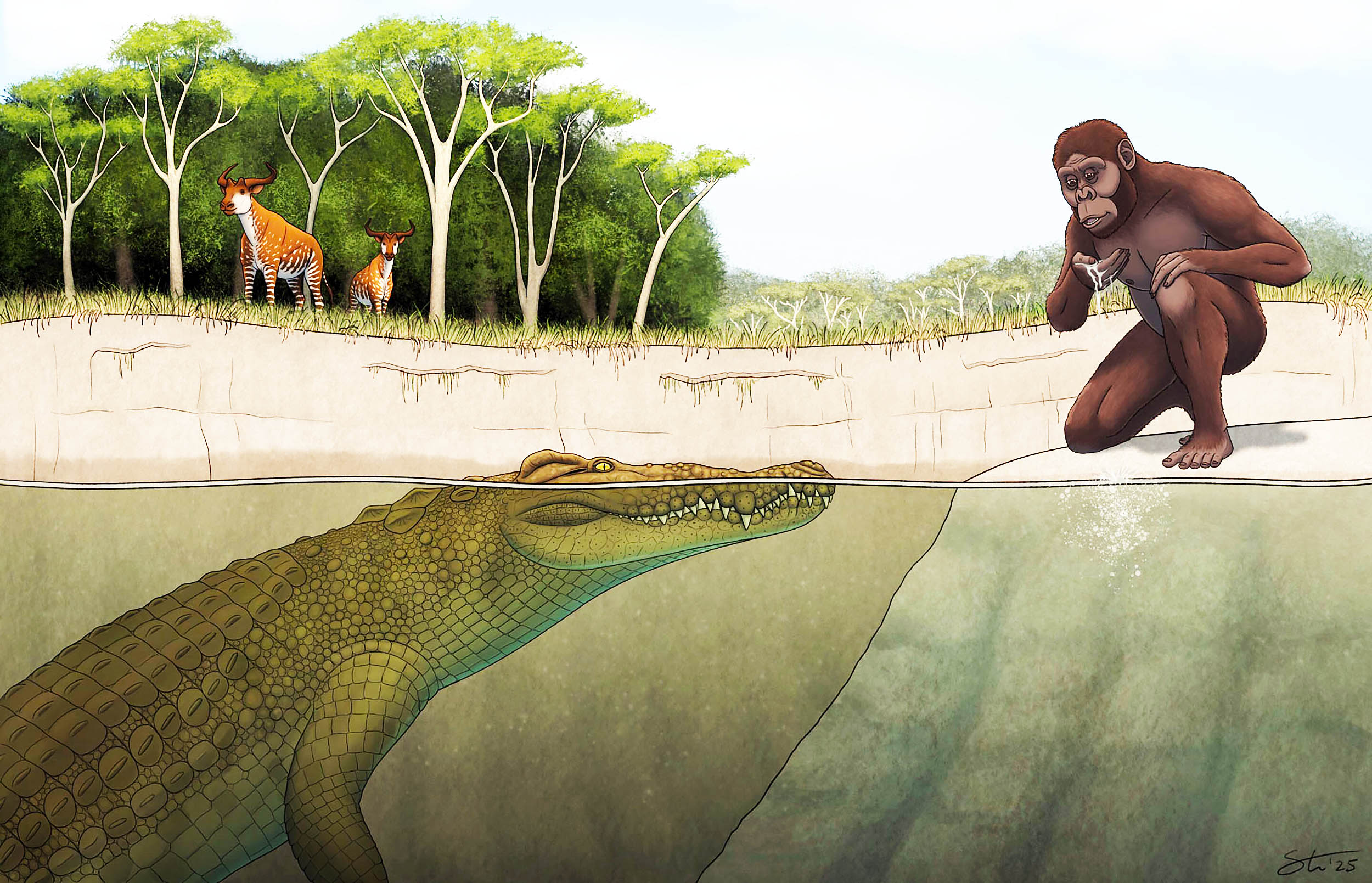 Researchers led by the University of Iowa have described and named a new crocodile species that roamed a region in Africa more than 3 million years ago. The species is named Lucy’s hunter, because it overlapped with the famed Lucy and her hominin kin and would have hunted them. Credit: Tyler Stone, University of Iowa. Click image to enlarge.Evidence of crocodile battles
The healed injuries suggest that the crocodile once fought another crocodile. Stephanie Drumheller from the University of Tennessee studied the fossil and explained what these marks might mean.
“The fossil record preserves similar injuries in extinct groups as well, so this kind of face-biting behavior can be found throughout the crocodile family tree,” said Drumheller.
“We can’t know which combatant came out on top of that fight, but the healing tells us that, winner or loser, this animal survived the encounter.”
Modern crocodiles also show similar behavior. Males often fight each other when competing for territory or mates.
Crocodylus lucivenator ruled its territory
Several crocodile species lived nearby in the Eastern Rift Valley during the same period. However, Crocodylus lucivenator appears to have dominated the Hadar region.
“During the Pliocene, Hadar was composed of a variety of habitats alongside its lake and river systems over space and time, including open and closed woodlands, gallery forests, wet grasslands, and shrublands,” noted Christopher Campisano, associate professor at Arizona State University.
“Interestingly, this crocodile was one of only a few species that was able to persist throughout.”
This discovery gives scientists a clearer picture of the world where Lucy lived. Early humans shared the landscape with many animals. Rivers provided water and life, but also hid powerful predators waiting beneath the surface.
The study is published in the Journal of Systematic Palaeontology.
—–
Like what you read? Subscribe to our newsletter for engaging articles, exclusive content, and the latest updates.
Check us out on EarthSnap, a free app brought to you by Eric Ralls and Earth.com.
—–