
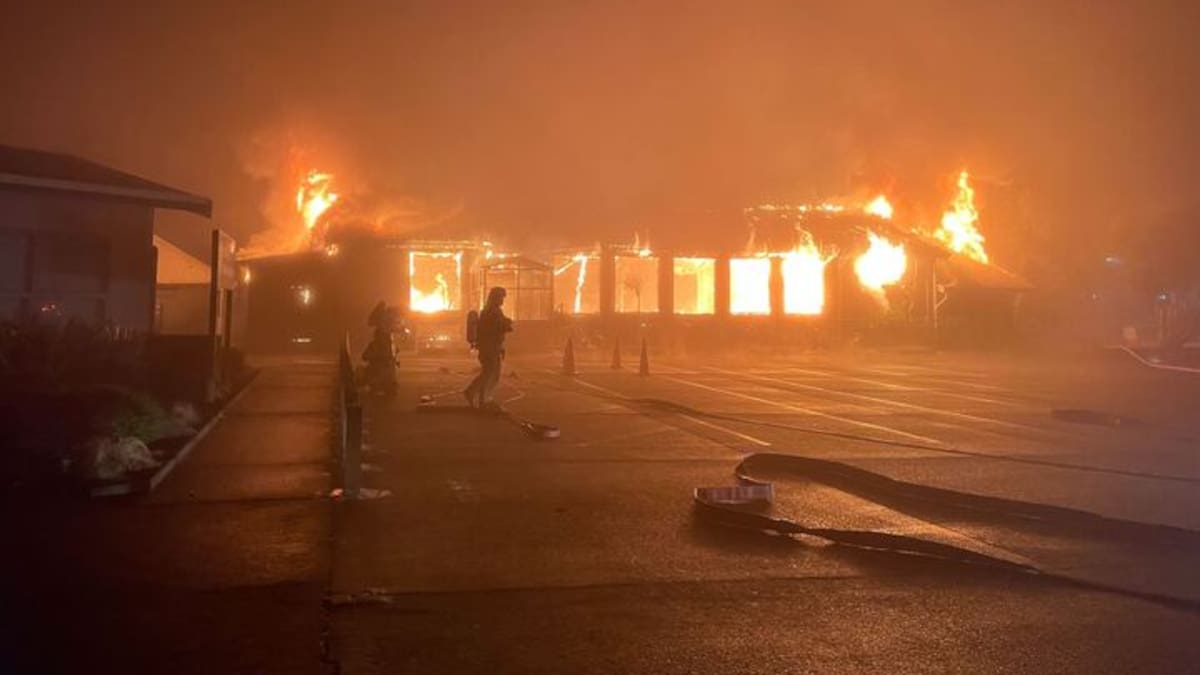
“Not only have they lost their friendship base but they can’t understand why the church isn’t being rebuilt at a quicker rate. People’s memory of it is charred embers and wood … burning in the early hours of the morning.”
After psychological assessments while in remand at the Mason Clinic, Katoa was deemed not guilty by reason of insanity.
Judge Claire Ryan oversaw a disposition hearing on Thursday to determine Katoa’s ongoing detainment and treatment.
The court heard that psychiatrist Dr Ian Goodwin had assessed Katoa as having undiagnosed schizophrenia which he had been “labouring with” for many years before the St Mary’s Church fire.
A report from Goodwin outlined that on the night of his offending Katoa was “acutely psychotic”.
He had been receiving auditory hallucinations for about three years before the offending.
“He believed God had to be punished for humiliating his father and he believed the church needed to burn down to do that,” Judge Ryan read in court today. Katoa’s psychotic state led him to “target a church to teach God a lesson”.
Firefighters at the blaze at St Mary’s Catholic Church on Great North Road in Avondale.
Photo / Hayden Woodward
However, it was noted that “even when delusional he was thinking of others” because Katoa intentionally chose to light the fire at night when it would be safer with no people around.
Judge Ryan outlined that his family said there had been an increase in the consumption of alcohol prior to the arson. Katoa said in the past he had problems with alcohol, but denied any involvement of alcohol in the arson.
“He did use alcohol in the four to five weeks leading up to the alleged offending, and according to his family he became more aggressive in verbalising his psychotic ideas,” Ryan said.
Police were called to Katoa’s home, where he lived with his parents, four times in the month before the fire at St Mary’s.
Katoa also has a criminal history, including: disorderly behaviour, wilful damage, driving a motor vehicle in a dangerous manner, excessive breath alcohol, possession of an offensive weapon, intentional damage, aggravated robbery, failing to stop for police lights, speaking threateningly, and being unlawfully in a building.
But he has not reoffended since 2008 – when he was convicted and discharged.
There was no further offending until last year with the arson, which Judge Ryan noted was “a considerable period of time”.
Goodwin reported that since being detained at the Mason Clinic, Katoa has been making “great progress” from his anti-psychotic medication and judged his risk of reoffending as low.
“Now that Mr Katoa has been treated he is very aware of what he’s done, he’s very remorseful for it and has a great deal of grief for the community,” Goodwin said.
Goodwin said Katoa no longer believed that God had been humiliating or speaking to him.
“He is so ashamed that he does not think he can ever attend the church again.”
Judge Ryan detailed that Katoa left school at 16 and had worked at various labouring jobs, but had been unemployed for most of the last 15 years.
The fire gutted the Avondale church. Photo / Andrew Matthew.
He lived at home with his parents and would like to return there to live.
In determining Katoa’s future management, Judge Ryan decided to implement section 25 1.a of the Mentally Impaired Persons Act (2003) – which is an alternative available if the defendant is unfit to stand trial or insane.
This ordered that the defendant be treated as a patient under the Mental Health (Compulsory Assessment and Treatment) Act 1992. Ryan said she was satisfied by the low risk outlined by Goodwin.
In practicality, this means Katoa will continue to be treated at the Mason Clinic until the treating clinicians decide he is ready to be released for community treatment. If this takes longer than six months, it will need to be reassessed by a judge.
“I cannot bind the treating clinician but I point out it is very important that Mr Katoa stays as an inpatient until there is wraparound support … I simply state when he’s put in community, that appropriate accommodation is arranged.”
Both Katoa’s defence lawyer Alexander Zhao and the lawyer representing the Crown, Ryan Benic, supported this decision.
Addressing Katoa, Judge Ryan said: “you need to be patient. You have been on a very long journey and a good journey. You have responded really well to treatment… there is a great deal of hope you will be able to return to your family”.
“Schizophrenia is just another condition … I’m sure your family is very proud of the steps you have taken.
“People in this country are very forgiving if they know what suffering others are undergoing.”
Priest’s prayer the night of the blaze
The aftermath of the fire that destroyed St Mary’s Catholic Church on Great North Rd, Auckland.
Photo / Michael Craig
Father Andrew Matthew said he awoke at 4am on July 14 to the sound of the windows popping.
“When I looked out the window, all I could see was a sea of red flames. It’s a real shock.”
Matthew rang 111 as he walked out into the church carpark.
“Our poor church was on fire. All I could do was watch and pray.”
Even at that stage, Matthew could see the church was lost.
Parishioners hugged and cried in front of the smouldering wreckage in the late morning.
Auckland Catholic Diocese general manager James van Schie, who was also at the church in the hours after the fire, said the parish was established in 1921 and the church was built in the late 1950s.
“For over 100 years, it’s been a vital part of the fabric of the Avondale community,” he said.
“There are so many Aucklanders who trace their family history here; baptisms, funerals, weddings. It is a vibrant parish.”
Fire and Emergency assistant commander Phil Larcomb said the brick St Mary’s Catholic Church, in front of St Mary’s School, was on fire and had been “severely damaged” when they got there at 4am.
At the fire’s peak, eight fire trucks were on the scene.
The brick St Mary’s Catholic Church was in front of St Mary’s School.
Photo / Michael Craig