
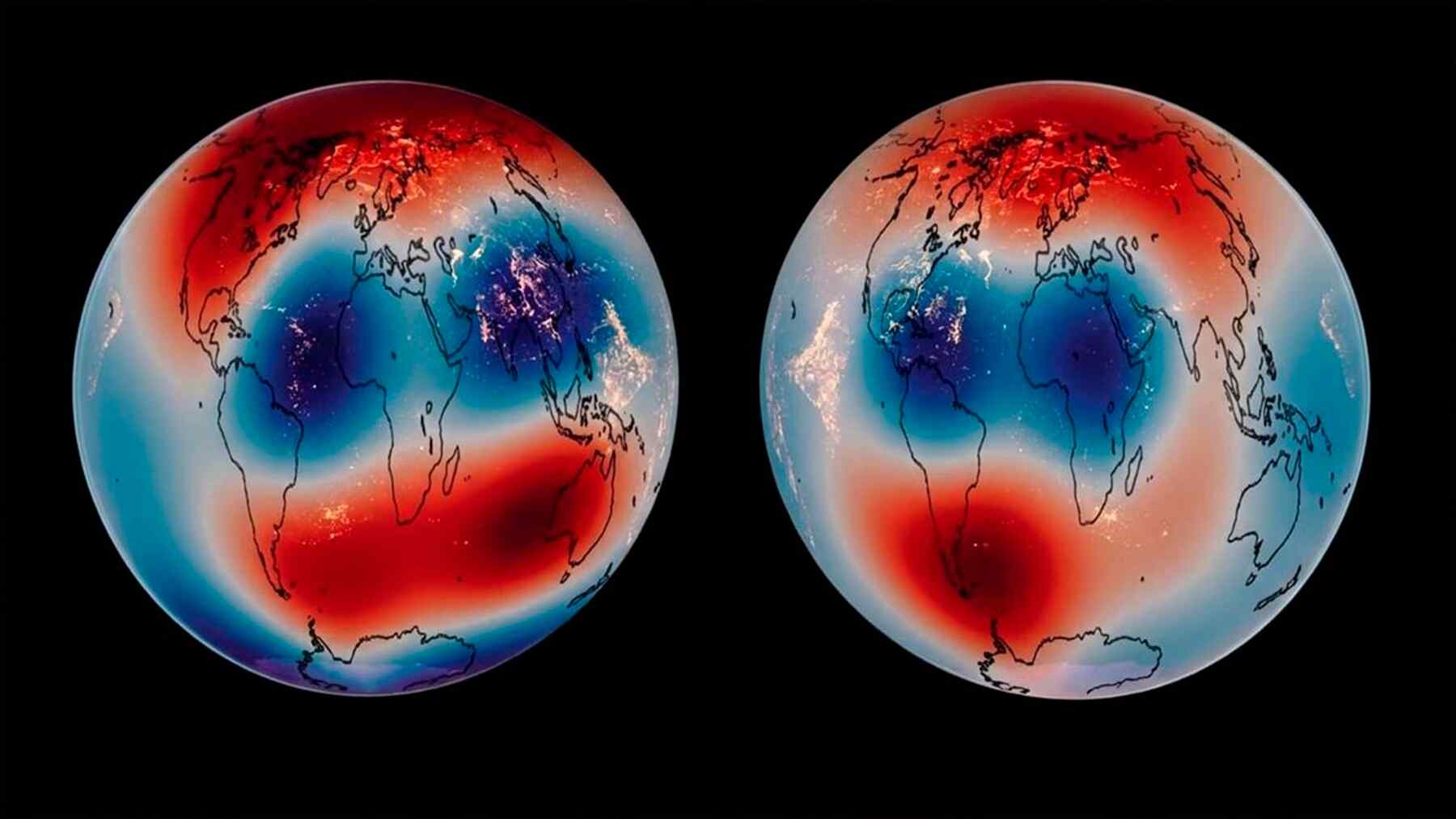
A strange and unexplained anomaly in the Earth’s magnetic field has been discovered.
Science regularly makes findings that reshape our collective set of knowledge as to how and why the planet behaves as it does. And as we search the deepest crevices of the Earth, fresh discoveries are being made that play a significant role in advancing our understanding of our one and only home.
How can there be two continent-sized structures right beneath our feet?
How studying the Earth has reshaped science, all for the better
By studying our planet, we have reshaped science from a collection of isolated information sets into a “system of systems,” as we now know that everything is connected.
Scientists have found that early organisms not only adapted to our atmosphere, but they actually created it as they produced the first oxygen before plant life.
By diving deep into the Earth’s core, we now understand that under enough pressure, even peanut butter can be transformed into diamonds. That builds on other new findings that point out that our magnetic north pole is not in fact fixed and is always in motion, sprinting from one point to another.
Modern science isn’t just evolving, it’s taking off
Scientific progress made has reshaped the world. Experts can now simply glance at a hill or coastline and easily explain millions of years of history.
Diving deep into the core of our planet has revealed an unknown world of mysteries, such as a recent mission that found over 100 new living species in the ocean when searching for minerals.
Another significant study conducted by the University of Liverpool may have lifted the veil on a long-held belief regarding the magnetic field of our planet.
The Earth is still a mystery to science. From “uphill rivers” to the unexplained mysteries of the deepest parts of our ocean, we have so much more exploring to do to deepen our knowledge of Earth science.
So, how are the two giant continent-sized rocks under the surface affecting our understanding of the planet’s magnetic field? The team from the University of Liverpool has provided a few answers.
A Liverpool discovery that would make the Beatles proud
A research study reveals that two huge hot blobs of rock influence Earth’s magnetic field, published by the University of Liverpool has revealed two huge continent-sized rocks that are dramatically affecting our planet.
The “blobs” have been found 1801 miles under the surface and reveal that our planet’s magnetic field is constantly shifting.
The continent-sized rock structures sit at the base of the Earth’s mantle and create extreme temperatures that see the liquid iron stagnating instead of flowing like the rivers that they are.
Digging up the Earth can lead to a new world of scientific discoveries that reshape our collective mindset.
The team combined magnetic records produced over the past few decades with computer simulations to find that these “hot blobs” have been affecting the Earth’s magnetic field for over 260 million years.
Why this discovery matters to science, and to us all as a species
Due to the findings of the study, scientists have now rewritten how Earth’s magnetic field behaves.
We now know that the assumption that the magnetic field is, in fact, not perfect and fixed in place. The study finds that these two continent-sized extremely hot rock structures have dramatically influenced the magnetic field of the planet over millions of years.
The findings will have far-reaching implications regarding ancient continental shifts, prehistoric climates, and even the possible location of natural resources.
The final frontier of Earth exploration has revealed that our magnetic field is influenced by huge, naturally occurring formations near the planet’s mantle, reshaping the history of science in the process.