America’s Cup: Kiwis put in a long day off Takapuna
by Richard Gladwell/Sail-World NZ 16 Mar 05:11 PDT
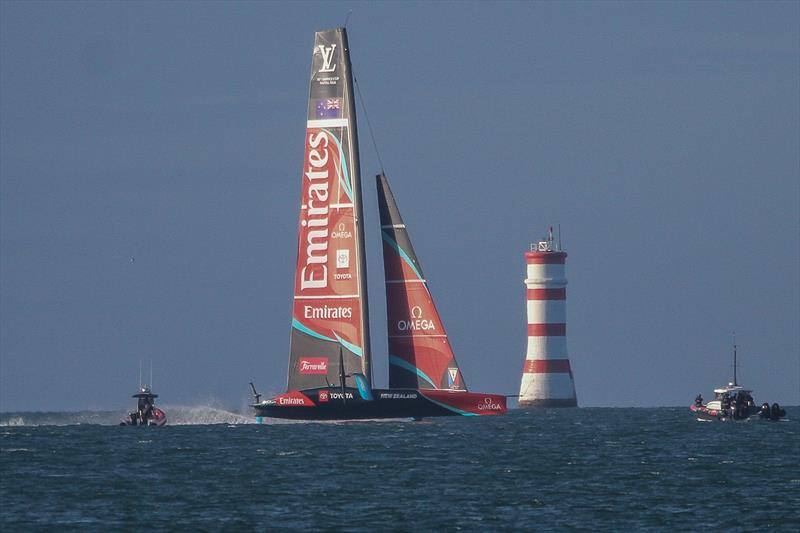
America’s Cup Recon, Emirates Team New Zealand, Taihoro, AC75, Day 2 – March 16, 2026 © Richard Gladwell – Sail-World.com/nz

Emirates Team New Zealand put in a long day on the inner Hauraki Gulf for the second of their allowed 45 sailing days in the AC75.
The team set up off Takapuna Beach, sailing in the area known as “Course A” during the last America’s Cup held in New Zealand.
In contrast to the fresh conditions of the weekend, there was no wind in the morning. In fact, it was only in the early afternoon when the first zephyrs of an advancing SW (offshore) breeze ventured across the course.
The AC75 was still in her Barcelona 2024 configuration, with the 2024 wing foils, which are heavier, but with two fewer crew (five sailors plus the observer), and whatever the weight difference is from replacing the cyclor power with battery power, plus the weight of additional batteries.
Initially, the AC75 was unable to self-foil in the lighter wind and was towed up onto its foils by the chaseboat.
The SSW breeze settled in by 1400hrs, and the AC75 began the standard routine of windward-leewards and some reaching, with the crew gaining confidence as the day progressed.
The information from the NZ-based Recon Team, who followed the session, is not posted until 1330hrs UTC (1430hrs NZDT) by the European-based America’s Cup Partnership, so it is not known who was sailing and in what position. No doubt the commentary from the post-session interviews will be very positive, and deservedly so – assuming the AC75 was being sailed manually and not on autopilot.
No major handling snafus or nosedives were observed, which is a little surprising, and maybe too perfect.
Every sailing day counts with the restrictions on the number of sailing days allowed in this America’s Cup cycle (portrayed as a cost limitation measure). The Kiwis are restricted to just 45 days until mid-January 2027. Other teams are allowed bonus time depending on where they finished in the 2024 Cup regattas.
Under this regime, every day counts. So it was no surprise to see the session continue until 1830hrs, or about a five-hour session depending on whether tow-ups are included in the duration calculation. Either way, it was a long night for the shore crew to pack the AC75 away and remedy any issues before the next sailing day.
By the end of the session, the AC75 was being put through quite aggressive manoeuvres as the breeze averaged 15 kts, gusting a few kts higher. The crew, most of whom are still on just their second day of sailing in the AC75, outwardly looked to be back to where the team was pre-Barcelona, which is great for building confidence and momentum. But today’s conditions were ideal for AC75 sailing.
There were several stoppages, none of which appeared to be due to gear breakage, but most likely due to commissioning/setup issues and crew swaps.
After multiple battery-related incidents at the F1 Grand Prix in Shanghai over the weekend, it will be interesting to see how much power the AC75 consumes before it needs to be recharged. The AC75s have an even more extreme power approach than the hybrid F1. Without any backup human power allowed, there’s no fallback position in the AC75s, unless the battery banks are split.
The AC75 battery setup is designed to mimic the power available under the former cyclor setup for the 2024 Cup. Hopefully, today’s stoppages were not battery-related.
Power usage will be one aspect of today’s performance that will have been monitored in real time by the data analysts and design team at the team base in downtown Auckland.
It is expected that the Kiwi team will maintain the current level of intensity, with just three weeks left until Daylight Saving Time comes off in New Zealand, which is a few days before the SailGP sailors in the America’s Cup sailing squad head for the fourth event in Rio de Janeiro. After that, the focus will shift to the AC40, with the New Zealand team putting up two crews for the first and only AC40 regatta of 2027 at the end of May in Naples.
With daylight saving time off, sessions of today’s duration will not be possible without navigation lights.
Today’s exercise also looked like a data-gathering and check-in process, comparing the 2024 performance data with the new data and verifying it against the output from the projections of the repurposed AC75.
It is expected that some gear development will be undertaken after Rio, with legacy wings trimmed down to the new weight, and with performance data again checked against what was seen today and in subsequent sessions.
Light to moderate winds are forecast for the rest of the week.