
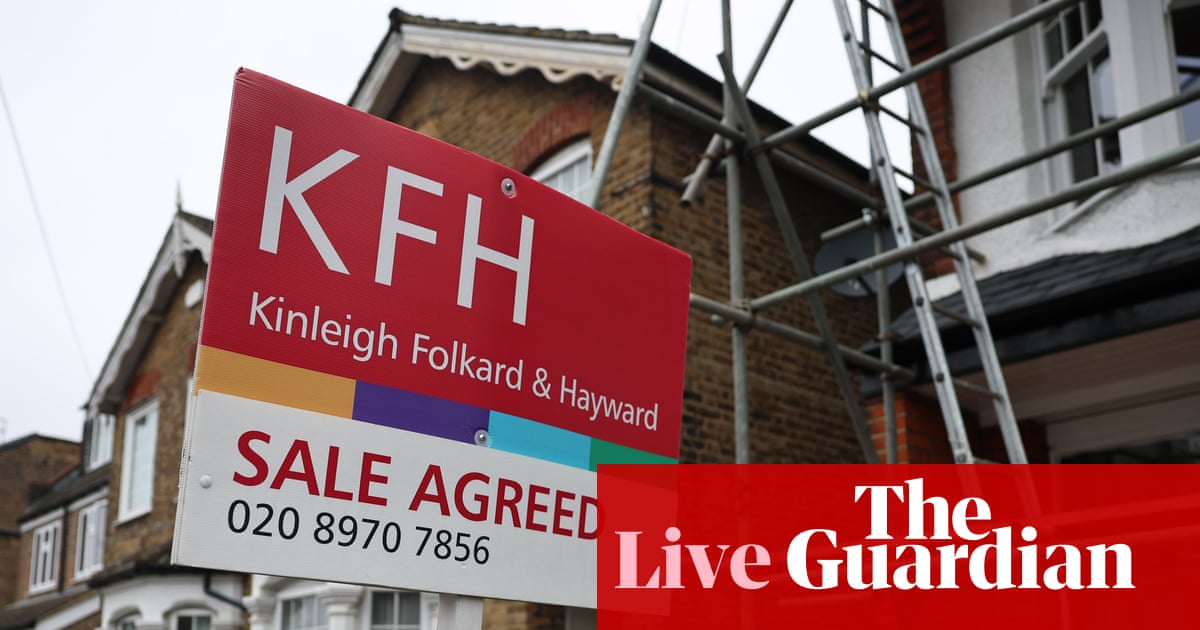
UK mortgage rates jump again
Oof! Average UK mortgage rates have jumped this morning.
Data provider Moneyfacts has reported that the average 2-year fixed residential mortgage rate has risen to 5.20% today, up from 5.10% on Friday. It was just 4.84% on the eve of the US-Israeli war on Iran last month.
The average 5-year fixed residential mortgage rate today is 5.25%, up from 5.19%.
That reflects rising expectations in the City that the Bank of England will not cut interest rates this year, and is likely to raise from back to 4% (from 3.75%) today by summer 2027.
[although, as flagged earlier, Goldman Sachs still expect two rates cuts this year].
Moneyfacts also shows a drop in the number of residential mortgages on the market – down to 6,972 today, from 7,106 at the end of last week.
Key events
Show key events only
Please turn on JavaScript to use this feature
Closing summary
Time for a recap.
Fears of a “Trumpflation” hit to UK households from the Iran war are rising.
ShareUK petrol and diesel prices up again
The cost of petrol and diesel has risen again today, as retailers continue to raise prices at the pumps.
The RAC reports that the average price of a litre of petrol has risen to 141.74p, a rise of around 30p today. Diesel is up 60p to 161.20p a litre.
Last week, chancellor Rachel Reeves asked the competition watchdog, the Competition and Markets Authority (CMA), to “crack down” on “rip off” fuel prices.
But despite that intervention, the RAC suspects further price rises are probably around the corner.
RAC head of policy Simon Williams said:
double quotation mark“Drivers with diesel cars are really feeling the heat with the average price at the pump climbing above 161p a litre for the first time since early November 2023. Prices have shot up 19p a litre in just over two weeks, adding over £10 to the cost of a full tank. The average cost of filling up a 55-litre family car with diesel is now £88, whereas for petrol it’s £78.
“RAC analysis of wholesale fuel data shows that petrol is now likely to rise in the next week or so by another 3p to an average of 145p a litre and diesel by 9p to 170p.”
ShareOil price falls as Bessent says US is letting Iran ship oil
The oil price is falling after US Treasury Secretary Scott Bessent told CNBC that the US is allowing Iran to continue to ship its oil via the strait of Hormuz.
In an interview with CNBC, Bessent indicated that the White House was “fine” that some Iranian, Indian and Chinese ships were going through the strait.
Bessent said:
double quotation mark“We are seeing more and more of the fuel ships start to go through. The Iranian ships have been getting out already, and we’ve let that happen to supply the rest of the world. We’ve seen Indian ships go out now … we believe some Chinese ships have gone out.”
“That should start ramping up before there are any of the flotillas or protective armadas in the Gulf. So we think that there will be a natural opening that the Iranians are letting out. And for now, we’re fine with that. We want the world to be well supplied.
This appears to be easing the pressure on the oil price. US crude is down 3.7% today at $95.05 a barrel, while Brent crude is 1.2% lower at $101.86.
Over the weekend, Iran’s foreign minister Abbas Araghchi insisted the strait was not closed, except to the ships of Iran’s “enemies and those who support them.”
UK government borrowing costs are dropping, which should cheer chancellor Rachel Reeves.
With bond prices rising, the yield (or interest rate) on two-year, 10-year and 30-year UK bonds are all dropping.
The benchmark 10-year gilt yield is down 8 basis points (0.08 percentage points) to 4.73%, as the drop in the oil price today soothes some concerns about inflation.
Updated at 10.36 EDT
Ths dip in oil prices today is supporting stocks, reports Joe Mazzola, head trading & derivatives strategist at Charles Schwab:
double quotation mark“After a third straight weekly drop pushed the S&P 500 Index to nearly four-month lows, investors face several central bank meetings, an Nvidia (NVDA) conference, and earnings from chip giant Micron (MU) in coming days. So naturally, Wall Street focused this morning on crude oil prices and the war in the Middle East.
Stocks edged up early as crude slipped, though investors might want to remember that recent rallies often faded.”
ShareOil now falling
Happy news in the fight against Trumpflation – the oil price is dropping.
Brent crude, the international benchmark, is now down 2.2% this session at $100.87 a barrel.
US crude is dropping faster; down 4.7% today at $94 a barrel.
This follows the resumption of some oil loading at the UAE’s port of Fujairah today after a damaging drone attack.
ShareThe New York Stock Exchange in lower Manhattan. Photograph: Spencer Platt/Getty Images
Wall Street’s main indexes have opened higher at the start of the new week, despite the ongoing conflict in the Middle East.
The Dow Jones Industrial Average has gained 329 points, or 0.7%, in early trading to reach 46,887 points. Tech stocks are rallying, with Nvidia up 2.3% and Salesforce rising by 2.2%.
The broader S&P 500 index is up 1%.
The body that advises the world’s central banks has urged policymakers not to overreact to the Iran crisis-driven spike in global energy prices.
The Bank for International Settlements (BIS), which is known as the “bank for central banks”, said the current surge in oil and gas prices was a textbook case of when to “look through” a shock.
In its latest report, BIS urged central bankers to show caution.
BIS economic advisor, Hyun Song Shin, explained:
double quotation mark“If it’s a supply shock, and certainly if it’s a temporary one, these are the textbook examples where you should look through and not react with monetary policy.”
Trumpflation is being driven by the oil price, which has surged since the Iranian war began.
Brent crude oil has surged 42% while WTI (US crude) is 47% higher in the two weeks after the strikes, Deutche Bank point out in a research note today.
But apart from oil, and commodities, every other asset in their regular chart is down since the strikes began:
A chart showing asset price moves since the Iranian war began Photograph: Deutsche Bank
Deutsche Bank told clients:
On a relative basis, US assets have fared better, reflecting their more limited exposure to any oil shock as a net exporter. So, in total return terms the S&P 500 is down -4%, whereas the STOXX 600 is down -6% (and -9% in USD terms).
Sovereign bond yields have also spiked sharply. For US Treasuries, the 2yr and 10yr yield are each up +34bps. Meanwhile 2yr German yields are up +44bps, and the 10yr yield is up +34bps, closing at a post-2011 high of 2.98% on Friday.
Similarly for sovereign bonds, US Treasuries are down -2%, and Euro Sovereigns are down -6% in USD terms.
If we drill down into the different sectors, all the big sector groups in the S&P 500 have lost ground, with the clear exception of energy (+3.2% in total return terms).
Interestingly, tech has the strongest sectoral performance after energy, only down -1.2% since the strikes.
ShareTUC: more help needed to stave off ‘Trumpflation’
TUC General Secretary Paul Nowak has also welcomed Keir Starmer’s announcement of £53m of support for households who use heating oil, but warned that more help will be needed to protect the UK from ‘Trumpflation’:
double quotation mark“Working people are being hit with a Donald Trump-made cost of living crisis. It’s right that the Prime Minister has acted quickly to support those most acutely affected by rising energy prices.
“This illegal war and ongoing chaos will continue to threaten living standards. More support will likely be needed to stave off ‘Trumpflation’.
“The Prime Minister is right to call for rapid deescalation in the Middle East. The Government must stand ready to pull out all the stops and shield households and firms from this global shock.”
Updated at 08.21 EDT