
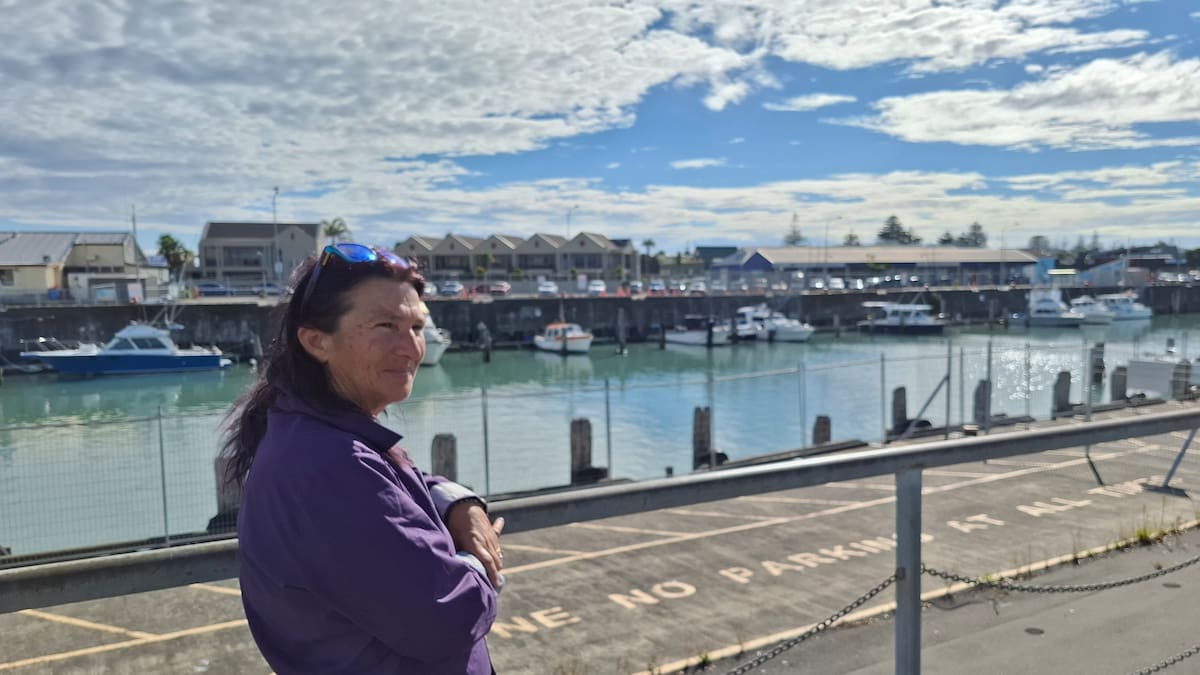
Since mid-February, the wharf has been off-limits to boaties.
About 12 boats have moved to different locations as a result, but 10 remain at the wharf with no access and nowhere to go.
Napier City Council met with impacted boat owners last Wednesday, at the nearby fishing club, and shared a potential solution.
The council is considering installing temporary floating pontoons in Iron Pot to create berths for the 10 boats.
Early plans for the temporary floating pontoons. Photo / Supplied
The solution needs final approval and, if approved, will take about four to six weeks to install.
Longer-term improvements in Iron Pot are being worked on.
Spice said it was a positive solution if the pontoon project went ahead.
However, she was disappointed by the lack of council maintenance on the wharf over the years, which has allowed matters to reach this point.
“To be banned from our boats, we can’t even get to them from water, it is really frustrating.”
Spice said boat owners could currently only access their boats with permission from the Harbour Master, and once on board you must move them elsewhere.
She said her family had nowhere else to take their boat and had not been given an alternative berth in the inner harbour.
Some boat owners have been offered alternative inner harbour spots, but the number of suitable spaces appeared to have dried up.
Fencing at Nelson Quay wharf at Ahuriri. Photo / Doug Laing.
Spice said some piers were also unsuitable because of weight-bearing issues.
She said the impacted boat owners had formed a collective, called the Ahuriri Inner Harbour Boat Association, and would like to see a sign-in and sign-out process introduced at the damaged wharf.
She said that would at least allow them to keep an eye on their boats – checking moorings, bilge pumps, starter motors, batteries and the like – while work on the pontoon project took place.
The council confirmed it had a marine engineer available to help carry out checks for impacted boat owners, in cases where the respective boat owner gave written permission.
Spice said the problem with that was liability if something happened while the engineer was on a private boat, and boat owners preferred inspecting their own vessels.
Spice and her husband pay more than $3000 a year in mooring fees, and the council said it will begin engaging with impacted boat owners about berthing fees.
A council spokeswoman said, in terms of restrictions at the wharf, it had a legal obligation to protect people’s safety, including boat owners and berth holders.
“This is the underpinning rationale for the full closure of Nelson Quay wharf, and unfortunately means vessel owners cannot currently access their boats directly.
“Council is working vessel-by-vessel with the Harbour Master on individual relocation plans, with no vessel movements undertaken without Harbour Master supervision.”
She acknowledged the situation was frustrating.
She said the council was considering a temporary solution, and assessing its costs, that would extend Jull Wharf with floating pontoons in Iron Pot.
The council will go ahead with the project unless the costing “returns a result that makes that option cost-prohibitive”, which the council believed was unlikely.
Boat owner Phil Pointon was based at Nelson Quay wharf but, after the closures, arranged to move his boat back to Jull Wharf.
That wharf is also damaged and he can only access his boat with a kayak or dinghy.
However, he said he was happy with the way the council was handling the overall situation.
He said, in his view, the big picture was avoiding risk to life.
“There is no grey area. They can’t put people’s lives at risk.”
He said the pontoon solution was positive.