

Track your investments for FREE with Simply Wall St, the portfolio command center trusted by over 7 million individual investors worldwide.
Oracle (NYSE:ORCL) expanded its Oracle Health Clinical AI Agent note generation across U.S. emergency and inpatient settings.
AtlantiCare completed a systemwide rollout, using the tool to support clinician documentation and emergency department workflows.
The deployment is showing measurable reductions in documentation time and changes in how clinicians manage patient notes.
The AI Agent is part of Oracle Health, targeting efficiency and care quality in high acuity hospital environments.
For you as an investor, this matters because Oracle Health is part of a broader cloud and enterprise software portfolio that often receives less attention than infrastructure contracts. Hospitals are under pressure to manage clinician burnout, capacity constraints and rising costs, which maintains demand for tools that save time at the bedside. Oracle, through NYSE:ORCL, is positioning this AI Agent as a practical product in that workflow, not just a pilot or proof of concept.
The AtlantiCare rollout gives Oracle a reference case in a complex care setting, which can be useful as it works with other health systems on similar deployments. It also highlights a path where AI features can help support Oracle Health’s installed base and may deepen customer relationships over time. For investors tracking Oracle, this illustrates one way AI is being applied in specific healthcare software use cases rather than remaining focused on the infrastructure layer alone.
Stay updated on the most important news stories for Oracle by adding it to your watchlist or portfolio. Alternatively, explore our Community to discover new perspectives on Oracle.
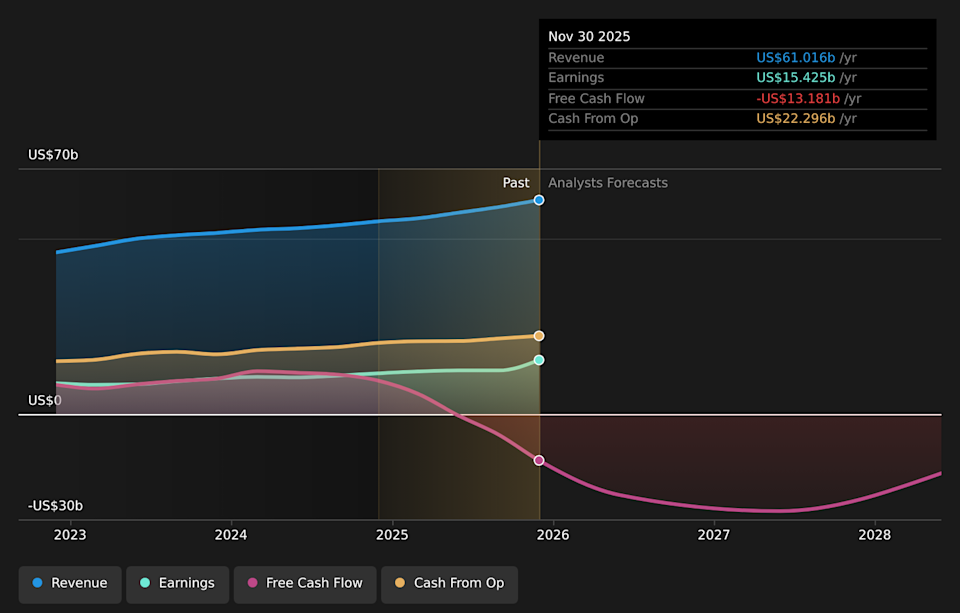 NYSE:ORCL Earnings & Revenue Growth as at Mar 2026
📰 Beyond the headline: 2 risks and 3 things going right for Oracle that every investor should see.
Oracle’s expansion of its Health Clinical AI Agent into U.S. emergency and inpatient settings gives you a clearer view of how its AI story extends beyond data centers into clinical workflows. The product is handling complex, multi event encounters, pulling in triage notes, lab and imaging results, and prior progress notes to produce draft documentation that clinicians can review and sign. AtlantiCare’s reported 41% reduction in documentation time in ambulatory care and broader rollout across emergency departments shows this is already being used at scale rather than sitting as a pilot. For investors, that matters because Oracle is using AI to deepen its footprint inside electronic health record systems, an area where it competes with players like Epic and MEDITECH while also differentiating from hyperscalers such as Microsoft, Amazon and Google that tend to focus more on infrastructure than bedside workflow tools.
The rollout supports the existing narrative that Oracle is trying to convert large AI investments into practical, sector specific products. This reinforces the idea that AI workloads are not just about training models but also about day to day usage in industries such as healthcare.
At the same time, this type of application level success does not directly address the narrative risk that a large portion of Oracle’s AI spending is tied to a few very large infrastructure contracts, where capital intensity and execution are key concerns.
The healthcare specific angle, including measurable clinician time savings and real time documentation support, is not fully covered in the broader AI infrastructure focused narrative, even though it could influence how sticky Oracle Health becomes for hospital customers.
Knowing what a company is worth starts with understanding its story. Check out one of the top narratives in the Simply Wall St Community for Oracle to help decide what it’s worth to you.
⚠️ Heavy AI infrastructure spending funded with significant debt means products like the Clinical AI Agent still sit against a backdrop of higher balance sheet and execution risk if large AI workloads do not scale as expected.
⚠️ Healthcare software buyers can be cautious about data privacy, clinical accuracy and regulatory compliance, so any issues with AI generated notes could slow adoption or create reputational risk for Oracle Health.
🎁 The reported 41% reduction in documentation time at AtlantiCare and more than 200,000 clinician hours saved across providers in just over a year show that Oracle’s healthcare AI is already producing quantifiable efficiency gains.
🎁 By embedding AI deeply into Oracle Health’s electronic health record, Oracle has a chance to increase switching costs and cross sell additional cloud services, which can support multi year contract renewals and broader use of its platform.
From here, it is worth watching how many additional health systems adopt the Clinical AI Agent, whether Oracle reports more quantified time savings or user metrics, and how tightly this product is linked to broader Oracle Cloud Infrastructure usage. You may also want to track how competitors such as Epic, Microsoft and Google position their own healthcare AI tools, and whether regulators or hospital associations issue guidance that affects how AI generated clinical notes are used or audited. Any disclosure on revenue contribution from Oracle Health and AI powered applications, alongside updates on overall AI related capital expenditure, will help you judge how this product level progress connects to Oracle’s wider AI and cloud story.
To ensure you’re always in the loop on how the latest news impacts the investment narrative for Oracle, head to the community page for Oracle to never miss an update on the top community narratives.
This article by Simply Wall St is general in nature. We provide commentary based on historical data and analyst forecasts only using an unbiased methodology and our articles are not intended to be financial advice. It does not constitute a recommendation to buy or sell any stock, and does not take account of your objectives, or your financial situation. We aim to bring you long-term focused analysis driven by fundamental data. Note that our analysis may not factor in the latest price-sensitive company announcements or qualitative material. Simply Wall St has no position in any stocks mentioned.
Companies discussed in this article include ORCL.
Have feedback on this article? Concerned about the content? Get in touch with us directly. Alternatively, email editorial-team@simplywallst.com