
But he told the tribunal Reid’s evidence, given during the hearing in Auckland today, had not shown her to be truly remorseful.
He said comments made in earlier appeal judgments outlined the kind of remorse and insight Reid would need to demonstrate to satisfy the tribunal she was now a “fit and proper person”.
It would need to be a “sufficiently full and unambiguous acknowledgment of her offending, its significance and implications”, he said.
During her evidence, Reid pointed to the fact that she has continued to visit her husband, Liam Reid, in prison – “hundreds of times” – following her conviction and strike-off in 2015, but had not smuggled contraband again.
Both she and her counsel, Alan Galbraith KC, said this showed a very low risk of reoffending.
However, Collins said insight wasn’t just about her risk of reoffending, it was also about “generally the quality of the person as an officer of the court and a lawyer…”
Lawyer Davina Reid, then Davina Murray, in the courtroom at the Auckland District Court after she was charged. Photo / File
“Empathy, humbleness, integrity”, says Reid’s lawyer
Reid’s application centred on the contribution she could make to the legal profession, and the remorse she said she felt.
Galbraith KC pointed to written references, including from John Tamihere, that described her “empathy, humbleness, integrity”, and said she had an ability to “bridge that gap” between formal legal settings, and those who were Māori, Pasifika, or “not so well-off”.
He asked the tribunal to read each reference individually, as they were “very strong indications” of what she could do with her abilities and how she could do it.
Tribunal members asked Reid questions about how she viewed her past actions – both in terms of the offending itself, and her earlier denials of the offending.
Reid says she should have said “stop the bus”, and pleaded guilty
They were concerned about her defence case, and the Corrections Officers she had pointed the finger at in relation to the contraband, accusing them of planting the items, all the while knowing she had smuggled in the iPhone, cigarettes, and lighter.
She gave a detailed explanation about the court proceedings, and said at the point another charge was dropped, she should have said “stop the bus” and accepted responsibility for the charge she was later convicted of.
She couldn’t explain why she had not done that, nor could she remember what her thinking was at the time her amicus lawyer was advancing a case that falsely accused Corrections officers.
She regretted representing herself, but said she couldn’t afford a lawyer.
Reid’s answers to questions about her views of her offending covered many topics – including her concerns about the level of media attention, the fact that the Crown had carried the Summary Offences Act prosecution instead of the police, her lack of access to Legal Aid, and the delays.
Collins found her responses concerning, describing them as “equivocal”.
“My simple questions about accepting the seriousness of the wrongdoing in the Corrections Act conviction and in the conduct of the defence were met with long-winded explanations in which the false evidence matter is attributed to the way in which the criminal procedures occurred and a failure to take the opportunity to enter a guilty plea at an early stage,” he said.
Collins said there was a “disappointing tendency to rely on the lack of seriousness of the summary offence as also being reflected in the seriousness of the professional aspects of what happened”.
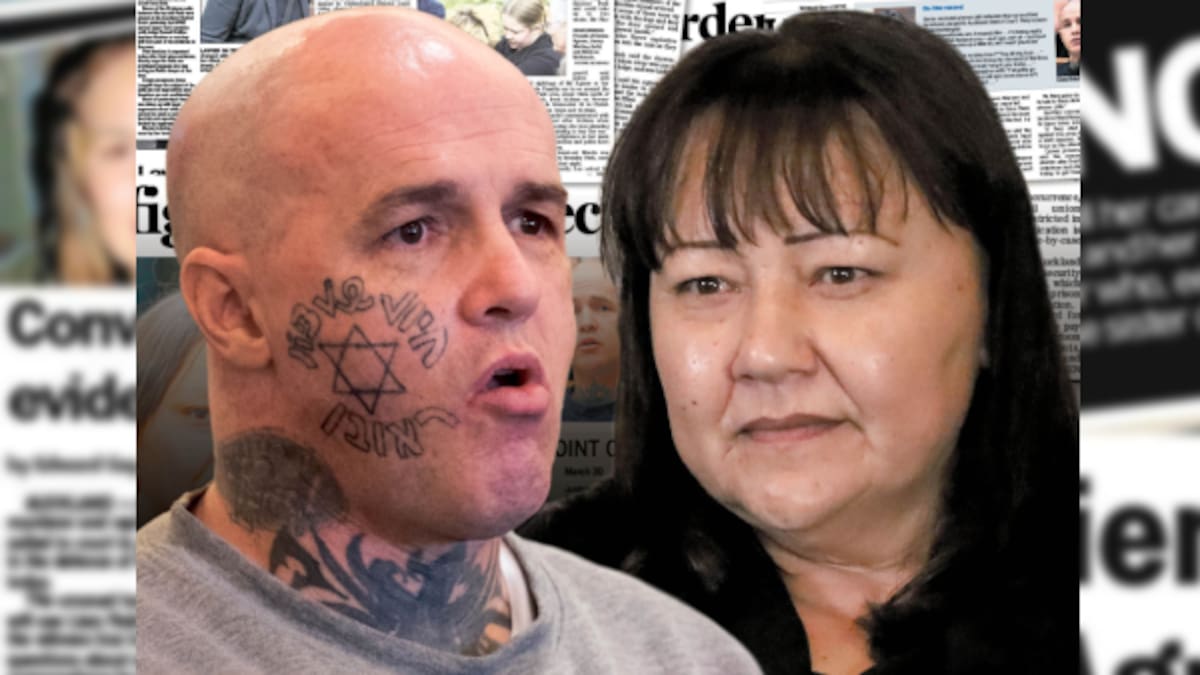
Davina Reid, then Murray, was convicted of smuggling contraband to now-husband Liam Reid.
She also referred to personal circumstances, and other matters, related to the prosecution, as well as complexities in other professional misconduct that had contributed to her being struck off.
Collins said the tribunal should be troubled about a “continuing pattern of lack of candour”.
“She has not yet reached the point of sufficiently full and unambiguous acknowledgment of her offending, its significance and implications.”
He was also concerned about a lack of appropriate supervision at a potential employment opportunity with Phoenix Law, should Reid be reinstated.
Lawyer Janet Mason provided a letter which outlined the job opportunity, but didn’t appear at the hearing to give evidence.
Reid explained that Mason lives in Fiji, but would be supervising remotely along with another Auckland-based lawyer.
However, Collins said the lack of specific detail indicated a “minimalist approach”; he said more was needed in this aspect of Reid’s application, given the background.
While not wishing to criticise Reid’s decisions to exercise her rights of appeal, Collins noted there appeared to be a “continuing pattern or theme of refusal to accept candidly the findings that were made by formed judicial bodies, and that in turn speaks of lack of insight or remorse in the most meaningful way”.
However, Reid told the tribunal she was remorseful, that she accepted the earlier findings were “reasonable”, and she now understands the earlier decisions.
She described her legal fights as a “journey”, telling the tribunal she couldn’t understand why her earlier expressions of remorse seemed to have been misinterpreted as entitled or lacking in sincerity.
One of the issues raised was Reid’s lack of payment towards costs orders that had been made – just $255 paid towards a total of $29,717 outstanding.
Reid said she had every intention to pay it back, as amends to the legal profession she had let down, but had been unemployed and unable to make payments.
Another issue raised was earlier accusations Reid had made that the initial decision not to reinstate her had been “racist”.
The tribunal panel asked her if she still held that view, but her answer wasn’t clear.
She spoke about her childhood, and experiences growing up, her education, and the things she’s learned.
“I’m going a very long way around the journey to say, to answer your question. Were the judgments racist? I don’t know.”
She concluded by saying if she were reinstated, she would not breach boundaries or reoffend, recognising that to practise law is a “privilege”.
‘The world’s complicated,’ says Reid’s lawyer
In his closing statement, Galbraith reiterated that Reid had so much to give the profession, and he was confident any details about supervision in a potential new role could be firmed up.
He said while Reid’s answers might have been complex, that went with the territory when talking about remorse and redemption, and she had been “honest in what she had explained”.
“Perfection is rare in our society. People aren’t like that. Everybody has different views…so with great respect to some of the language which has been used in the judgments, I think they go too far…they make it a purist thing,” Galbraith KC said.
“If you’re going to offer people redemption, you can’t have them flagellate themselves to death… The world’s complicated. I don’t think it comes in neat little packages like all wrapped up.”
He said the focus should be on whether she would reoffend, which he submitted was not likely.
“And she can contribute so much, and I think she wants to contribute so much.”
Collins, in his final comments, said there was a difference between an honest opinion about an aspect of what happened and “excuse-making”.
“And some of what we’ve heard today, this, in my respectful submission, tends to fall into that category.”
He also said the tribunal couldn’t just take into account the long passage of time, in and of itself, but needed to consider whether the person is “now a more mature person capable of better judgment”.
The tribunal panel reserved its decision.
Reid’s earlier appeals
After a tribunal refused her earlier bid for reinstatement in 2023, she appealed to the High Court in August that year and was again turned down.
The Court of Appeal declined to hear her case, so she applied for leave to appeal directly to the Supreme Court, but that was declined.
Reid, formerly Davina Murray, was struck off in February 2015 after taking cigarettes and an iPhone into a jail for a convicted murderer she later married.
The phone, pack of cigarettes and lighter she smuggled into prison in 2011 were for Liam James Reid, who is serving a life sentence with a 23-year non-parole period for raping and murdering Christchurch woman Emma Agnew in 2007.
Hannah Bartlett is a Tauranga-based Open Justice reporter at NZME. She previously covered court and local government for the Nelson Mail, and before that was a radio reporter at Newstalk ZB.