
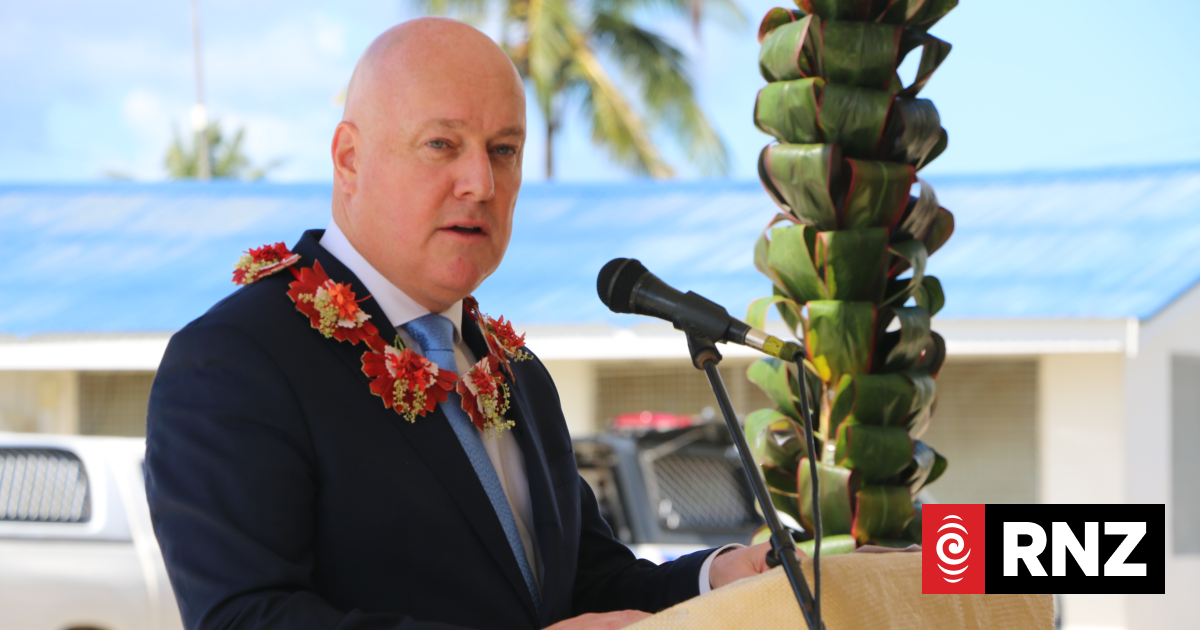
The Prime Minister says he will leave the Pacific with a “strong set of alignment” with Samoa and Tonga, with agreements signed on crime and education – but not immigration.
Luxon is flying back to New Zealand on Wednesday evening after a three-day trip, in which he made a series of announcements to strengthen cooperation in transnational crime and drug trafficking.
“We come away from here with a very strong set of alignment between Samoa, Tonga, and New Zealand, and that’s a very important part of my job,” he said.
Luxon said the world was moving away from multilateralism, and so New Zealand wanted to “buddy up” with likeminded partners.
“Which is why trips like this are really important, because you get to have some really decent conversations and alignment conversations as well around some of the geopolitical pressures small countries like New Zealand and Pacific island nations are facing.”
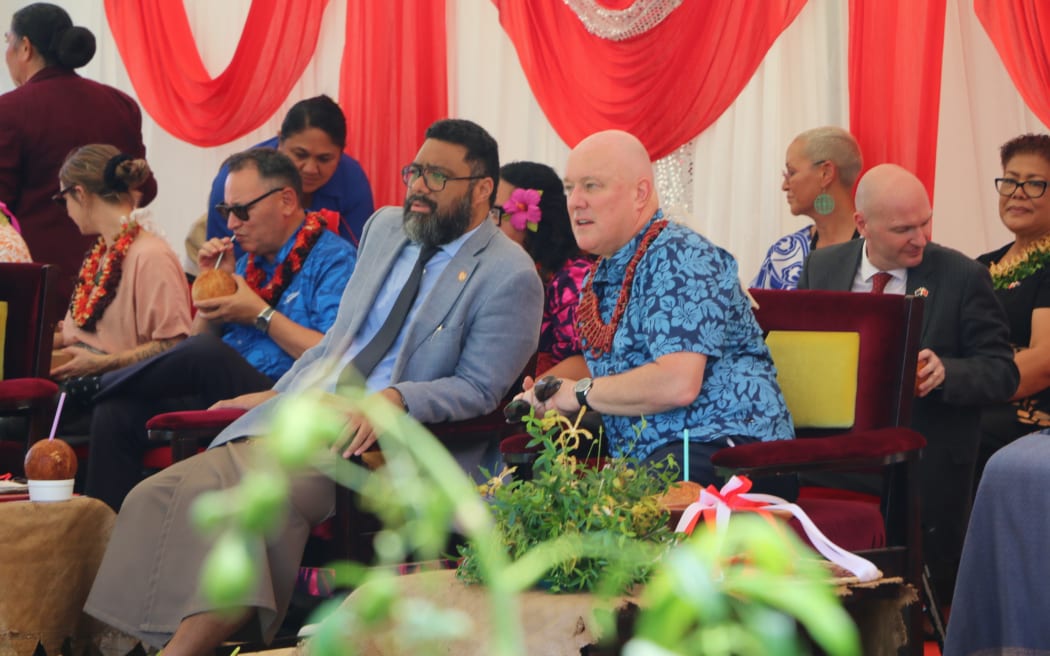
Christopher Luxon at Nuku’alofa Government Middle School in Tonga.
Photo: RNZ / Giles Dexter
While he would not confirm whether he would attend the Pacific Islands Forum in Palau later this year, he said New Zealand was “very deliberately” stepping up its engagement in the Pacific and was encouraging other powers that wanted to engage to respect the “centrality” of PIF.
“It’ll be the Pacific that solves specific challenges with Pacific solutions,” he said.
Luxon said he was “pleased with the progress” countries were making with drugs, and while he expressed support for the Pacific Policing Initiative, he stressed the importance of bilateral arrangements.
On Wednesday morning, Luxon announced further funding for the Pacific Detector Dog programme, which is run by New Zealand Police and Customs, and watched a demonstration of the programme in action.
The funding will see two new kennels built in Tonga.
Tonga’s prime minister Lord Fakafanua said he was “very happy to be the recipient of all of the aid and assistance, in terms of deploying the capacity of police,” which was already having “tangible effects” on the ground.
Luxon also announced a two-year funding arrangement for Samoa and Tonga to access Starboard Maritime Intelligence.
Luxon said the platform would give countries a common software to monitor vessels moving in and out of the Pacific.
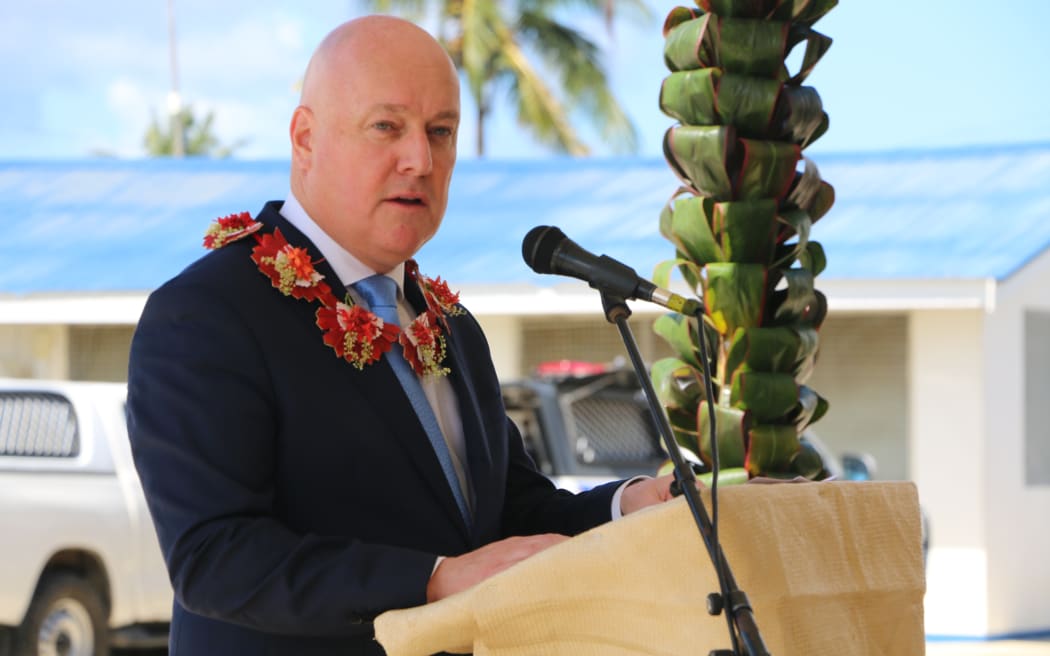
Christopher Luxon speaks at Tonga’s police headquarters, announcing further support for the Pacific Detector Dog programme.
Photo: Giles Dexter / RNZ
Starboard’s chief executive Trent Fulcher told media in Nuku’alofa that Starboard had been providing capability to foreign fisheries agencies for a number of years, and this would be an extension of that relationship.
“It used to be this large swathe of ocean, and you have limited assets, like a patrol aircraft or a vessel, and you’re basically going out looking for those needles in a haystack with a very expensive asset,” he said.
“What a server allows you to do is look at the ocean, apply a series of risk indicators over the top to say, hey, of the 5000 vessels that might be in my EEZ today, which ones have these characteristics? And you can really narrow all those vessels down into a few that you want to take a look at, and then you deploy your assets strategically.”
Fulcher said there had been a trend over the last 15 to 20 years of more drugs coming through the islands as a transit point, and the use of yachts, fishing vessels, narco-subs, and drop-off points was increasing.
“A few years ago, it was hundreds of kilograms. Now, it’s tons,” he said.
Asked whether he had a sense that countries were getting on top of the problem, Luxon admitted it was “relentless” and “unprecedented,” but memorandums of understanding between countries were being signed, and the detector dogs and more maritime surveillance were being made available to everybody.
“We’ve got one common approach, whether it’s Australia, New Zealand, Tonga, Samoa, Fiji, increasingly, we want to work together, the five of us.”
Education was also of “huge interest” in his discussions with Lord Fakafanua. At a school in Nuku’alofa, Luxon announced $14 million to improve access to quality skills, training, and education.
Luxon expected education minister Erica Stanford would visit Tonga, and he wanted Tongan ministers visiting New Zealand as well.
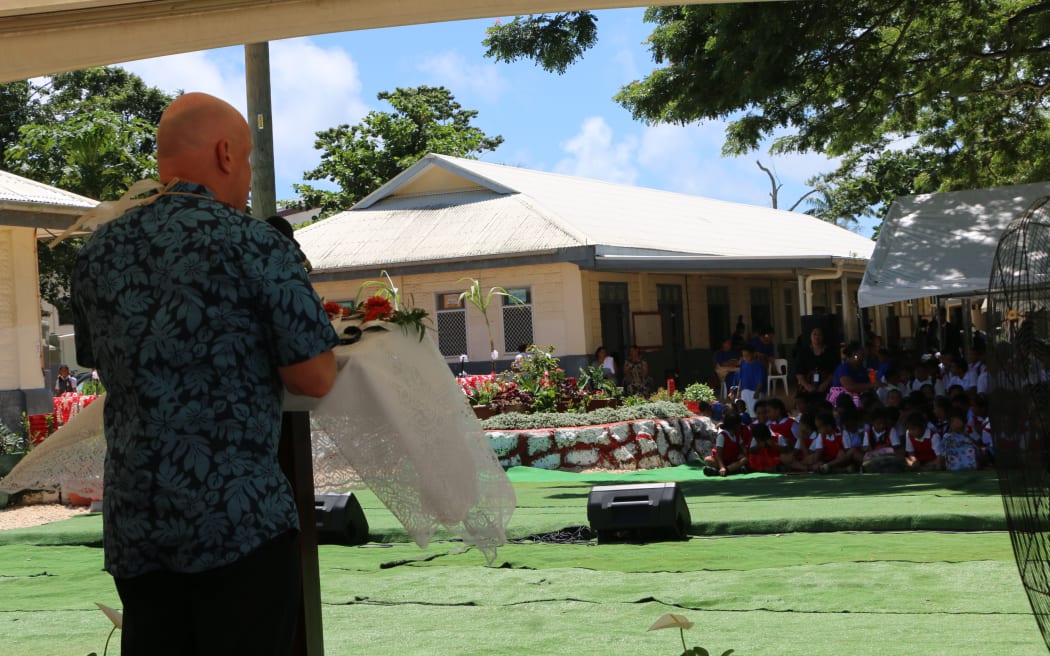
Christopher Luxon speaks at Nuku’alofa Government Middle School in Tonga.
Photo: RNZ / Giles Dexter
The issue of visa waivers has followed him to Tonga, although with less clamour than in Samoa.
On Wednesday, Lord Fakafanua seemed less concerned about calls for visa waivers than Samoan prime minister Laʻaulialemalietoa Leuatea Polataivao Fosi Schmidt, instead backing the cheaper visa approach New Zealand has taken.
Asked about Lord Fakafanua’s response to the visa situation compared to Laʻaulialemalietoa’s, Luxon acknowledged it was a “big issue” that had followed him throughout the trip, but said in his own conversations there had been “huge appreciation” for the steps New Zealand has already taken, such as faster processing times, cheaper visa fees, longer visa durations, and the pilot scheme allowing visitors with an Australian visa to enter New Zealand visa-free.
“All of those things have been greatly appreciated, because previous New Zealand governments haven’t offered that to the community and to the Pacific,” Luxon said.
“We have consistently looked at making our immigration system tight and well-balanced and smart. As a result of that, we’re able to move dynamically and agilely, as we’ve seen, to loosen up and make things more liberal, where we can.”
In terms of his engagements, approach, and relationship with Lord Fakafanua compared to Laʻaulialemalietoa, who had earlier caused a minor diplomatic headache with his comments on Luxon’s matai, Luxon said his job was to work with everybody he engaged with.
“They’re all different personalities. They all have different traits and characteristics. And my job is to find a way to make sure we build rapport and have a relationship regardless.”
Earlier on Wednesday morning Luxon had a private audience with King Tupou VI, which he described as a “real privilege and a great honour,” but would not divulge what they discussed for protocol reasons.
Sign up for Ngā Pitopito Kōrero, a daily newsletter curated by our editors and delivered straight to your inbox every weekday.