
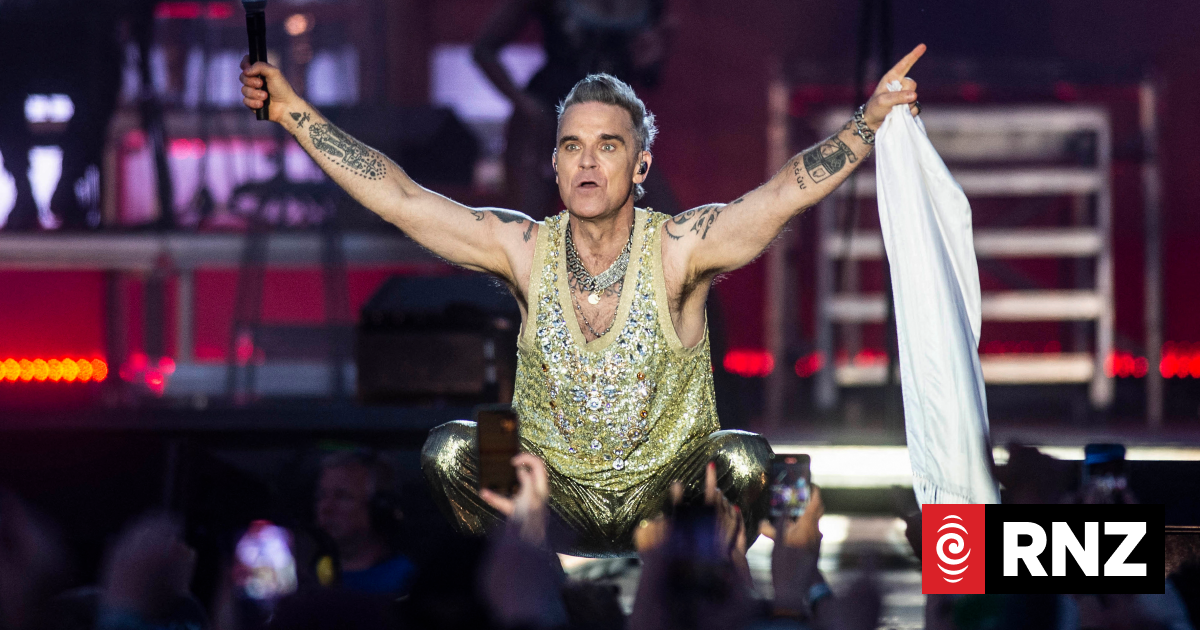
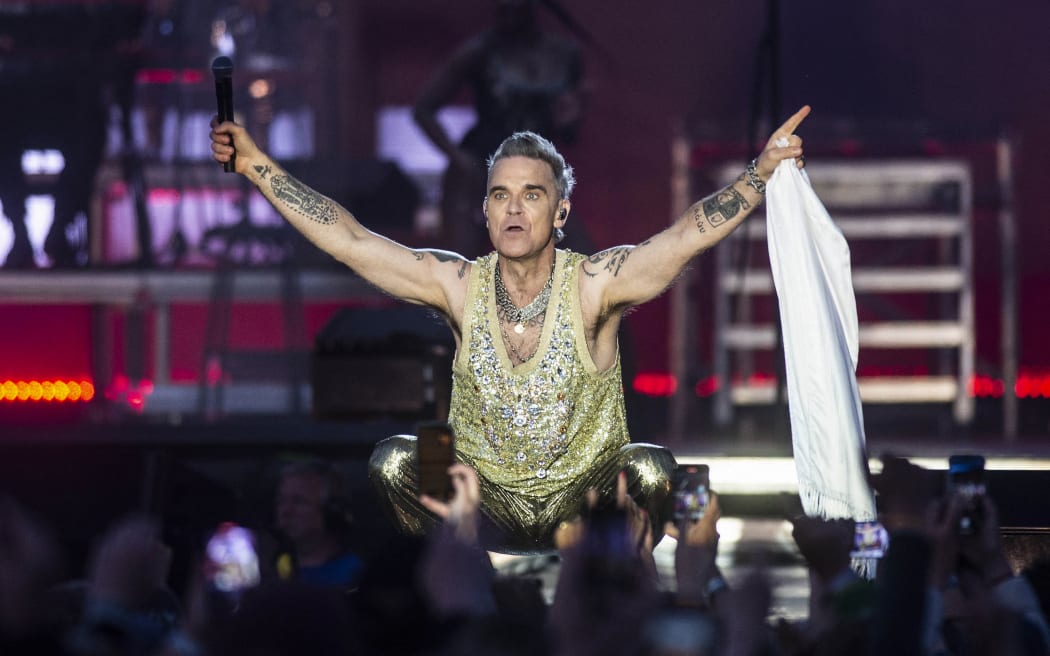
Robbie Williams
Photo: Tim Kildeborg Jensen / Ritzau Scanpix / AFP
There are allegations of corporate concert welfare and promoters holding the government to ransom over funding for big events while home grown talent is left out.
The government has announced it will be using the Major Events and Tourism fund to help fund pop star Robbie Williams’ tour to New Zealand.
It is a decision that some promoters are not in tune with.
The $70 million fund is aimed at stimulating economic activity around entertainment events, and $40 million of that money is to secure large-scale international events.
However, how much it paid to get Robbie Williams here for two shows – one in Auckland the other in Christchurch – has not been disclosed.
The government said the number is commercially sensitive.
It has also contributed undisclosed amounts to other gigs including Linkin Park and Wellington’s Ultra music festival – that includes major international DJ’s.

The government fund contributed to Linkin Park’s gig.
Photo: James Minchin
Rob Warner has been involved in the music industry for over 30 years as a DJ, artist, promoter, and advocate for homegrown music culture and events.
Warner told Checkpoint the government is being taken for a ride by big players.
“It should worry both taxpayers and anyone who likes live events or values music culture. The schemes, as happened in Australia, have taught the biggest promoters they can hold events to ransom and the Minister and MBIE apparently don’t recognise they’re being taken for a ride. Or they’re more concerned about looking good in the lead up to this year’s election.
“The funding schemes are shaping to become a shrine to the credulity of the current government to accept clever pitches from the biggest promoters seeking corporate welfare.”
He said the government should be putting more focus on local artists, who are already battling difficult times.
“Events that are financially viable will keep happening. If they’re not, then we cannot run a corporate welfare scheme like this for the biggest players – mostly offshore owned – and pretend it doesn’t also harm homegrown and grassroots music culture who are much more deserving of support through difficult times.”
Splore Festival producer Fred Kublikowski applied for event funding through the Major Events and Tourism Fund but was denied.
After nearly 30 years in action, festival organiser John Minty announced last year that 2026 would see the final edition of Splore, citing struggles with ticket sales.
Kublikowski told Checkpoint there needs to be more transparency around the fund.
“I think when taxpayer money is involved and it’s going into a pool that’s going to, international interests, if there’s no clarity around that, people ask questions.”
Kublikowski said there have been a countless number of successful international shows both in and outside of New Zealand without the government funding.
While it was hard to say whether the government was being influenced by these multinational promoters, Kublikowski said similar things had occurred in Australia.
“There’s been examples where funding’s been made available and it’s easy for large conglomerates to access that.
“Certainly easier than local homegrown events without the resources or the backup of that kind of admin facility.”
That rings true for the Splore organisers, who applied for funding and were denied.
Splore festival qualified for a share of the contestable $10 million event boost fund, for which Kublikowski said the application process was “rigourous and quite complicated.”
“It took several days to complete and supply the information.”
He said the event fund is being used as a proxy for tourism benefits.
“The outcomes are purely economic and counted around tourism numbers.
“We believe events created by artists and musicians create a cultural and social benefit, and those sort of benefits can’t all be measured within dollars and cents.”
Kublikowski was sceptical that an event like Wellington’s Ultra music festival would have brought tourism benefits to the country, considering it was also held in a number of other cities overseas.
He said he would like to see the government release the tourism outcomes that have come from the events funded.
“Those measurements aren’t being made public at this point. Linkin Park was on last week, and I’d love to see a report come back from that, what the outcomes on the investment were for a gig that probably would have been happening at the Spark Arena, regardless of funding.”
The Minister of Tourism and Hospitality Louise Upston declined the request to discuss the funding on Checkpoint.
Sign up for Ngā Pitopito Kōrero, a daily newsletter curated by our editors and delivered straight to your inbox every weekday.