
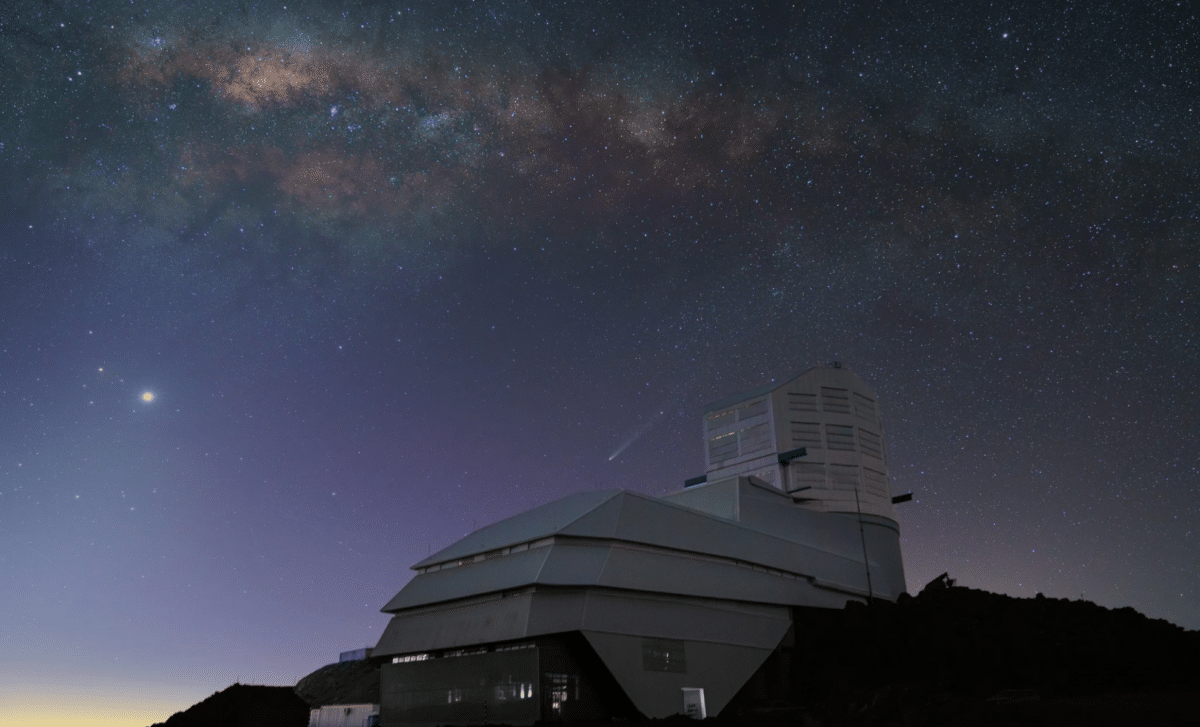
The Vera C. Rubin Observatory has detected a staggering 800,000 celestial changes in the night sky during a single observation session. This unprecedented achievement opens a new chapter in the study of the universe, showcasing an advanced system that monitors sky activity at an unimaginable scale and speed.
A Leap Forward in Astronomical Monitoring
The Vera C. Rubin Observatory, perched high above the Andes in Chile, represents a significant leap in astronomical monitoring. Unlike traditional telescopes that capture isolated snapshots of the sky, Rubin continuously observes the night sky, capturing a new image every 40 seconds. This rapid pace provides an unparalleled view of the universe, detecting subtle changes such as movements, flashes, and brightness shifts.
By employing a camera capable of capturing 3,200 megapixels per image, Rubin can detect objects far dimmer than the human eye can perceive. Its high sensitivity means that even the faintest cosmic events are documented and analyzed within minutes of their occurrence.
“By connecting scientists to a vast and continuous stream of information, NSF–DOE Rubin Observatory will make it possible to follow the universe’s events as they unfold, from the explosive to the most faint and fleeting,” says Luca Rizzi of the National Science Foundation (NSF).
This constant flow of information is crucial for timely reactions to celestial events like supernovae or asteroid flybys. By revisiting the same areas of the sky repeatedly, Rubin provides real-time data that enables scientists to study rapid developments in the universe, something that traditional telescopes could not offer before.
The Scale of Discovery: From Hundreds to 800,000 Alerts Per Night
In a remarkable shift from conventional astronomical surveys, the Rubin Observatory is generating an overwhelming volume of data. Where astronomers once discovered a few hundred or a few thousand transient events (such as exploding stars or asteroids) per year, Rubin’s system now processes 800,000 alerts each night. This surge in information marks a seismic change in the way astronomers track cosmic phenomena.
“Until now, we used to discover a few hundred to a few thousand transients per year,” says Or Graur from the University of Portsmouth, UK. “Going from that to 800,000 alerts per night is a sea change.”
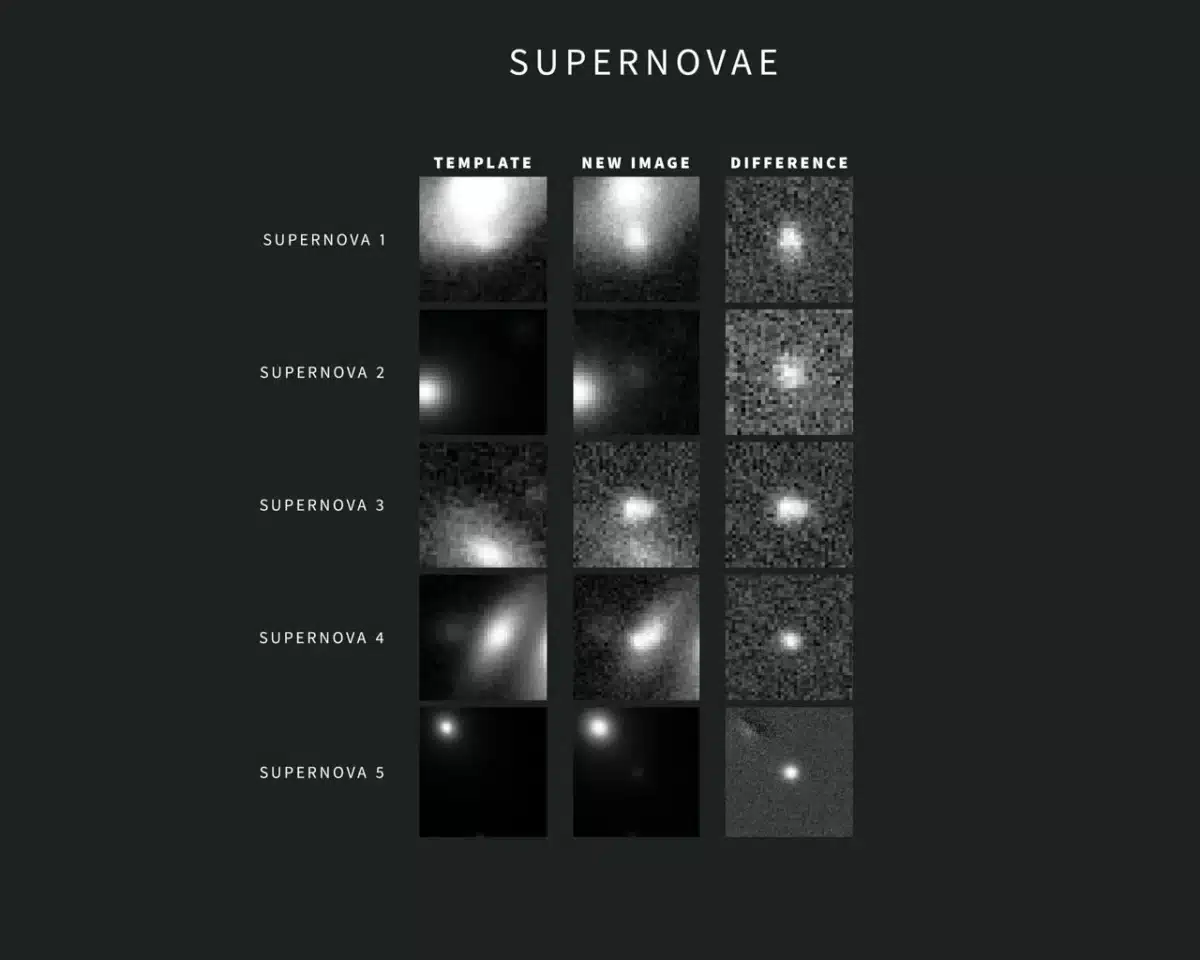 Rubin Observatory’s sophisticated software automatically compares each new image against a template image, built by combining Rubin’s previous images of the same area in the same filter. Subtracting the template from the new image leaves only the changes, shown in the difference image. Each change triggers an alert within minutes of image capture. The supernovae here are not seen in the template images, but are clearly revealed in the center of the difference images.
Credit: NSF–DOE Vera C. Rubin Observatory/NOIRLab/SLAC/AURA Acknowledgement: Alert images with classifications provided by ALeRCE and Lasair.
Graur’s comment reflects the immense scale of the data Rubin generates. The observatory is not just increasing the number of detected events, it’s also enhancing the quality and scope of astronomical research. In the past, rare celestial events could go unnoticed. Now, thanks to Rubin’s unprecedented speed and coverage, such events are becoming commonplace.
“Objects that used to be rare will become commonplace, and even rarer objects, that could not have been discovered with the previous surveys, will start popping up,” Graur explains. “In other words, the chance of discovering brand-new objects and phenomena is very real.”
Revolutionizing the Study of Supernovae and Other Cosmic Phenomena
One area where Rubin is already making a notable impact is the study of supernovae, particularly Type Ia supernovae, exploding stars used to measure cosmic distances. According to Georgios Dimitriadis, an astronomer at the University of Lancaster, Rubin’s alert system is uncovering transient events that other surveys would have missed entirely.
“Even with the current alert stream, we have identified transients that would be completely missed from any other survey operated until today, which is amazing,” says Dimitriadis. “I am super excited to discover, observe, and analyze Type Ia supernovae from Rubin.”
This early success demonstrates the value of Rubin’s high-speed monitoring system, which is capable of detecting even the briefest events that traditional telescopes may miss. As Rubin’s operations ramp up, astronomers expect to identify countless new supernovae and other cosmic phenomena that could lead to major breakthroughs in our understanding of the universe.
The Technology Behind the Alerts: Speed, Scale, and Artificial Intelligence
One of the keys to Rubin’s success is its ability to rapidly process and sort through the massive volume of data it generates. With so many alerts streaming in every night, it’s impossible for humans to analyze them all manually. Instead, Rubin relies on sophisticated software systems known as “brokers” to filter and prioritize the most important events.
“The broker teams have built systems that operate rapidly at scale so that scientists can find all of the objects of interest to them, as well as things we’ve never seen before,” says Tom Matheson, who developed the ANTARES alert broker.
These broker systems use machine learning algorithms to sift through the flood of data and flag significant events, allowing astronomers to focus on the most promising leads. As a result, Rubin not only improves the speed of astronomical discovery but also enhances the quality of research by ensuring that rare and fleeting events don’t go unnoticed.