
A new study has found that World War II warheads lying on the Baltic Sea floor support far denser marine communities than the surrounding seabed.
That result reveals how relic weapons can double as rare habitats in places where marine life struggles to find solid surfaces.
Marine life on warheads

About 65 feet (20 meters) down in Lübeck Bay, along Germany’s Baltic coast, rusting warhead casings supported thick biological growth while nearby sediment remained comparatively sparse.
Analyzing submersible video from the site, Andrey Vedenin at Senckenberg am Meer documented how marine animals clustered across the metal shells.
Most organisms settled on the intact metal rather than the exposed explosive material, concentrating their growth on the structures that offered stable footholds.
That uneven pattern raised a larger question about why these toxic relics still support dense communities, a puzzle explored in the sections that follow.
Dense life on warheads
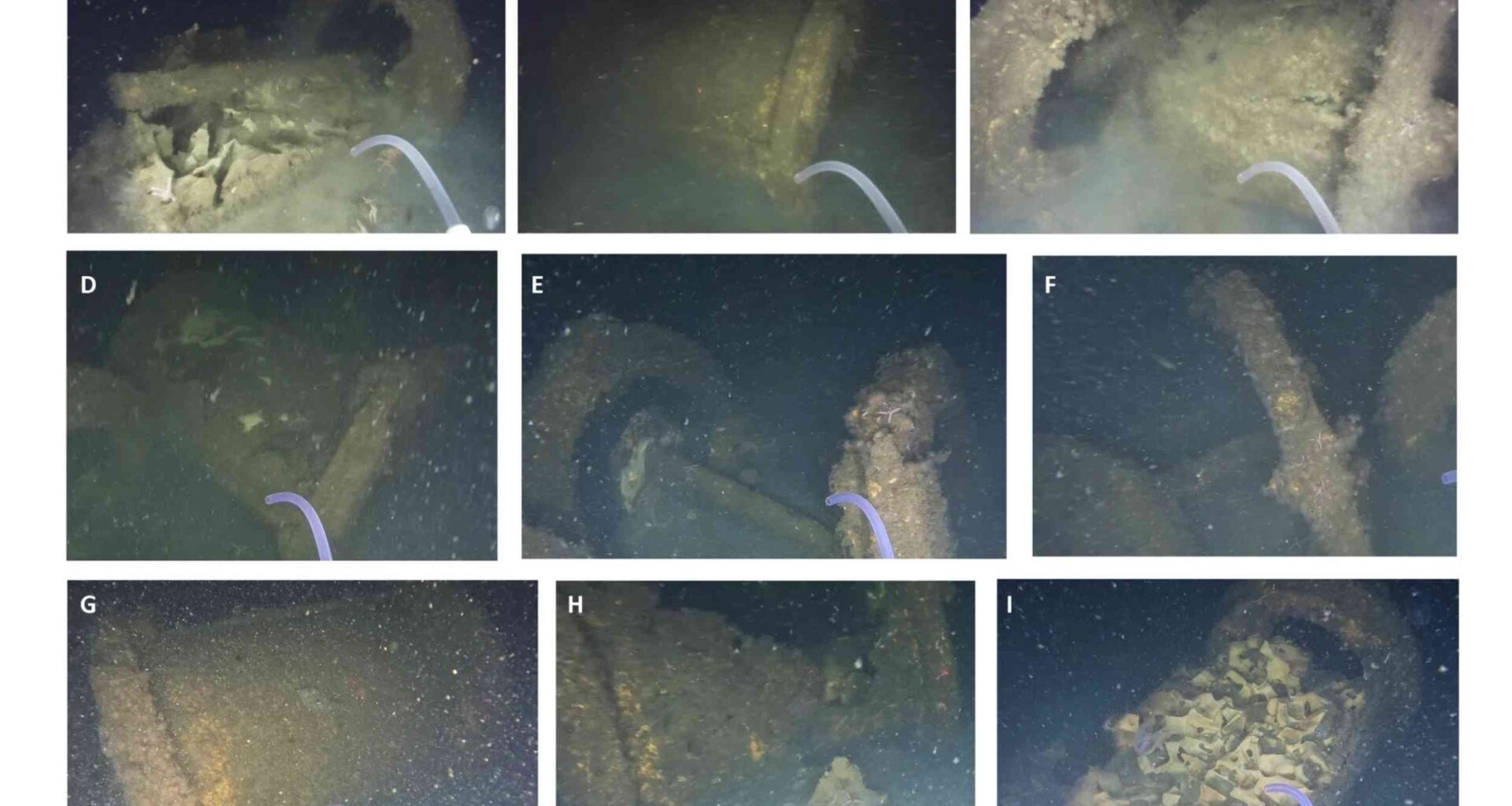
Across nine warheads, the team identified eight species – most of them epifauna – animals that live on underwater surfaces.
Close video showed tube-building worms dominating the shells, with anemones, starfish, crabs, and three fish species adding visible cover.
On average, the shells held about 4,000 organisms per square foot, while nearby mud held about 760.
Those numbers put the munitions in the same rough league as natural hard surfaces elsewhere in the bay.
Poison in the plume
Water sampled beside broken warheads carried explosive chemicals at levels that approached or exceeded danger thresholds for aquatic animals.
As the metal corroded, compounds such as TNT leaked into the water and formed concentrated plumes around each source.
One sample reached 2.7 milligrams per liter, close to levels estimated to kill some aquatic life in laboratory tests.
Yet those bursts did not stop dense settlement on the metal, which deepened the puzzle rather than resolving it.
Toxic zones stay bare
The difference between metal and exposed filler was stark, and it helps explain how life persisted in such a hostile place.
Animals that stay fixed in place mostly coated the casing, transport frame, and fuse pockets instead of bare explosive.
Rare starfish and crabs crossed the explosive surface, but the yellow material stayed largely free of visible overgrowth.
That pattern suggested water touching the dissolving explosive remained too toxic for most creatures to colonize.
Dumped weapons at sea
These objects were not random scrap, but warheads from V-1 flying bombs dumped during postwar weapons disposal.
Before 1972, throwing unwanted explosives into the sea was common enough that nations later negotiated the London Convention.
That practice loaded many coasts with dangerous leftovers whose metal shells have now spent decades rusting open.
What began as a disposal habit ended by creating accidental structure in places where structure had become scarce.
A stripped seafloor
Here, the surrounding bay offered little competition because the bottom was mostly soft sediment rather than rock.
Past removal of natural boulders for construction left few stable footholds, a regional shortage Vedenin described in an interview.
Regular hypoxic (low-oxygen) periods also favored a short list of hardy animals over a richer, more varied community.
Those constraints made any stable metal frame disproportionately useful, even when it leaked chemicals into the water.
Ecosystem extends outward
The shells were not the whole story, because other work in Lübeck Bay found ecological changes extending into the surrounding seabed.
A nearby analysis found that abundance and biomass also rose near individual munitions, not only on their surfaces.
Distance from the objects shaped the local community more clearly than explosive compounds in the sediment did.
That finding suggested the metal structures were influencing the neighborhood, not just serving as tiny islands of growth.
Cleanup without collapse
Removing the munitions would reduce a toxic hazard, but it could also flatten one of the bay’s few busy habitats.
That tradeoff is why the authors argued for replacing cleared bombs with safe hard surfaces instead of leaving bare mud.
Concrete modules or restored stone could preserve attachment space without keeping explosive chemicals on the seafloor.
The idea would not erase all risk, but it would separate habitat value from the danger source that created it.
Questions after discovery
The dense growth solved one mystery but sharpened another: whether the animals are merely present or actually thriving over time.
Across the southwestern Baltic, at least one explosive compound appeared in nearly every water sample in another survey.
That broader chemical backdrop helps explain why the crowded shells still looked improbable to the team.
“We were prepared to see significantly lower numbers of all kinds of animals. But it turned out the opposite,” said Vedenin.
Implications for marine systems
The Baltic warheads show how quickly life can occupy even toxic leftovers when those leftovers supply something the habitat lacks.
Any cleanup plan will work best if it removes the poison and keeps the structure, treating ecology and safety as the same problem.
The study is published in Nature.
—–
Like what you read? Subscribe to our newsletter for engaging articles, exclusive content, and the latest updates.
Check us out on EarthSnap, a free app brought to you by Eric Ralls and Earth.com.
—–