
Crew followed standard operating procedures, investigators said.
The hydraulic failure caused some steering and the right-side engine reverser to be disabled.
“The flight crew were aware of these limitations and had planned to use differential braking to steer the aeroplane off the runway to avoid causing delays to following flights,” the commission said.
The landing initially went to plan, but a thrust problem sent it onto the grass.
The aircraft left the taxiway exit because thrust levers were moved to “climb” position rather than the forward idle minimum thrust setting, and the crew did not detect or correct that error, the TAIC said.
Investigators said the pilot was likely startled by the engines accelerating to “climb” power and so pulled the thrust levers back into maximum reverse.
Investigators found a damaged pipe had lurked unnoticed in the A320 for at least eight years. Photo composite / TAIC, NZME
“Engine No 1 developed reverse thrust while engine No 2 continued to provide forward thrust but at a reduced level.”
That caused asymmetric thrust and the pilot lost directional control of the aircraft.
Chief investigator of accidents Louise Cook said: “The pilots could have planned to stop on the runway and wait for a tow, but to avoid blocking the runway and delaying other flights, they opted for the rapid exit they had often used before.
The aircraft made an unintended excursion. Photo / TAIC
“They were likely so focused on making that exit that they missed important cues that the position of the thrust levers was not as intended.”
The commission said a titanium pipe had ruptured, leading to the loss of hydraulic fluid.
“The deformity was very likely caused when the new part’s packaging was damaged in transit between two Airbus parts warehouses in 2015, but had not been detected at the time.”
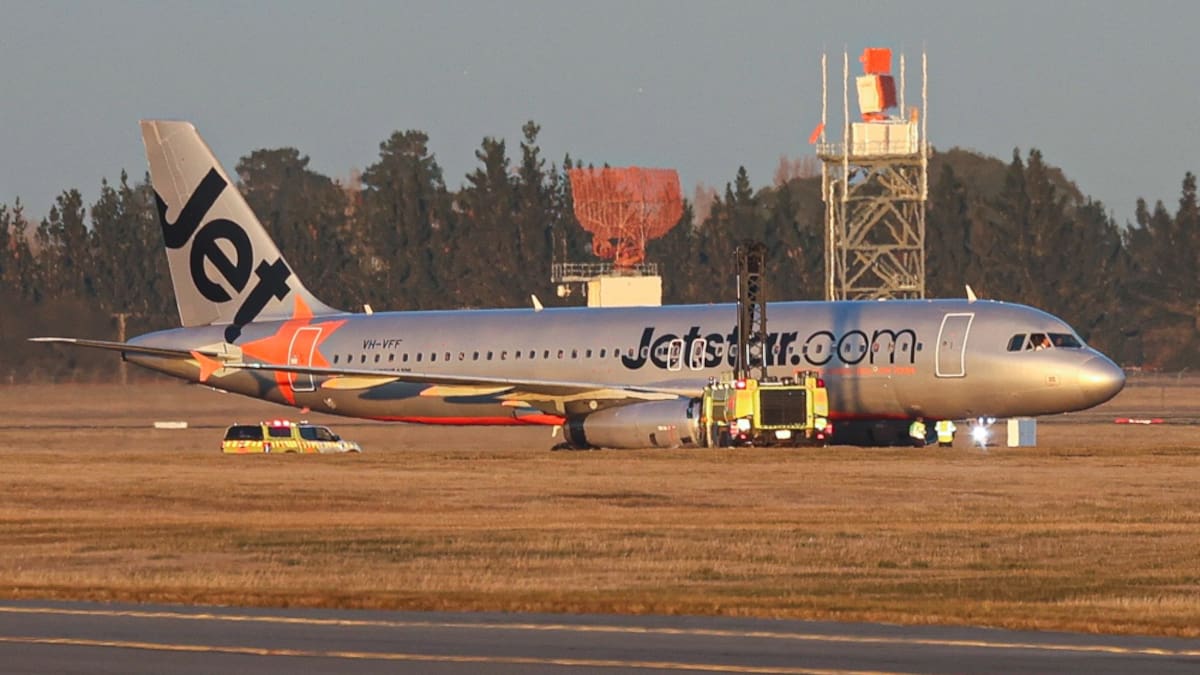
The Jetstar A320 after the Christchurch Airport incident. Photo / George Heard
System alert
Crew were alerted to a system failure at 6.58am just south of Mt Taranaki, then followed standard procedure for abnormal situations.
They checked the landing distance at Christchurch Runway 2 and decided they could use the rapid exit.
The rapid exit involved a shallow-angled exit path from the runway at a reduced speed after landing, but was still faster than normal taxi speed.
An illustration of the taxiway excursion path. Image / Christchurch Airport, TAIC
But in landing, one reverser did not deploy.
The aircraft went off the runway and entered the rapid exit, then left the taxiway.
One of the twinjet’s engines hit the movement area guidance sign, then the aircraft curved around and travelled back to the runway.
The engine had significant damage to its cowling, or removable protective covering.
Engine damage from impact with the sign. Photo / TAIC
Hydraulic oil had leaked from inside one main landing gear stowage bay.
The leak was traced to a rupture in a high-pressure, titanium alloy hydraulic pipeline.
“The leak resulted in hydraulic oil being sprayed around the area.”
Investigation photos showed a pipe with a 25mm split.
The hydraulic pipe was taken to an Airbus facility in Germany and examined to determine the cause of failure.
The A320 family is the world’s best-selling group of jetliners, with operators all around the world.
The commission said the A320 was designed to allow for redundancy if a failure happened in one area.
“The degradation to landing capability was not relevant in this accident and the aeroplane remained controllable but with minor and manageable differences to some systems.”
Cracked under pressure
Fatigue from repetitive pressurisation and depressurisation of hydraulic fluid at each engine start-up and shutdown likely exacerbated crack formation, the TAIC said.
The pipe started out as a section of seamless titanium stock from a supplier in France and met Airbus specifications.
When Airbus needed to replenish spares of the hydraulic pipe, it placed an order with supplier GKN Aerospace in Bristol, western England.
The commission said the box was received in good order, then repackaged with other spare parts and sent as a bigger package to a warehouse in Germany.
It was received in 2015 with damaged packaging.
“The contents of the damaged packages were not inspected to ensure that they were still in serviceable condition,” the TAIC added.
“The pipe was removed and stored on a shelf, with documents and tags to show that it was serviceable, until it was required nearly seven years later.”
There were several opportunities to examine the pipe, but the scale of distortion would have been hard to detect.
“In this case, a titanium hydraulic pipe was just 1mm out of shape.”
High stress
The TAIC said the pilot was likely under stress, with a high cognitive load.
“Both members of the flight crew were likely to have experienced attention tunnelling, which precluded them from perceiving wider information, including the position of the thrust levers.”
It said attention tunnelling involved processing crucial task-relevant information with limited or no processing of potentially important secondary information.
“When the flight crew used the rapid exit with nosewheel steering unavailable, this increased their cognitive workload and the risk of an incident.”
Nosewheel steering was used at low taxi speeds to manoeuvre on the ground.
The TAIC said today that it was important to conduct detailed inspection of new parts for potential damage before installation.
It said Jetstar had since changed guidance to flight crews who found themselves in a similar position.
Jetstar told the Herald that the safety of customers and crew was the airline’s top priority.
“We’ve worked closely with the regulator and Airbus to fully understand what occurred and have strengthened our procedures to help prevent a recurrence and ensure the ongoing safety and resilience of our operations.”
Airbus told the Herald it also accepted the investigator’s recommendations and safety was its top priority.
It told the TAIC it had updated its training manual to highlight proper use of thrust levers.
New Zealand Air Line Pilots’ Association president Andrew McKeen said the report identified technical and operational factors which helped the industry’s understanding of aviation system limitations.
He said the pilots’ union supported the continued application of lessons to enhance aviation safety.
Screwdriver incident
VH-VFF was made in 2012 and left Auckland in serviceable condition but with some minor cabin items due for deferred maintenance.
In 2020, crew on a Brisbane-Cairns flight reported hearing a popping noise and flames in the right-side engine.
Australian investigators found a screwdriver tip had been left in the engine after maintenance for at least 100 flights.
John Weekes is a business journalist covering aviation and courts. He previously covered consumer affairs, crime, politics and courts.
Stay ahead with the latest market moves, corporate updates, and economic insights by subscribing to our Business newsletter – your essential weekly round-up of all the business news you need.