
Luxon, who repeatedly referenced New Zealand’s lack of control over the war’s trajectory, said the uncertainty surrounding the war’s longevity meant the Government had to prepare.
“We are preparing for the worst-case scenario.”
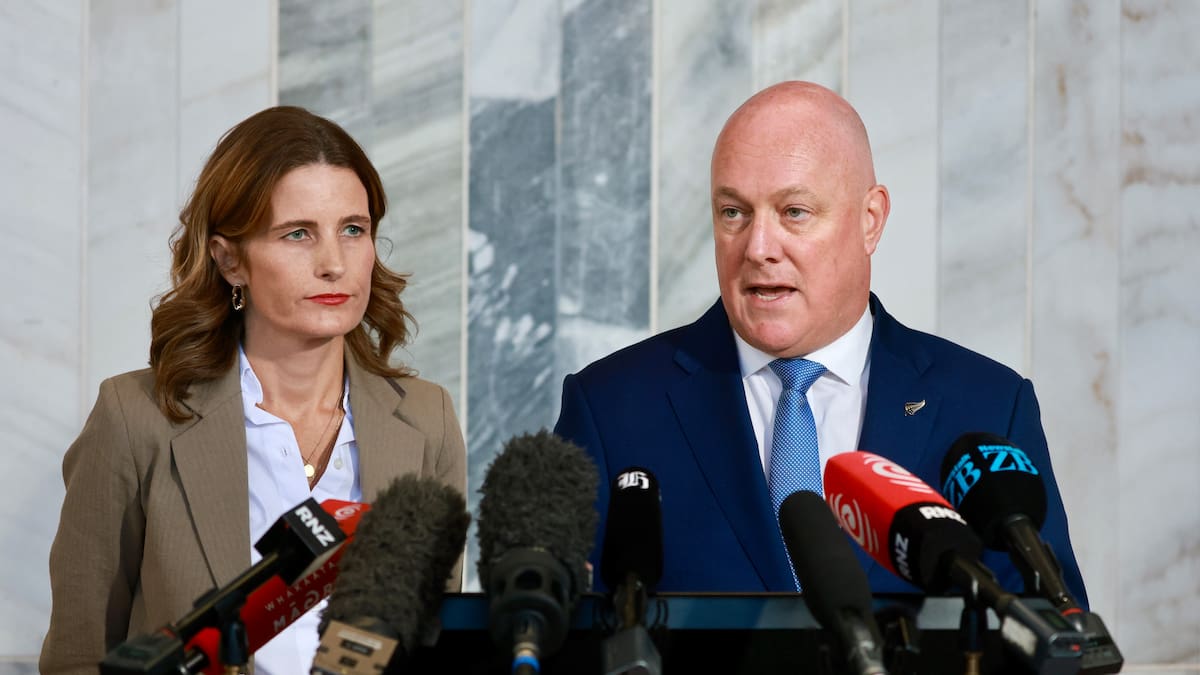
Christopher Luxon and Nicola Willis speak to media at a press conference regarding the Government’s response to the conflict in the Middle East and its effects on New Zealand’s fuel stocks and the wider economy. Photo / Mark Mitchell
Willis, who led the Government’s ministerial group assessing the conflict’s consequences for New Zealand, outlined a three-pronged approach which included considering “domestic prioritisation measures”.
Without speculating on what measures could be employed, Willis said she would be engaging with fuel companies to explore options and would provide an update next week when she would also expand on what would require New Zealand moving up from Level 1 in its fuel emergency level system.
New Zealand’s National Fuel Plan contained possible options, such as designated fuel retail outlets for “critical” customers, designated lanes at stations or mini-tankers on site, which was described under emergency Level 2.
Under Level 3, options include restricting opening hours for fuel retailers, setting maximum purchase limits and restricting sales in containers to limit hoarding.
The Government’s current position was any rationing or prioritisation measures were not necessary as the country had enough fuel either in storage or being shipped, totalling about seven weeks’ worth of petrol, diesel and jet fuel.
Christopher Luxon and Nicola Willis are preparing New Zealand for the “worst-case scenario” as the war in the Middle East continues. Photo / Mark Mitchell
Luxon was quick to express his belief New Zealanders had thus far been well-behaved in their fuel consumption. Willis added she had seen reports of increased public transport usage, carpooling and employers letting employees work from home.
The pair reinforced the Government’s limited power to control the price of fuel and any financial support would be directed to people who were most in need, Willis identifying people who had to drive to work.
While Cabinet was yet to decide on the level of support and how it would be administered, Willis said she had directed Inland Revenue and the Treasury to provide options. She confirmed she was aiming to assist families “directly” through measures in the “tax and transfer system”.
She was cautious when asked whether support would extend beyond low-income households, saying it would be “irresponsible” to provide support too widely, fearing it would create a “vicious spiral” of inflation and price surges.
On Monday, Willis said she had sought advice on how high fuel prices could go.
Today, she accepted there were “a lot of predictions” and summarised her advice as “how long is a piece of string”, noting price increases would depend on the continued closure of the Strait, how difficult access to crude oil became and the extent of damage to exploration fields.
Little, in his speech, offered a “rule of thumb” for thinking about how fuel prices affect prices.
“A rule of thumb is that every US$10 increase per barrel of oil roughly translates to 10 cents a litre extra for New Zealanders at the petrol pump. Therefore, prices at around US$100 a barrel mean a 40 cents a litre increase in New Zealand,” he said.
Despite the uncertainty, Willis remained confident New Zealand’s economy would continue to grow this year but said the extent of that growth was becoming harder to predict.
As of March 15, New Zealand’s combined petrol, diesel and jet fuel stocks equated to about 49 days of cover nationwide, including fuel being held in storage and fuel on ships bound for New Zealand.
That is slightly below the levels held on March 8, when New Zealand had a combined 52 days of cover.
Earlier this week, Willis urged people not to panic-buy fuel.
“There are about 50 days of petrol and diesel in the country, or on the way here, which is normal,” she said, noting that petrol stations that had run dry had done so because they were offering heavily discounted promotions.