
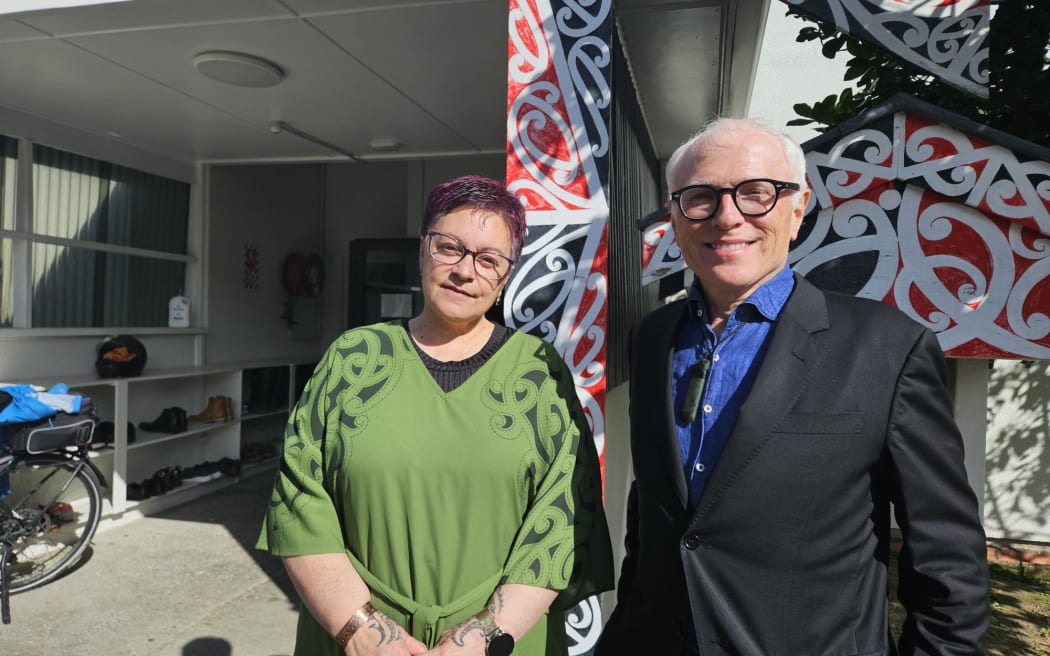
Researchers Cheryl Davies and Michael Baker at Kōkiri Marae in Lower Hutt.
Photo: Pokere Paewai
New research is looking into how “syndemics” – where two or more diseases interact and amplify disease outcomes – impose a higher health burden on Māori and Pacific whānau.
The five-year $5 million research programme, funded by the Health Research Council, has seven separate but related projects to identify and quantify the linked effects of infectious diseases, long-term conditions and structural inequalities. The programme was deliberately focused on preventable health issues that impose a high burden on Māori whānau.
Professor Michael Baker from the Department of Public Health at the University of Otago, Wellington, was the principal investigator for the study. At the launch at Kōkiri Marae in the Lower Hutt suburb of Seaview on Thursday, he told RNZ the overlap between acute infections and long term conditions is often looked at in separate silos which misses many opportunities for treatment.
“The other link is between long term conditions, or what we sometimes call non-communicable diseases, they also make you more vulnerable to acute infections.
“And we saw that particularly during the Covid-19 pandemic, where people with underlying illness were much more vulnerable to getting ill and even dying from this infection. So in the past, I think we’ve missed opportunities by looking at infections and long term conditions separately.”
Baker said the other element which is a risk factor for many infectious diseases are what is known as the social determinants of health, including poverty, poor housing etc.
“We’ve done research particularly on diseases like rheumatic fever, and we know that in previous research we’ve done on that disease, the biggest single risk factor is living in a crowded house, that means you’re more exposed to strep A bacteria, you get skin infections, throat infections, and that interferes with your immune system, and that causes the severe heart damage of rheumatic fever, and that is also a very unequal disease in New Zealand, so often infectious diseases really mirror inequalities.”
Baker said during the Covid pandemic, one strand of this research was a total assessment of the burden of acute infections, hospitalisations and deaths in New Zealand, what they found was that Māori and Pacific people are two or three times higher risk of being hospitalised and dying from many infectious diseases.
“That’s totally unacceptable, that shouldn’t be happening in the modern age, and so those inequalities then drive further problems with long-term conditions,” he said.
Public health researcher and founder of the Tū Kotahi Māori Asthma Trust at Kōkiri Marae Cheryl Davies worked alongside community providers, primary health care teams and most importantly whānau during the research.
“Many of the whānau that we interviewed have long term conditions, and it just happened that Covid was around at the time we were undertaking our mahi. So it was a good opportunity to listen and hear those lived experiences and to hear what was working and where some of those gaps are.”
Davies (Ngāti Raukawa, Ngāti Mutunga ki Te Wharekauri, Ngāti Pikiao) said Kōkiri Marae has been part of studies looking at the bacteria Helicobacter pylori, which is the leading cause of stomach cancer, so elimination of H. pylori infection will not only treat the infection, it will also be cancer-preventing.
As part of the study researchers were able to share information with whānau so they could make more informed decisions around their health, and their was a willingness from whānau to participate in turn because they could see the benefits, she said.
“One of the other key findings that has come out is looking at a whānau ora approach, so rather than just looking at… one condition, looking at the whole person, looking holistically, looking at the housing conditions, looking at our whānau’s ability to go in to see their GP, have they got a GP, all of those things have become important, and not just looking at the individual, but understanding what’s happening for the whole whānau.”
Davies said Kōkiri Marae has had a long-standing relationship with the University of Otago.
“You need to have those trusted relationships when you’re going into the communities, and often they know us because we’re also providers in these communities, so we have those trusted relationships and you know, working alongside Michael and our team brings together a wealth of different expertise and knowledge, and so we really appreciate that.”
Sign up for Ngā Pitopito Kōrero, a daily newsletter curated by our editors and delivered straight to your inbox every weekday.