
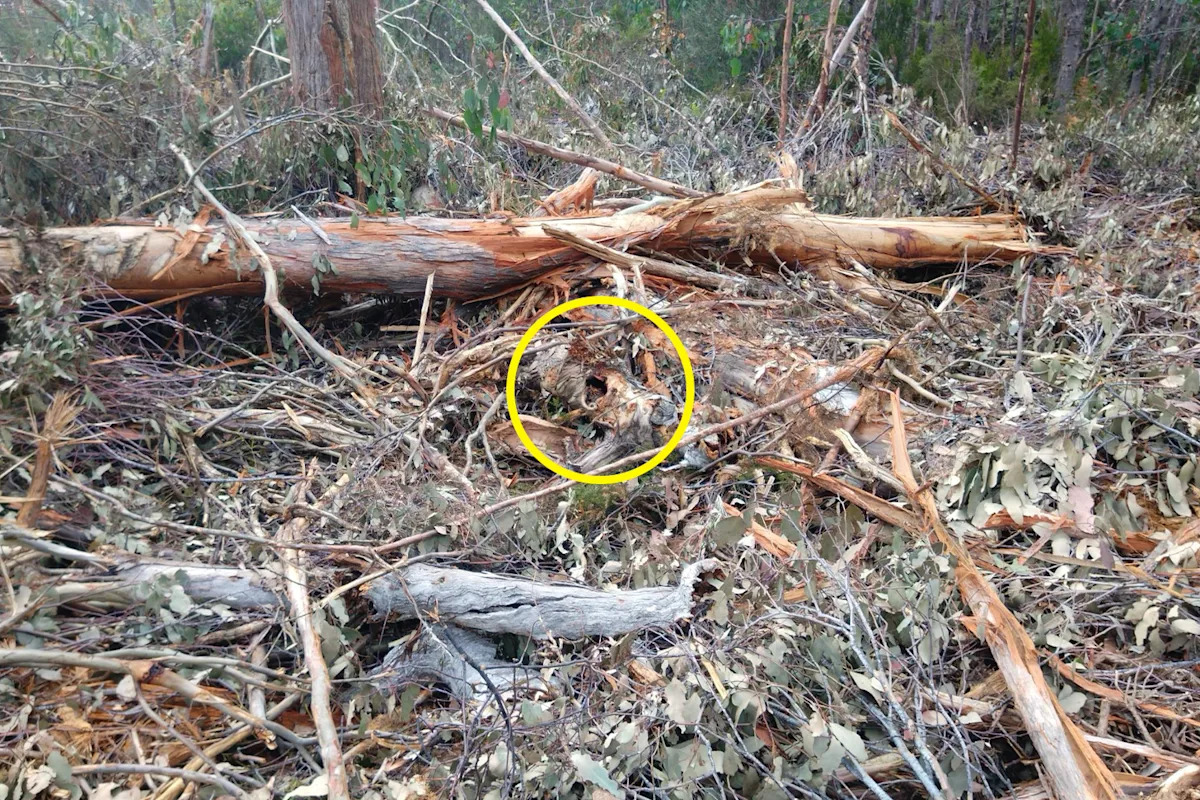
A walker has made a rare discovery inside the hollow of a towering tree that had been felled by loggers in Tasmania’s rugged Central Highlands.
Curled perfectly inside was the body of a ringtail possum that had likely called the eucalypt home.
Jenny Weber, a conservationist with the Bob Brown Foundation, explained it’s unusual to find the bodies of animals after native forests have been harvested for wood.
She compares the rigour with which forests are dismantled to an abattoir, where every piece of the cow is processed into cuts of meat, leaving little behind.
“The trees are cut down, then stripped, the hollows are cut off, and there’s nothing left,” she told Yahoo News.
It’s only the second time their investigators have found the remains of a mammal after a harvest in the state, although it’s common to find squashed Tasmanian devils on logging roads.
And there have been several unrelated incidents of animals found dead near forestry worksites in other states.
Sustainable Timber Tasmania (STT), the state government-owned company that harvests public forests, declined to comment on the death of the ringtail possum.
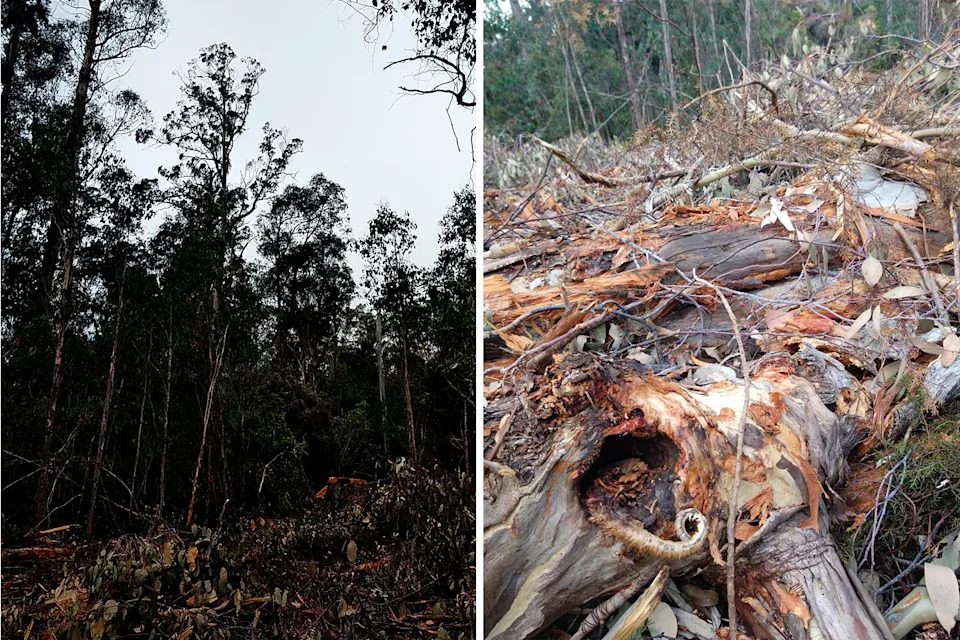
A ringtail possum’s tail could be seen curled inside the hollow of the felled tree. Source: Bob Brown Foundation
Weber said the animal’s discovery in March at Bradys Lake left her feeling “really helpless”.
“A ringtail possum isn’t an endangered species, so people probably aren’t going to care,” she said.
“But people should know ringtails sleep and nest in family groups, they’re really beautiful creatures.”
Australia divided over native forest industry
Western Australian and Victorian Labor governments have largely ceased native timber harvesting on public lands.
But in other states, including Tasmania and NSW, the industry is backed by the Rockliff and Minns governments.
While the industry provides important jobs to regional areas, felling native trees remains contentious because of its impact on native landscapes and endangered wildlife.
A 2024 Wilderness Society report estimated around 300,000 animals a year are displaced by logging in Tasmania.
Do you have a story? Contact newsroomau@yahoonews.com
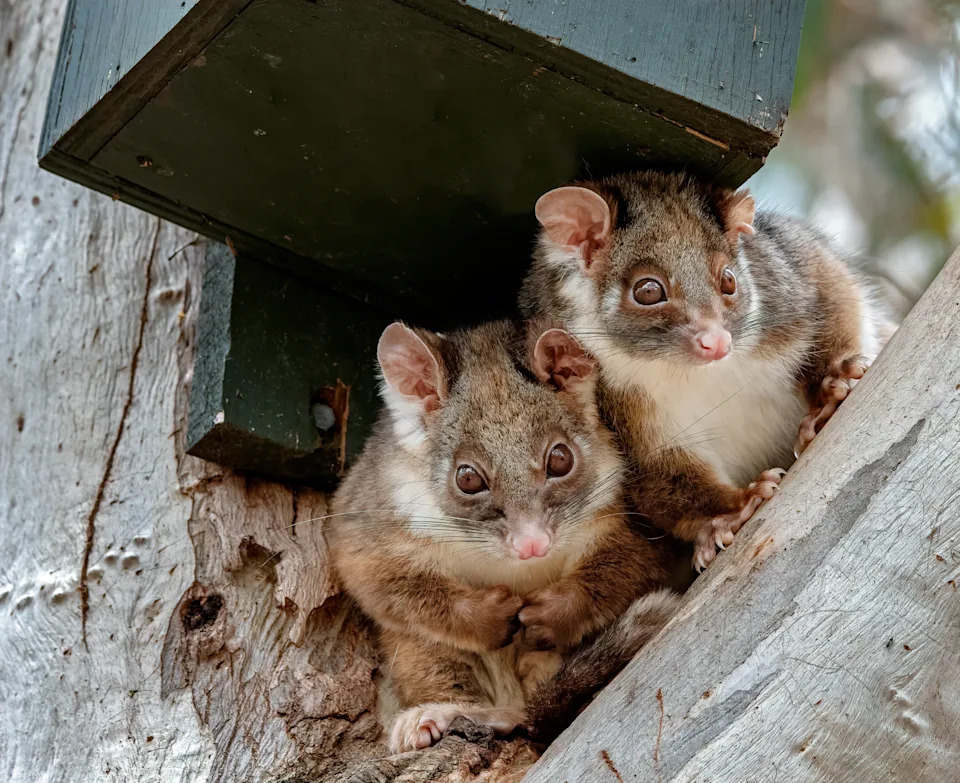
Ringtail possums live in family groups. Source: Getty
(Getty Images/iStockphoto)Timber operator argues many hollows retained
One of the most contentious forestry practices is the felling of hollow-bearing trees, because generally they only begin to form after a tree has stood for a century.
They provide critical habitat for species like masked owls, which are endangered in Tasmania, and can’t survive without them.
Responding directly to a question from Yahoo News about hollows, STT called them an “important habitat feature”.
Suzette Weeding, its general manager of conservation, noted some hollow-bearing trees are retained under the Forest Practices Code.
“Under this framework, hollow-bearing trees and other habitat values are commonly retained through a combination of wildlife habitat clumps, habitat strips, reserves and other unharvested areas, with retention planned at both the coupe and landscape scale,” she said in an email.
“In practice, that means some trees with hollows are retained in place, while in other cases habitat is protected through aggregated retention areas rather than a tree-by-tree approach.”
Do you have a story tip? Email: newsroomau@yahoonews.com.
You can also follow us on Facebook, Instagram, TikTok, Twitter and YouTube.