
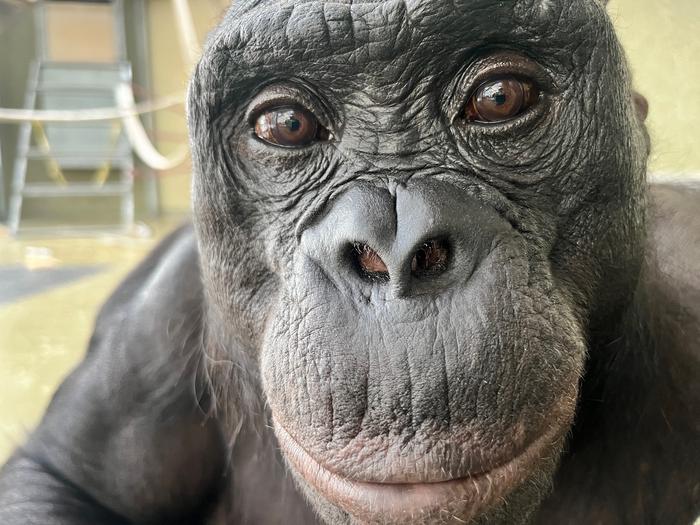
Kanzi, a language-trained bonobo, identified and tracked pretend objects across tea party-like experiments, marking the first controlled demonstration of imagination in a nonhuman animalIn three experiments, Kanzi repeatedly pointed to the correct location of imaginary juice and grapes, and chose real juice over pretend juice, showing that he understood the difference between real and imaginary objects.This study suggests that the cognitive capacity for imagination may date back 6 to 9 million years to the common ancestor of humans and great apes, though some researchers question whether simpler explanations could account for Kanzi’s responses.Kanzi died in March 2025 at age 44, but researchers hope to explore whether other apes, including those without extensive human language training, share this capacity.
See All Key Ideas
Imagine you’re at a tea party with a bonobo. What kind of tea are you serving? Are there cakes? What is the bonobo wearing? Is the ability to imagine things unique to humans? According to new evidence from Johns Hopkins University, it is not.
A study published in the journal Science in February found that a bonobo named Kanzi could identify and track pretend objects across a series of controlled experiments. This is the first time imagination has been demonstrated in a nonhuman animal under scientific conditions.
The findings suggest that the cognitive machinery underlying imagination may date back 6 to 9 million years to the common ancestor shared by humans and other great apes.
“It really is game-changing that their mental lives go beyond the here and now,” said co-author Christopher Krupenye, an assistant professor in the Department of Psychological and Brain Sciences at Johns Hopkins, in a press release. “Imagination has long been seen as a critical element of what it is to be human but the idea that it may not be exclusive to our species is really transformative.”
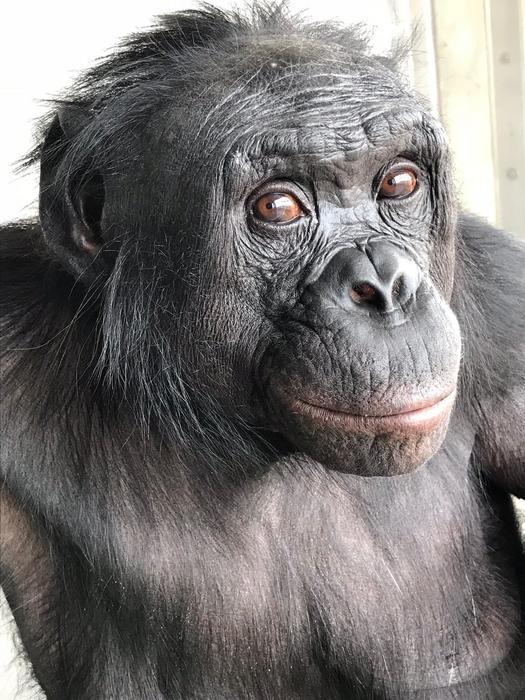 Kanzi, a 43-year-old bonobo living in captivity at Ape Initiative taught scientists about the bonobo mind. Photo courtesy of Ape Initiative.
Kanzi, a 43-year-old bonobo who lived at Ape Initiative, a nonprofit research center in Des Moines, Iowa, had been raised in a captivity and trained to communicate using more than 300 lexigrams (symbols linked to words). He could also respond to spoken English prompts.
In the first experiment, a researcher sat across from Kanzi at a table set with two empty transparent cups and an empty pitcher. The experimenter pretended to pour juice into both cups, then pretended to dump the juice out of one. That transparency was an important part of the experimental design, since it meant Kanzi could see that the cups were actually empty, reinforcing that he was tracking imaginary rather than hidden objects.
When asked, “Where’s the juice?” Kanzi pointed to the cup that still held the imaginary liquid. He chose correctly the majority of the time, even when the experimenter varied which cup retained the pretend juice.
A second experiment tested whether Kanzi might have believed the cups contained real juice he simply couldn’t see. This time, one cup held actual juice while the other was empty but had been “filled” with pretend juice. Kanzi chose the real juice roughly 78% of the time, according to Smithsonian, indicating he understood the distinction between the real and the imaginary. A third experiment repeated the concept with grapes, and yielded similar results.
“Kanzi is able to generate an idea of this pretend object, and at the same time, know it’s not real,” said co-author Amalia Bastos, a former Johns Hopkins postdoctoral fellow now at the University of St. Andrews in Scotland, in a press release.
Human children begin showing signs of pretend play by around age two, and infants as young as 15 months demonstrate surprise when someone appears to drink from a cup they just pretended to empty.
There have been anecdotal reports of pretend-like behavior in other primates. Young female chimpanzees have been observed cradling sticks as if they were infants, and a captive chimpanzee once appeared to drag imaginary blocks across the floor. But no controlled study had explicitly tested this capacity for imagination in nonhuman primates.
“This is an exciting finding that lends experimental support to anecdotal reports from both captive and wild-living individuals,” Nicholas E. Newton-Fisher, a primate behavioral ecologist at the University of Kent in England who was not involved with the study, told CNN. He added researchers likely “systematically under-appreciate the cognitive abilities of these species.”
The study was not without its skeptics. Daniel Povinelli, a biologist at the University of Louisiana at Lafayette, questioned whether Kanzi might have been responding to simpler cues, such as which cup the experimenter had most recently touched, according to Smithsonian.
Kanzi died in March 2025 at age 44, so further experiments with him are not possible. But researchers hope to explore similar questions with other apes, including those without Kanzi’s extensive human enculturation and language training.
“Jane Goodall discovered that chimps make tools and that led to a change in the definition of what it means to be human and this, too, really invites us to reconsider what makes us special and what mental life is out there among other creatures,” Krupenye said in the press release. “We should be compelled by these findings to care for these creatures with rich and beautiful minds and ensure they continue to exist.”
Banner image of Kanzi the bobobo courtesy of Ape Initiative.
Citation: Bastos, A. P. M., & Krupenye, C. (2026). Evidence for representation of pretend objects by Kanzi, a language-trained bonobo. Science, 391(6785), 583–586. doi:10.1126/science.adz0743
Bonobos, the ‘hippy apes’, may not be as peaceful as once thought
