
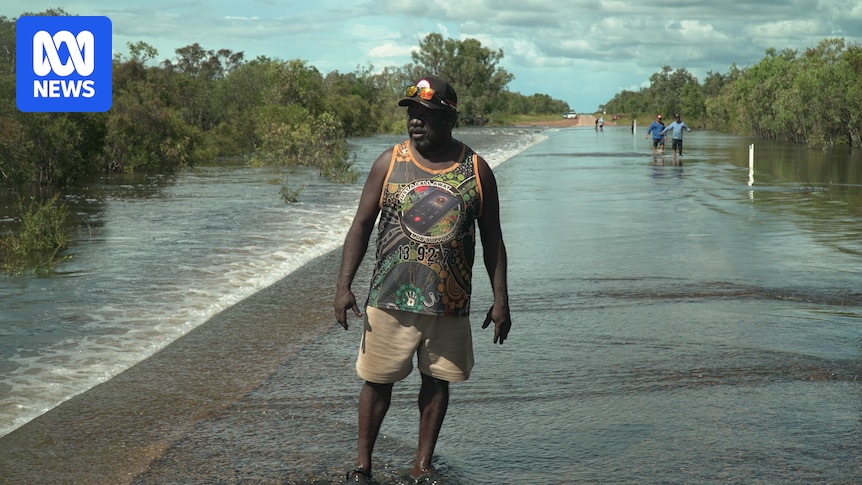
Residents from a remote Northern Territory community who have been displaced by floods have called on the NT government to release their full relief payments after they were forced to flee their homes with almost nothing.
Jilkminggan evacuees said they were blindsided by a government decision to withhold three-quarters of flood relief payments, which they needed to purchase bedding, clothes and food while they were staying in an evacuation centre in nearby Mataranka.
Loading…
They have been told the remaining money will not be paid until after they return home — the timeline for which is uncertain as heavy rainfall from Tropical Cyclone Narelle is expected across the region in the coming days.
Families lined up for the pre-paid debit cards on Tuesday and were expecting the same up-front sums — $611 for adults and $309 for children — that have been paid in full to thousands of residents of the nearby flooded regional centre of Katherine.
But Jilkminggan woman Cecilia Lake said when they spoke with Northern Territory government welfare teams, they were told they would only be given a fraction of that.
“We got up, went to line up to get our payment card and they informed us we were only entitled to 25 per cent of the payment and that we would receive the rest, the 75 per cent, when we go back to community — which is, we don’t know when,” she said.
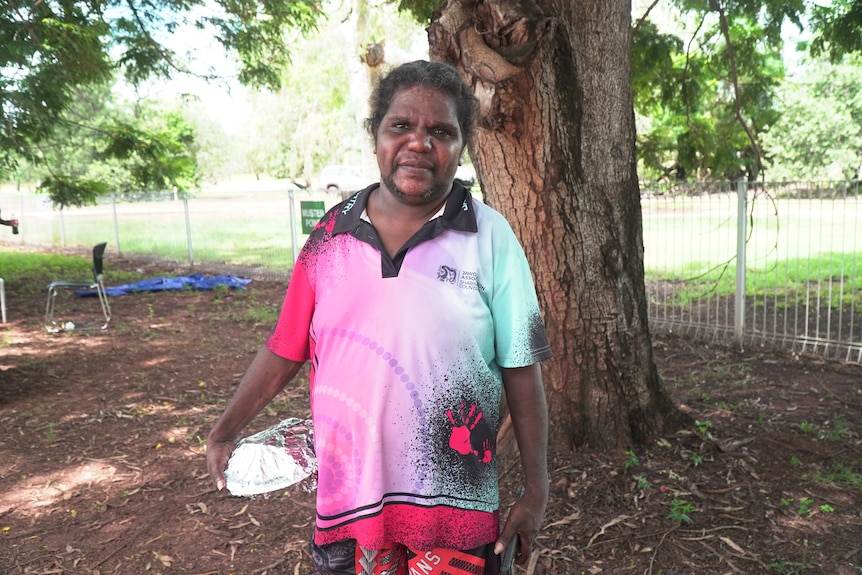
Cecilia Lake says people need the flood recovery money now. (ABC News: James Elton)
In an announcement late last week, the NT government said evacuees in Darwin from Nauiyu/Daly River and Palumpa would only receive 25 per cent of the payment now, with the rest to come when they returned home, but did not specify this for Jilkminggan evacuees.
Daly River evacuee’s heartbreak at seeing flooded community
The roughly 400 residents of the community were told to “self-evacuate” on Saturday, March 7, amid major flooding across the Big Rivers region.
Some had less than an hour to get themselves out, making treacherous crossings in overcrowded utes, while others had to be collected by boat.
Ms Lake said the speed of the exit meant many were ill-equipped for what has now been an almost two-week stay in Mataranka, around 100 kilometres south of Katherine.
“Some of us only came with a few clothes from home,” Ms Lake said.
“We need to buy clothes here in town, some of us came with one set of sheets, one set of blankets.
“The payment would have been useful, you know? Very useful.”
Authorities have told community members the incoming Tropical Cyclone Narelle — likely to have become a tropical low by the time it hits the region — will prolong their stay in Mataranka.
Rough nights on hard floors
Due to limited capacity and cultural avoidance protocols, where some family members cannot share spaces with others, Jilkminggan evacuees are spread out across several locations in Mataranka.
Many are staying in school classrooms and a council hall, while others have bought their own tents and blankets which they have set up at the rodeo grounds, in the school grounds, and outside the town hall.
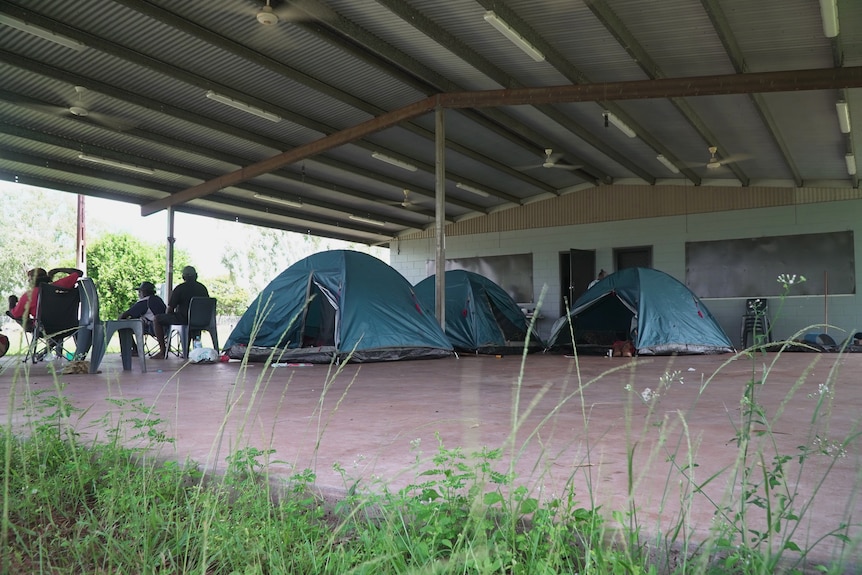
Jilkminggan people are facing weeks in temporary accommodation, cut off from their home by flooded creeks. (ABC News: James Elton)
Mattresses have been distributed by welfare teams in recent days but prior to that, many community members had spent significant time sleeping on hard floors.
Some of those staying in tents at the rodeo grounds told the ABC they had been informed by police they were not eligible for the free meals provided at the official shelters unless they were also sleeping there.
In NT Parliament this week, Children and Families Minister Robyn Cahill was asked about conditions for evacuees in Mataranka — she said there had been a “small gap” between the evacuation and the arrival of necessities such as bedding.
“Some people opted to camp out … that is entirely their decision,” she said.
25 per cent rule came as a surprise
The government announced the relief payments would be offered to residents of Jilkminggan and Wugularr/Beswick on March 12, but did not make clear that they would only receive a portion of the total amount.
“Nobody mentioned 25 per cent so we were all confused on that part,” Ms Lake said.
“Most of the people are on social media, they watch the news.
“They were expecting this payment to be in full.”
Ms Lake said when she questioned the policy, the welfare team could only say it was a decision of the “big bosses” and could not explain it.
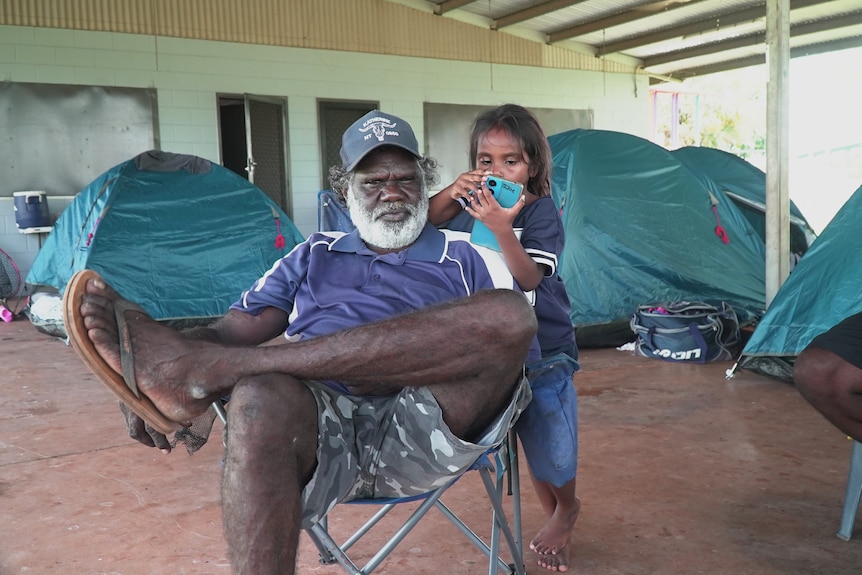
Some Jilkminggan residents are camping in tents, and others are sheltering in classrooms. (ABC News: James Elton)
An NT government source told the ABC the rationale was to encourage spending in local shops when communities reopened.
But Mangarrayi traditional owner Ozzie Daylight, who runs the local men’s ranger group, said the moment for financial help was now, while community members were stranded.
“They really need the money,” he said.
“Even myself, I really need the money.
“I’ve got a granddaughter I’m looking after … and all them other ones, all my cousin-brothers.”
In a statement, the Department of Children and Families said the Mataranka shelters had originally been designated as “emergency shelters” but then later transitioned to “evacuation shelters”, which triggered government assistance with food and bedding.
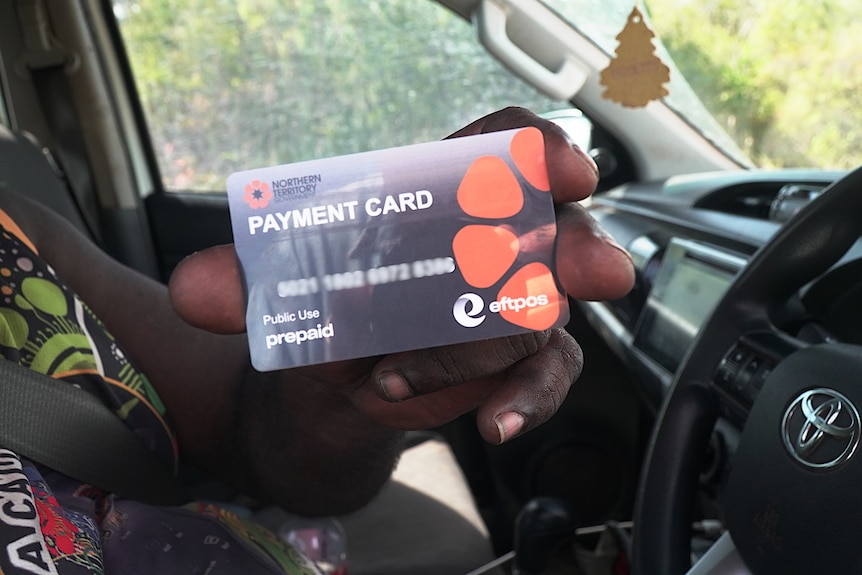
Resident Cecilia Lake says residents expected the payments in full. (ABC News James Elton)
“People are asked to bring their own food and supplies for the first few days — this is standard practice across the Territory,” chief executive Brett Warren said.
“Immediate Relief Payments are designed to help people meet essential needs immediately after an emergency. For remote communities staying in evacuation centres for an extended period, payments may be staggered so support is available both now and when people return home.”
The department did not respond to questions about why the 25 per cent policy was not publicly communicated for Jilkminggan, as it has been for other remote communities.