
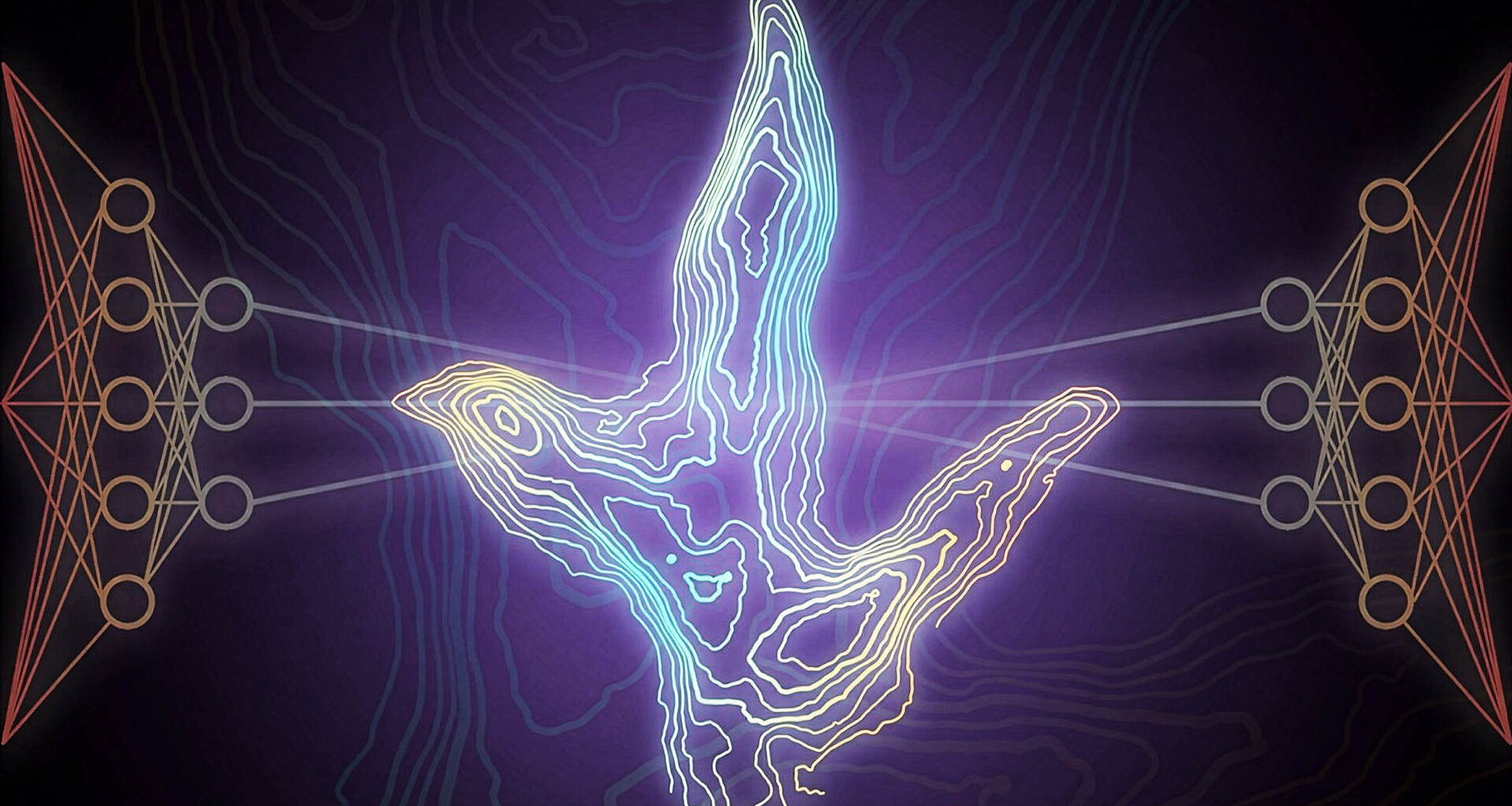
For more than a century, dinosaur footprints have been both a gift and a headache. They’re some of the most direct evidence we have of animals moving through real landscapes, but they’re also notoriously hard to interpret.
A footprint is not just a “stamp” of a foot. It’s a record of soft mud squishing, toes sliding, edges collapsing, and later erosion that rewrites the shape.

That’s why researchers can look at the same trackway and still argue over whether it came from a predator, a plant-eater, or something in between.
A new study suggests artificial intelligence can help bring order to that mess.
Researchers have created a tool called DinoTracker, a mobile app that lets people upload a photo – or even a sketch – of a dinosaur footprint and get an instant analysis of which kind of dinosaur may have made it.
Footprints don’t fossilize in a neat, standardized way. Two animals with the same foot anatomy can leave very different tracks depending on the sediment, the moisture, how fast they were moving, and how much the ground deformed under their weight.
On top of that, a can change after it’s made. Sediment can compact, edges can crumble, and later weathering can erase or exaggerate details.
Because of all this, traditional footprint research often depends on expert judgment and careful comparison with known examples.
Many older computer-based methods relied on researchers to manually compile datasets.
In those datasets, researchers assigned tracks to specific dinosaurs, a step that can introduce bias or reinforce assumptions.
AI was trained to “see” variation
The team behind DinoTracker was led by researchers at a Helmholtz Research Center in Berlin, working with colleagues at the University of Edinburgh.
Instead of trying to force footprints into overly tidy categories, they trained their algorithms to recognize how tracks realistically vary.
The AI learned from nearly 2,000 real fossil footprints, but it also trained on millions of simulated variations designed to mimic what happens in nature.
Those extra versions reproduced effects such as compression, edge displacement, and other distortions.
These changes can make the same kind of footprint look different from one site to another.
From there, the system learned to focus on a set of key traits that help distinguish trackmakers even when the print isn’t perfect.
The research describes features such as how far the toes spread, where the heel sits, how large the contact area is, and how weight seems to be distributed as the foot hits the ground.
When AI agrees with experts
After training, the model was tested by asking it to predict which dinosaur likely made a footprint by comparing it with existing fossil tracks.
According to the article, the algorithm reached around 90 percent agreement with classifications made by human experts, including cases that are usually controversial.
That doesn’t mean the AI is “right” in some absolute sense. Footprints can be ambiguous, and paleontology often deals in best-supported interpretations rather than certainty.
But a system that performs at that level can act as a consistent second opinion and highlight which tracks deserve closer study.
One of the most intriguing findings came from very old footprints, more than 200 million years old. The AI flagged several tracks that share unusually bird-like features, resembling prints associated with extinct and modern birds.
The researchers suggest two possibilities. Either birds could have originated tens of millions of years earlier than many timelines assume, or some early dinosaurs had feet that coincidentally looked very similar to birds’ feet.
The result doesn’t settle the debate, but it strengthens the case that footprints may contain signals that have been underappreciated.
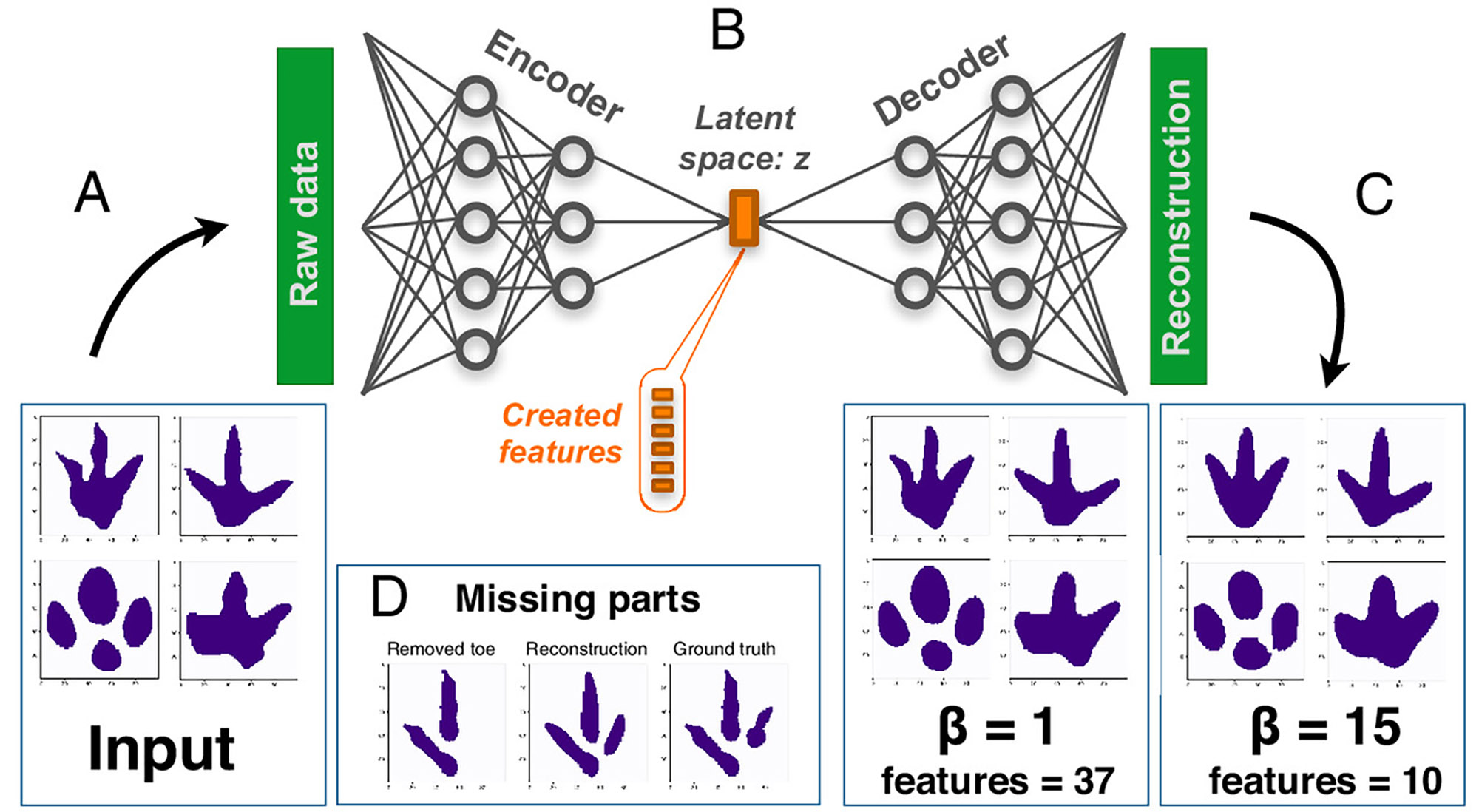 The disentangled variational autoencoder method. Silhouettes of dinosaur footprints (A) are processed through an artificial neural network (B) with a dimensional bottleneck in its center. Credit: PNAS. Click image to enlarge.Scotland’s tracks get reexamined
The system also took a fresh look at puzzling footprints from the Isle of Skye in Scotland. These tracks were made around 170 million years ago on the muddy shore of a lagoon, and they’ve been difficult to confidently assign to a specific dinosaur group.
Researchers say the AI points to some of the oldest known relatives of duck-billed dinosaurs as the trackmakers.
If that interpretation holds up, it could shift how scientists think about when and where that lineage began to spread.
Taking AI to real tracks
DinoTracker isn’t just a research demo; it’s designed for broader use. Footprints are one of the most common kinds of dinosaur evidence that people encounter in the wild, and an accessible tool could help both scientists and the public.
In research settings, it could help screen large numbers of tracks quickly and identify patterns across sites. In education, it turns footprints into something interactive rather than purely descriptive.
And for fieldwork, it offers a fast way to test hypotheses on the spot, especially in places where track interpretation has traditionally depended on whoever happens to be standing there with experience.
“This study is an exciting contribution for paleontology and an objective, data-driven way to classify dinosaur footprints,” said paleontologist Steve Brusatte from the University of Edinburgh.
“It opens up exciting new possibilities for understanding how these incredible animals lived and moved, and when major groups like birds first evolved.”
Turning mess into meaning
Dinosaur footprint research probably won’t ever be fully settled by an app. Tracks are messy, and the past doesn’t come with labels. But this study points to something valuable: a tool that treats variation as information instead of noise.
If DinoTracker can reliably recognize how real footprints warp and still connect them to likely trackmakers, it could speed up research, widen participation, and push debates onto firmer ground.
And maybe it also does something else: it makes the ancient world feel a little more reachable. A footprint is a moment of contact between an animal and the ground beneath it.
If we can read those moments more clearly, we get closer to understanding how dinosaurs actually lived, moved, and evolved.
Image credit: Tone Blakesley
The full study was published in the journal PNAS.
—–
Like what you read? Subscribe to our newsletter for engaging articles, exclusive content, and the latest updates.
Check us out on EarthSnap, a free app brought to you by Eric Ralls and Earth.com.
—–