
On many weekend mornings, several balloons will launch together across the region.
“It’s not unusual to see seven of us out there on a Saturday morning,” Anderson said.
He said ballooning was also attracting a younger generation of pilots.
“The best thing at the moment is we’ve got a way younger demographic starting to come through now,” he said.
“There’s a good few circles of younger pilots.”
Anderson has flown balloons for about four years, but his fascination began much earlier.
“I grew up in Levin and followed them around on my bike every time I saw them,” he said.
His first experience in the air came early on.
“I got dumped in a basket at the age of 9 for a flight with a complete stranger,” Anderson said.
“That kind of stuck with me.”
He later stepped away from ballooning while travelling and working, before rediscovering it after moving to Hamilton during Covid-19.
“I kind of moved to Hamilton, on accident, over Covid and decided to get back into it,” he said.
“I haven’t really stopped since.”
Flights during Balloons over Waikato usually take place early in the morning when winds are light and stable.
Pilots typically spend about an hour in the air, although the distance covered can vary widely, due to the wind.
“On an average morning we’ll fly for an hour, depending on the winds,” Anderson said, adding that the balloons might fly 20km or just 3km.
Some pilots also take part in long-distance competitions that push both endurance and planning skills.
Anderson said he once travelled more than 100km during a single flight.
“We’ve got a long-distance competition in New Zealand,” he said, adding that he had once done about 116km over a four-hour flight.
Flying a hot-air balloon requires constant planning because pilots cannot steer directly like a plane.
“All of our control is vertical,” Anderson said.
“As you go up, you’ll go through several different layers of wind.”
Each layer can push the balloon in a different direction.
“Sometimes you can go from zero feet to 2000 feet and you might only get a few degrees of steerage,” he said.
“Other mornings, the more you go up and down, you can pretty much fly around in circles.”
That means pilots must think well ahead of where they want to go.
“It’s not as easy as saying I want to turn left,” Anderson said.
“If you want to turn left, you need to think about which height will take you that way and when to move up or down.”
“You’re always thinking about 20 minutes ahead.”
The structure carrying the basket and passengers is simple but strong.
“These wires attach the frame, and that’s what supports the whole basket while we’re flying,” Anderson said.
“There are four of them that cross over, so you’re essentially hanging from those four wires.”
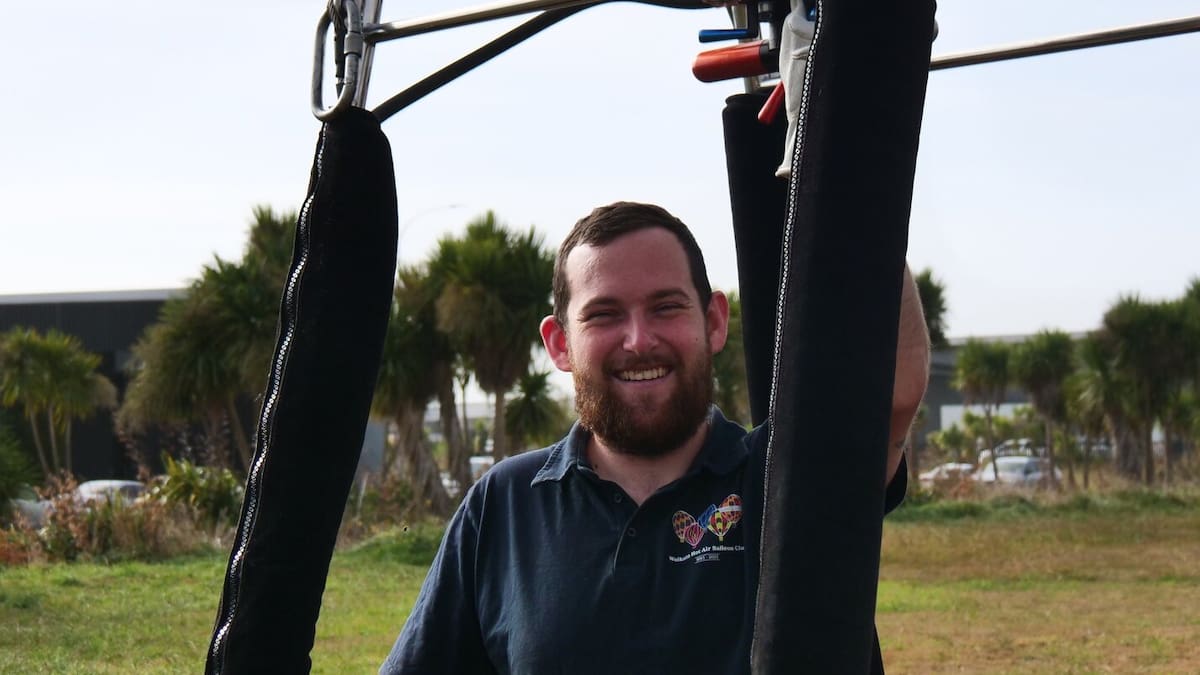
Hamilton pilot Joshua Anderson. Photo / Tom Eley
Those wires connect to thick fabric straps that support the wicker basket and the balloon envelope above.
Ballooning itself dates back centuries.
“The first part of ballooning in France was essentially a big fire lit under a basket,” Anderson said.
The earliest passengers were animals used to test whether flight was safe.
“The first passengers were a sheep, a duck and a chicken.”
Once those animals survived the flight, inventors moved on to human passengers.
“They were like, well they didn’t die, let’s try it with a person,” Anderson said.
Later balloons used gases such as helium or hydrogen, with pilots controlling altitude by releasing sandbags.
Modern hot-air balloons developed during the early to mid-20th century.
Despite improvements in materials and equipment, the basic principle has changed little, Anderson said.
Many balloons still use traditional wicker baskets because they handle landings well.
“They’re incredibly absorbing if you have to land hard at all,” Anderson said.
Newer designs also exist.
Some baskets include doors to help passengers with limited mobility, while others use lightweight frames.
“You get people who have baskets made of fabric and a frame,” Anderson said.
“They fold down so you can get a hot air balloon in the back of a small car.”
The Balloons over Waikato Festival runs from March 21-28.
Event details at balloonsoverwaikato.co.nz/this-years-festival/.
Tom Eley is a multimedia journalist at the Waikato Herald. Before he joined the Hamilton-based team, he worked for the Weekend Sun and Sunlive. He previously worked as a journalist at Black Press Media in Canada and won a fellowship with the Vancouver Sun.