
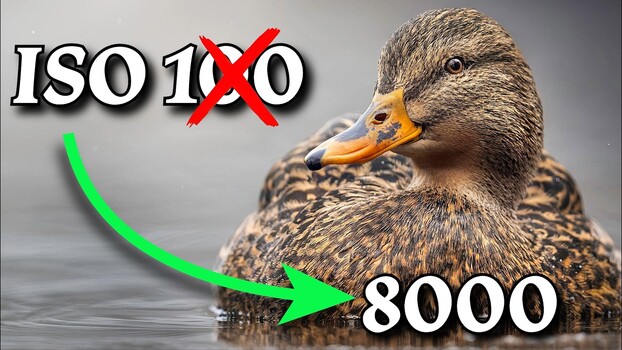
Keeping your ISO at 100 sounds responsible, but it may be costing you sharp, usable shots. This video argues that treating ISO as a strict limit rather than a flexible tool leads to sacrificed shutter speed, compromised stability, and missed moments.
Coming to you from Matt Shannon, this practical video breaks down how ISO actually works and when pushing it higher is the right call. Shannon explains ISO as a volume knob: the light hitting your sensor is the signal, and ISO amplifies it. He walks through static shooting situations, like tripod-mounted landscapes of waterfalls or cityscapes, where low ISO makes perfect sense because nothing is moving and you can let in plenty of light with a slow shutter speed. But the moment anything in the frame starts moving, that calculus changes fast.
One of the more interesting examples Shannon shares involves photographing trains in the Canadian Rockies during the first snowfall. Without the train, a long exposure at low ISO would have worked fine. With it moving through the frame, he had to raise the ISO to get a fast enough shutter speed to keep it sharp. He compares two versions of the shot side by side: one with the train sharp and some visible grain, one with the train blurred and almost no noise. His preference is clear, and so is the reasoning. He also gets into wildlife, specifically how the best light for shooting animals, early morning and late evening, is also the hardest light to work in. His photos of ducks on a frozen pond, shot at high ISO, held up well enough to be among his favorites. Some of his award-winning wildlife images were captured at high ISO settings.
Shannon also covers a few practical strategies for getting cleaner results when you do shoot at high ISO. He recommends getting your composition right in camera rather than cropping later, since cropping magnifies noise. He warns against intentionally underexposing to keep the ISO low, then trying to recover brightness in post. That approach, he says, creates more noise than simply raising the ISO in the field would have. He also touches on a camera setting he returns to often: manual mode with auto ISO, which lets you lock in shutter speed and aperture while the camera handles exposure automatically. This is especially useful for wildlife, where the action moves faster than you can adjust three separate controls. The video also briefly covers dual native ISO sensors, using the Nikon Z9 as an example of how modern camera technology has pushed high-ISO performance well beyond what was possible 15 years ago. Shannon doesn’t go deep on the technical side of how dual gain sensors work, but he gives enough context to make it relevant.
Check out the video above for the full rundown from Shannon, including his side-by-side shot comparisons and his complete breakdown of how he adapts his shooting style in the field when light gets low.