

Exit Strategy
Season 1
Episode 8
Editor’s Rating
3 stars
***
Photo: FX
Love Story’s bottle episode is here, and at long last, it contains an argument that escalates with believable momentum and airs out a slew of resentments that, so far, had been mostly contained. Paul Anthony Kelly puts in a good effort, and Sarah Pidgeon — by now probably sick and tired of crying her eyes out — commits to soap-opera levels of big emotion. By narrowing in on the emotional complexity of John and Carolyn’s relationship and relieving itself of the burden of doubling as a Pinterest board, “Exit Strategy” finally offers something close to fascination. I would have given it a fourth star if it weren’t also the penultimate episode of the season.
To be taken so close to these characters’ humanity, their deepest vulnerabilities, only to watch them die next week, doesn’t sit right with me. We all know what happened: It’s why we’re watching. Love Story knows it, too, which is why it opens with Carolyn, John, and Lauren boarding a plane we know will never safely land. The sliminess of manipulating real tragedy like that notwithstanding, it’s lazy, cheap writing to appeal to the characters’ flaws in the moment before they die, thereby ensuring our shock and sympathy. “Exit Strategy” closes with Carolyn sobbing, alone, in their apartment. By making this register the emotional climax of the season, the show leaves us with the impression that John and Carolyn’s relationship was more messed up than fulfilling or loving. Of course, we don’t know what it was really like. Maybe that’s what the show should have concerned itself with the whole time; relying on inelegant tragedy-porn makes it no better than the sleazy tabloids it’s setting out to critique. Even more offensively, this approach cuts writing corners. I wanted to experience their messy human complexity the whole time! Why did we spend seven episodes looking at dolls?
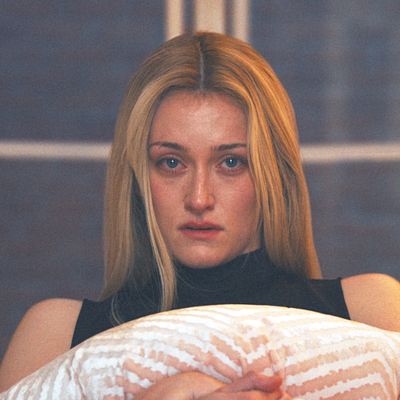
Speaking of dolls, “Exit Strategy” begins with Carolyn sitting in various tableaux, smoking and looking sullen, her body posed in ways that suggest entrapment. When John gets home from “a mediocre book party in midtown” — they spit out midtown like it’s an unconscionable part of the city, the reason for the party’s mediocrity — Carolyn, who had been crying, is comforted by his presence if slightly withholding. The crack in the foundation of their relationship appears when John says that he misses the way his wife “used to walk into a room and own it.” Still helpless in the face of her new, ultrapublic life, and at a loss for how to re-center herself and her needs and wants within it, Carolyn has been spending most of her time in the loft. To her, John’s insistence that she return to their social commitments doesn’t feel like it’s coming from a place of concern. It’s more like he wants them to be seen together, to avoid any speculation about the state of their marriage. He admits it’s true, though he also acknowledges that, as Carolyn tells him, people will invent stories anyway.
In an effort to nudge them out of this inertia, Carolyn suggests they go on a vacation somewhere the paps can’t find them, but John reminds her they are booked from late August until January, including an upcoming weekend in Hyannis, which, according to Carolyn, does not count as a vacation. She rattles off a number of stuffy Kennedy Compound rules: You can’t watch TV during the day, have yogurt for lunch, or read Vogue. (Only magazines that are “spiritually a book,” like The New Republic, are allowed. I wonder if George passed the test?) Besides, it’s impossible for Carolyn to relax when she feels perpetually on the verge of saying, doing, or suggesting the wrong thing, like she is a “living, breathing report card.” Despite being amused by Carolyn’s caricatured picture of his family, John is too dense to see that what she is really saying is that the Kennedys are only another facet of the public who gawks at her every move: The only place where she is not being constantly judged is in her own apartment, which is why she stays there.
The most telling rift in their perspectives is that where Carolyn sees rules, John sees “norms”; where she sees “sadistic” expectations, he sees “specific” expectations. In other words, John’s worldview is that certain norms are meant to be followed and maintained, whereas Carolyn charged through life breaking them. Their conversation is interrupted by a call from Lauren, who urges them to turn on the television. The news shows that Princess Diana has been in a car accident. Caroly is immediately affected, glued to the TV; John, suddenly irritable, retreats. The broadcast echoes the tones of their earlier conversation, showing how Diana’s “private” Mediterranean cruise had been spotted and photographed by the tabloids.
John goes for a run, and when he comes back, Diana’s death has been announced. Carolyn, whose position in America’s preeminent political dynasty is a counterpart to Diana’s place in the royal family, is spooked, to put it mildly. It occurs to her that Diana “did everything right, she posed for every photo,” and still “they killed her.” John’s reaction is to turn off the TV: To think of the two princes being woken up to the news that their mother is dead — news which, by now, the whole world knows — hits too close to home. Yet he sounds bitter when he says that their experience will be completely different from his and Caroline’s, pointing out that he “rode his bike to school” by way of illustration. I was confused by this, and so was Carolyn, but John doesn’t want to talk about it. In fact, that she even asks him to say more angers him. Ultimately, he blurts out that he doesn’t remember his father’s death as much as he does his mother’s grief, in itself a kind of death. Carolyn’s withdrawal into depression reminds him of his mother’s own. “Why couldn’t she play with me?” he cries. This is the level of saccharine writing we’re dealing with.
One year later, John and Carolyn are still fighting about her reclusiveness. John is in crutches after crashing in a Buckeye — a kind of motorized parachute that Carolyn calls a “lawn-mower contraption” — but eager to complete the 40 hours of flying he needs to become instrument rated. More foreshadowing of their plane crash is worked in, as if Diana’s death and the mere fact of this being the season’s penultimate episode wasn’t enough: A pilot is instrument rated when they are trained to fly in low-visibility conditions, without visual reference. And Carolyn sides with Caroline that he should give up flying altogether. If, before, John and Carolyn’s relationship was defined by a witty playfulness, now they bicker with hardened resentment. Carolyn is annoyed that, over a dinner hosted for “her” friends — a topic to be fought over — John suggested that she work with a friend who is a jewelry designer. That he can’t understand the difference between fashion PR and jewelry design is proof that he doesn’t care about her qualifications or interests.
As their fight escalates, Carolyn accuses John of being embarrassed that she doesn’t have “a thing.” When Carolyn says that “it’s not enough to be a Kennedy,” John shrugs his shoulders: It’s true, another Kennedy norm. Carolyn feels lost, and she wants to be allowed to feel that way, to take her time figuring out what to do with her life. (I hate to say I told you so, but she shouldn’t have quit that job …) John, unhelpful as ever, points out that his mother “turned her life around” and became a book publisher at 46 years old. When Carolyn makes the great point that Jackie didn’t do that until she was a widow (meaning, she had already learned how to be a public figure by then), John makes a nasty dig: Jackie would have never approved of their marriage. Carolyn throws it back in his face that her mother doesn’t approve of their marriage, either.
You don’t have to be a therapist to see, clear as day, that John’s anger is projection. He hasn’t been able to figure out his “thing,” either. The difference is that, while Carolyn struggles to define herself against expectation, John has always obliged expectation. He at least tried to be a lawyer, he indulges the press and the public, and he’s even considering a run for Senate, which Carolyn accuses him of doing “out of a misplaced sense of obligation” rather than personal conviction. His frustration with the fact that he failed at everything he set out to do — be a lawyer, a magazine publisher (maybe he should have listened to Berman), and now, apparently, a husband — is a product of how bound he feels to these choices. Carolyn angrily brings up the point Ann made to her the day they got married: While John’s life has stayed exactly the same, Carolyn has had to change every single thing in hers. His response: “That’s your choice.” It’s probably the worst thing he tells her, even worse than his proposal that they set aside two days a week to have lunch together. My guy, you are talking about your wife, not your college friend who’s visiting town.
John makes a good point that Carolyn is becoming a victim of her own lack of agency, forgetting that she is capable of doing with her life what she will, just as she did before she became a Kennedy. But he doesn’t know how to make it, instead accusing her of “having no identity outside [her] victimhood.” Their fight reaches a breaking point when Carolyn says that she is “another tragedy” he has to endure. John packs a bag and decides to go to a hotel for a couple of days, though Carolyn begs him not to leave. This is when Pidgeon goes full berserk, maybe too over the top for such a bad fight: Carolyn is desperate, but she is also fuming. John promises to come back and makes a point out of telling her he loves her before leaving, but it’s implied that something irreparable breaks when he walks out the door. That’s in their relationship, but maybe just as important, in John’s self-regard, too. Seeing Carolyn’s tortured journey toward self-definition, it becomes obvious that John has never attempted to define himself at all.
• I guess my dream that Love Story would turn into a political conspiracy thriller will remain just a dream. I’m interested to see if and how the finale will weave in this tentative subplot about John’s potential run for Senate.
Sign Up for the Vulture Newsletter
Entertainment news, for the pop-culture obsessed.
Vox Media, LLC Terms and Privacy Notice