
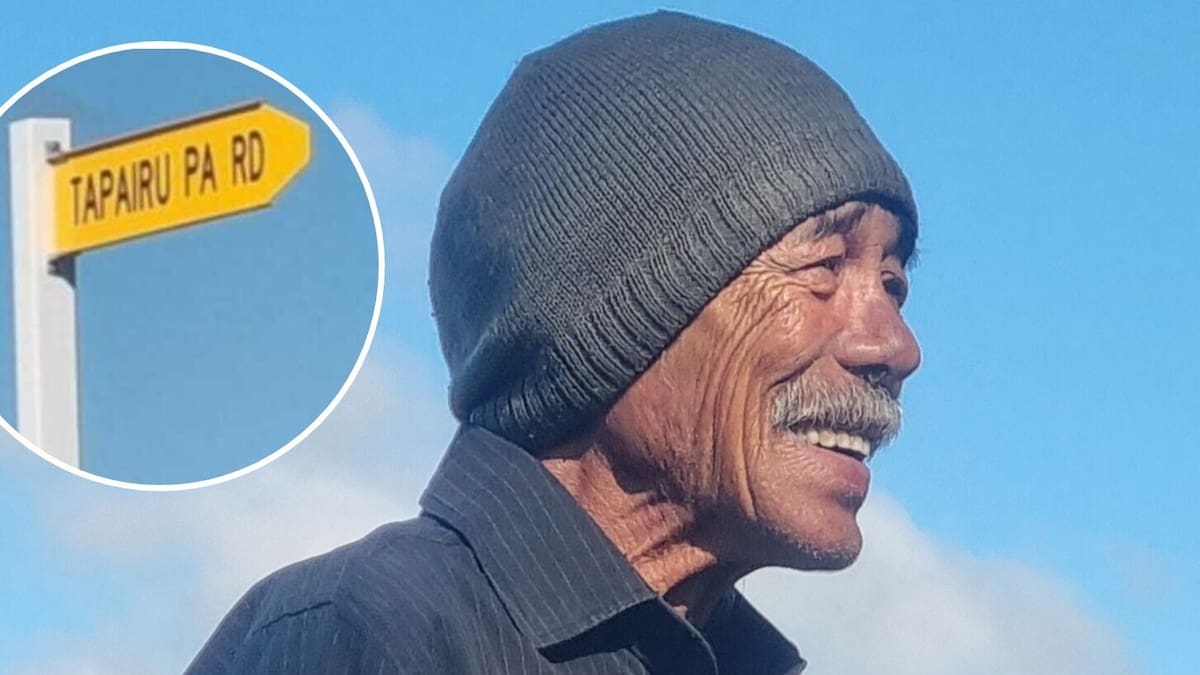
White grew up at Tapairu and remembered throwing stones at the sign while he waited for the school bus as a boy.
“I remember then it said Tapairu Pā Road. At some stage when I was overseas working, it was changed. I came back and the word Tapairu was gone.”
Tomoana was incensed and began a campaign that would last for years.
“The name is the most important part.”
Tomoana White is pleased to see the historic Tapairu Pā Rd sign reinstated. Photo / Central Hawke’s Bay District Council
He took down the offending sign, and the council reinstated it, about eight times.
Eventually, Tomoana appeared in court for the destruction of the signs.
“I nearly went to jail. But those signs didn’t belong there.”
Eventually, the signs stopped being replaced, and the name was painted correctly on the tarseal.
Now, the council has installed new road signs.
“I thought I would never see it,” said White.
“I’m old now, and it’s been going on so long.”
The reason the sign was changed is not clear, but the Tapairu Marae Committee was adamant the original name needed to be reinstated, as it was named for the history of the Tapairu Pā and the surrounding land.
The pā (now Tapairu Marae) was established across the river from the growing town of Waipawa.
It hosted hundreds of Māori who came to appear at the Native Land Courts and, later, before the Hawke’s Bay Native Lands Alienation Commission.
The pā was named for the Rangitane chieftainess, Te Ruatotara, who married Tutaua, the chief of Tukipoho Pā on Ongaonga Rd. Tapairu means high chieftainess.
Bevan Thompson, left, and Amiria Nepe-Apatu attended an emotional ceremony to bless the new signage. Photo / Central Hawke’s Bay District Council
The council’s marae representative, Bevan Thompson, raised the issue with the council and, after six years of advocacy, said he was pleased it had changed.
Land for the pā was gifted by Nepe Apatu, and the pā originally occupied the area that is now the Waipawa Golf Course and the Waipawa Pāckhouse.
Nepe Apatu married Amiria Ropiha from Pari o Mahu and they lived at Tapairu.
Amiria longed for her family, so Apatu gifted land to her brothers so they could move to be near her.
Repeated flooding forced the pā to move to higher ground in about 1867, and Amiria gifted land and her homestead to Tapairu Pā, allowing it to move to its current site and away from the risk of flooding.
The road leading to the pā was logically named Tapairu Pā Rd.
CHB District councillor Amiria Nepe-Apatu attended an emotional ceremony to bless the new sign this month.
“Ka mate kainga tahi, ka ora kainga rua,” she said.
“When the first home is destroyed, the second home will survive.”
Currently, the sign is spelled without a macron in “Pa”, but after Hawke’s Bay Today inquiries, CHB District Council group manager of infrastructure and asset management Mark Kinvig said this too would be corrected.