
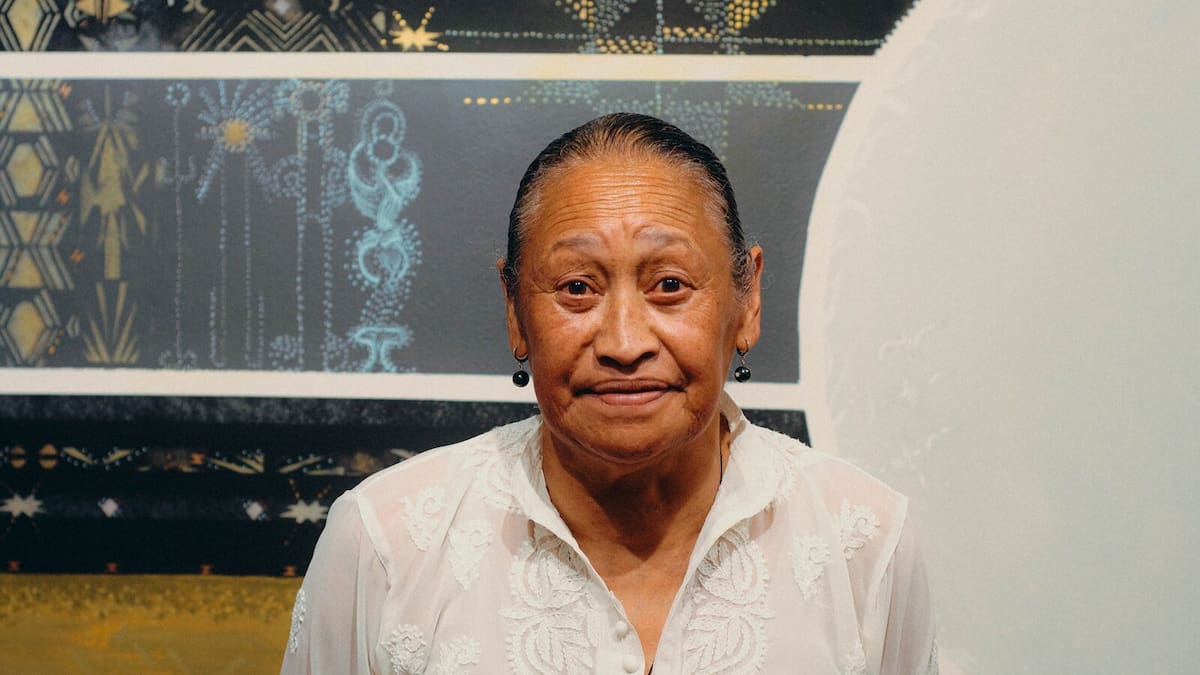
I was born here in Hastings, but I went to live in the Bay of Islands for most of my childhood. My mother’s from Pakipaki, just outside of Hastings.
She used to bring us back here every Christmas, and I didn’t really know why. But it was to keep the connection here. I always knew this was home.
I went to art school, the Toimairangi School of Māori Visual Arts here in Hastings, after living overseas for 32 years. I went there to learn about me as a Māori person.
Ruebena Paraha’s Wayfinding is showing at Te Whare Toi o Heretaunga Hastings Art Gallery.
You spent more than three decades overseas – in places such as Germany, Melanesia, Micronesia, Polynesia, Oceania and India. What took you overseas?
I went to school in Auckland, in Mt Albert, a Catholic boarding school for girls. When I left school, I decided, because everybody I knew was going to university, that I was going to do the university of life, I was going around the world, I was going to learn.
It was purely wanderlust. I always meant to come back here to New Zealand in my 60s, and I did.
Why did you choose to get into painting later in life?
I decided to walk this path, partly to learn about Māoritanga when I got back to Aotearoa.
It’s good for older people to know that you can still be good as you get older. That’s what I’ve created for myself, something purposeful to do.
What do you hope people take away if they visit the exhibition?
People’s lives and experiences are going to be in their eyes when they look, but for me, the works represent the exact keys of migration.
Some artworks reference the likes of the star compass developed by Māori navigator Sir Hekenukumai Busby, like Ātea a Rangi, the one at Waitangi Regional Park near Napier. I hope people take away a deeper understanding of migration and our place in it.
I know that a lot of people think about migrations as seven canoes arriving here, and that’s it.
But there’s all the other parts to it – all around the Pacific – and I’m including everybody.
Why is that important to you?
It makes me whole, it’s about me, learning about who I am.
Knowing why I sit here, when I came here and what I’m made of, I’m not just made of being Māori, I’m made of all these other languages and all these other people are part of us as well. And I know I understand why and how now, I didn’t before, but I do now.
Wayfinding: Ruebena Paraha Te Whare Toi o Heretaunga Hastings Art Gallery, March 7 – May 30 2026