
The galaxy stretches out as a hazy band across a dark south-eastern Australian night sky.
All is still, apart from the steady blinking of a high-altitude jet plane.
A “star” appears to streak across the sky, then another, then another … dozens in a row. All along the same path.
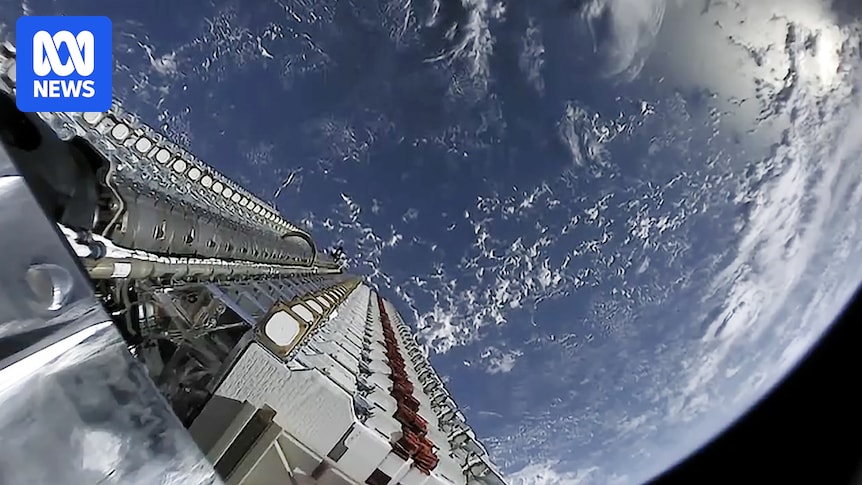
The “stars” are newly released Starlink satellites before they spread out to their final positions.
Starlink is an internet satellite constellation of about 9,600 small spacecraft in low orbit around the Earth.
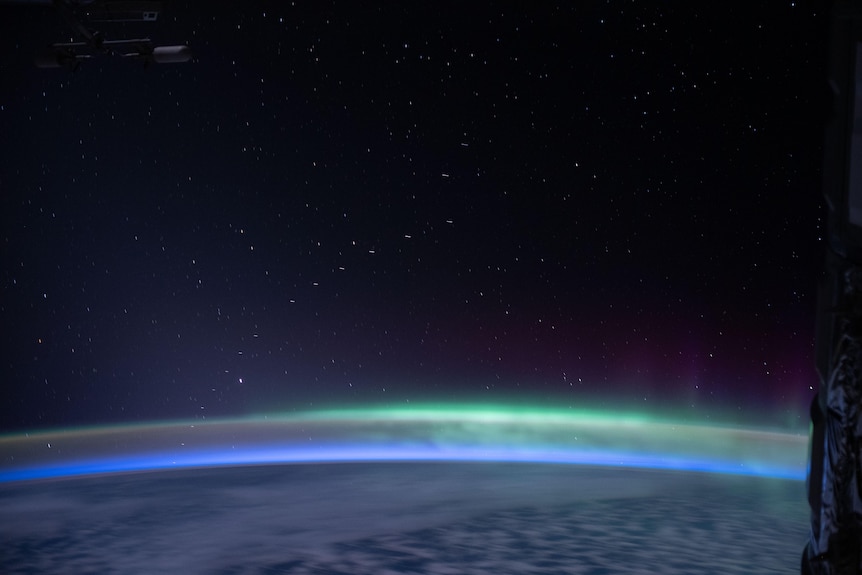
A Starlink train, as viewed from the International Space Station. (Supplied: NASA)
They represent little more than half of active satellites but a mere fraction of artificial objects now circling the globe.
Space above the Earth is filling with clutter.
Computer scientist and space junk enthusiast Mars Buttfield-Addison says there are about 33,000 objects large enough to be individually identified from the Earth’s surface.
That doesn’t account for debris too small to be seen or observed using telescopes and ground-based radar.
Ms Buttfield-Addison, who is completing a PhD at the University of Tasmania focused on tracking space debris, said about 17,500 satellites have been put into orbit since 1957 and more than two-thirds of those (about 12,000) have been launched in the past six years.
However, the overall number of individual pieces of space junk is unknown.

Computer scientist and space junk enthusiast Mars Buttfield-Addison. (Supplied: Brand Tasmania)
“The number of things that we have put up there, as in whole objects that we put in space, is much less than that 33,000 figure,” Ms Buttfield-Addison said.
“Sometimes they hit each other and get smashed into lots of tiny objects, and we then count those as separate objects.
“If we guess based on the pock-marking seen on shielding of crewed spacecraft that come back down, or things that we know about the properties of the drag in the upper atmosphere, or about the history of those kind of collisions that we see, we actually think there are millions of smaller fragments which are just too small for us to reliably see from the ground and catalogue.”
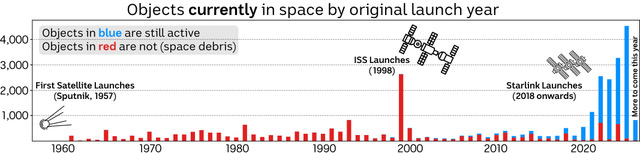
The number of objects in space is increasing. (Supplied: Mars Buttfield- Addison)
Despite an ever-increasing amount of space debris orbiting the globe, actual collisions are rare.
The number of individual objects may be large, but space is larger still.
“You must think about how huge space is,” Ms Buttfield-Addison said.
“It is a lot huger even than the number of objects we’ve put up there, so they’re not very close together by any means.”
However, there are orbits that are more cluttered than others.
The so-called geostationary ring, which is 35,786km above the equator, is where objects orbit at the same rate the Earth spins.
That means, from the point of view of someone on the ground, the object maintains a fixed position in the sky.
Scientists in the past had considered this ring to be the most likely to become overcrowded, but the more recent proliferation of objects in low Earth orbit (less than 1,000km above the surface) has meant this zone is now the one of greatest concern.
This is compounded by the orbital velocity needed to stay aloft in the low Earth orbit zone, which is 27,500km/h or more, and once satellites and space junk are on a collision course, there is little to prevent them from hitting.

Puncture damage to the space shuttle Atlantis caused by micro-meteoroid orbital debris. (Supplied: NASA)
Spacecraft in low Earth orbit rarely have propulsion capability, to reduce cost and complexity.
“They’re not sophisticated spacecraft,” Ms Buttfield-Addison said.
“Even if we find out two craft are heading towards smashing into each other, there might not be anything we can do about it if neither of them is capable of moving.”
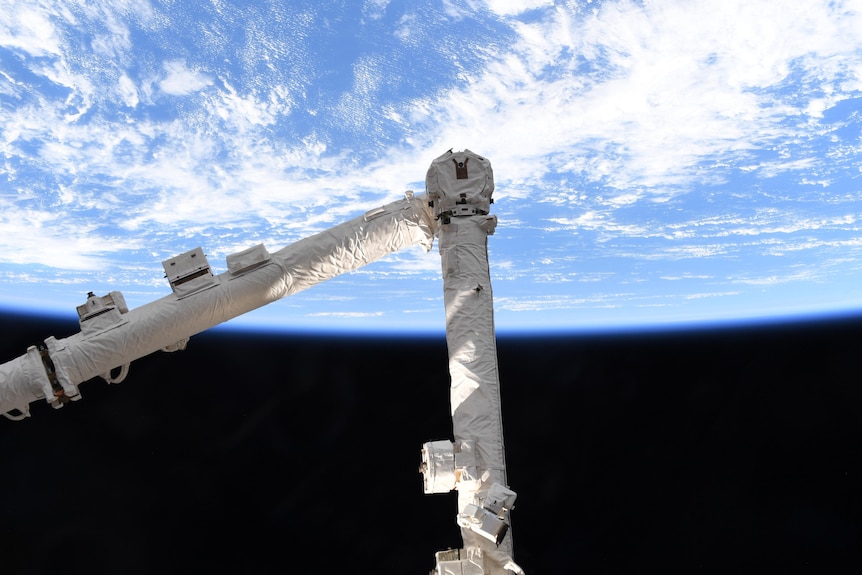
A millimetre-scale object punched a hole straight through Canadarm2, part of the International Space Station. (Supplied: A. Mogensen, NASA)
Night sky wanderers
Many satellites can be seen with the naked eye, despite their modest size, even though they don’t emit light themselves.
Ms Buttfield-Addison said the best times to see them were just before sunrise or after sunset.
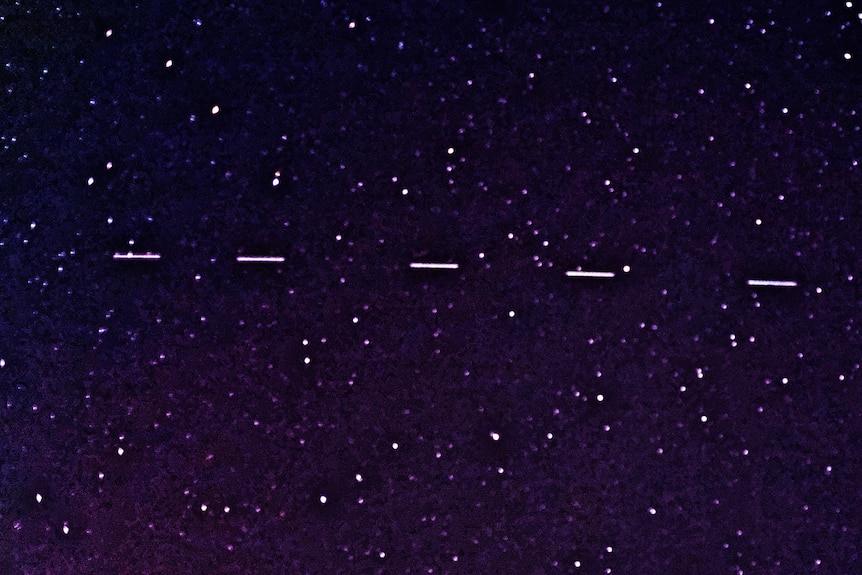
A long-exposure image shows a Starlink satellite train moving across the night sky. (Wikimedia: Jud McCranie/ CC-BY-SA-4.0)
“It’s this very specific kind of glint mechanism where, as soon as the sky behind it is dark enough, but the sun is not too far below the horizon, sunlight is glinting off those objects,” she said.
“Most people when they’re like, ‘Oh, I look up at the sky and I see satellites all the time’, it’s because they happen to be looking just after the sun goes down.”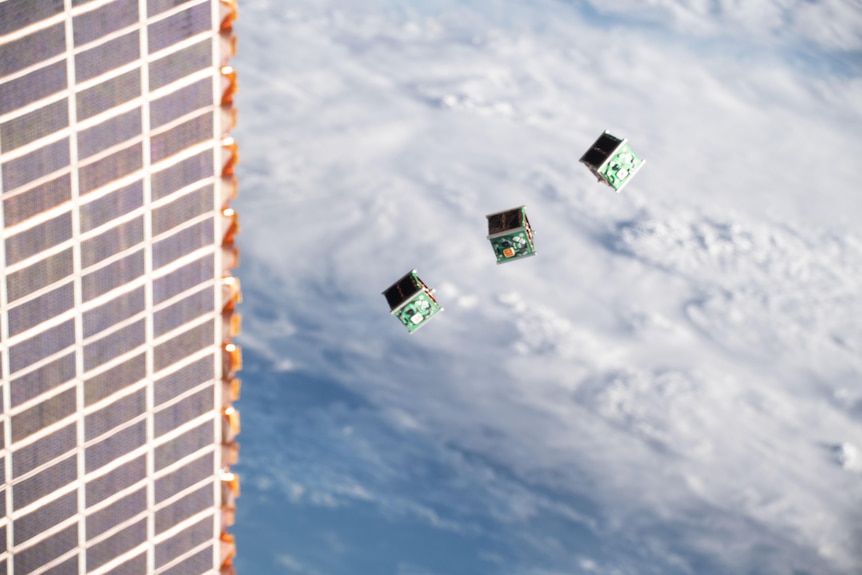
The three BIRDS-3 Project micro-satellites, developed by Japan, Nepal and Sri Lanka. (Supplied: Nick Hague)
Identifying them is more challenging but observers can pinpoint many, though, using a combination of optical telescopes and radar.
“We can recognise a surprising number of them, actually,” Ms Buttfield-Addison said.
“We’ll use optical telescopes and we can see some larger things, like the International Space Station.
“But we also use radars and they give us an impression of the shape of a thing, which is often quite a bit more informative than what you see through a telescope.
“For example, maybe you see a tiny white square. Many small satellites are the same colour, the same shape.”
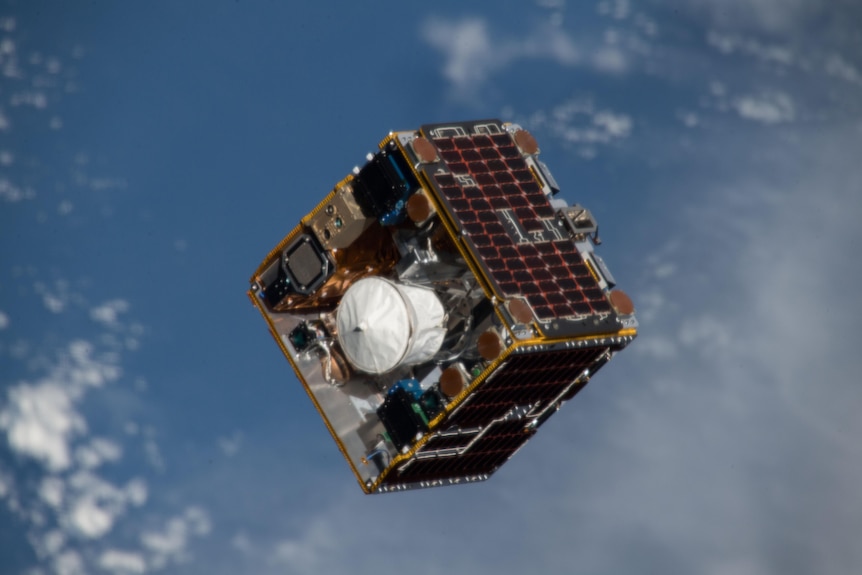
A ‘cubesat’ called RemoveDEBRIS, was intended to test space debris removal technologies. (Supplied: NASA, Expedition 56 crew)
While a lot of satellites in low Earth orbit are helping deliver internet, Ms Buttfield-Addison said that’s just a fraction of the space objects catalogued.
“Those we’ve catalogued include everything from tiny micro-satellites to huge space stations that people can go inside,” Ms Buttfield-Addison said.
“Most of them are halfway between those two and they’re doing infrastructure jobs we don’t really think about every day.”
That’s no moon
One low Earth orbit satellite that is relatively easy to pinpoint is the International Space Station.
At 109 metres in length, it is the largest spacecraft yet produced and is continually crewed by a rotating roster of up to seven astronauts and cosmonauts at a time.
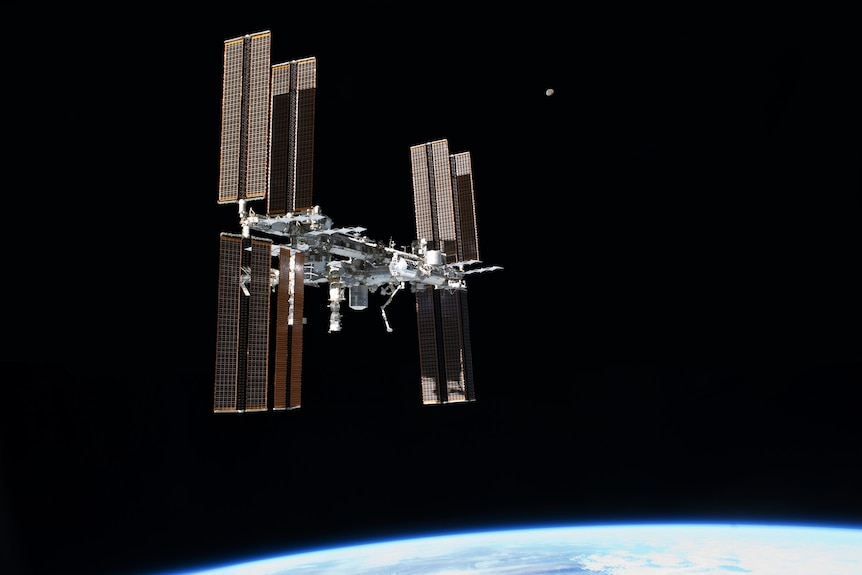
The International Space Station photographed from the space shuttle Atlantis in 2011. (Supplied: NASA)
The ISS orbits at 27,600km/h and passes overhead every 93 minutes.
Even at that speed, it has to be boosted once a month to maintain its orbit of about 420km above the surface due to atmospheric drag.
Its size and low orbit mean the ISS is a bright object, but only just after sunset or before sunrise when it reflects sunlight.
“There are loads of websites that can tell you what direction it’s in,” Ms Buttfield-Addison said.
“It will go around Earth every 90 minutes but in the meantime we have moved, which means it’s not visible in the same place each time.
“You can look at a tracking website or join an astronomy club and, if you get a relatively good camera or a telescope, that’ll help you find it.”