
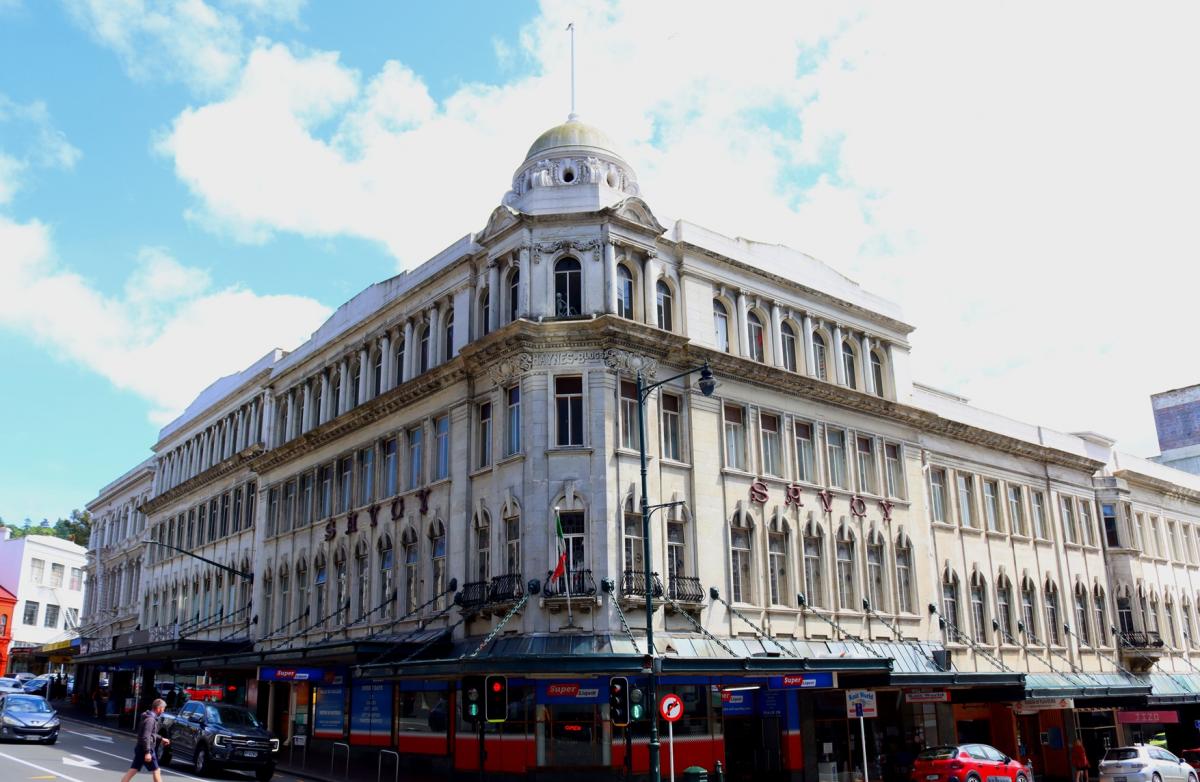
Behind ornate exteriors, Dunedin buildings can reveal human tales of industry and exploitation.
This week The Star reporter Sam Henderson uncovers how a drapery fortune left a lasting legacy on the city’s built heritage.
A faded name on an elegant facade is all that remains of a forgotten retail empire.
Stand on the corner of Princes St and Moray Pl, look closely at the Savoy Restaurant building and below the lanterned dome are the words Haynes Bldgs. This site was the crowning glory of a firm of drapers and clothiers run by Daniel Haynes.
Born in Warwickshire in 1832, he was apprenticed to a Coventry drapery business aged 13. Seeking greater opportunity, he emigrated to New Zealand in 1857 and landed in Auckland.
There he met George Herbert and Alexander Hay. The 1861 discovery of gold in Otago altered New Zealand’s economic geography, turning Dunedin into the colony’s busiest city.
Sensing this shift, the three entrepreneurs set up Herbert, Haynes and Hay, first at the heart of the gold rush in Gabriels Gully before relocating to Dunedin in 1862.
Mr Hay left the merchant and drapers firm after a few years and Mr Herbert retired in 1872, leaving Mr Haynes as sole proprietor, although he continued with the name Herbert, Haynes & Co.
The enterprise bypassed intermediaries to bring goods from Lancashire mills and Paris fashion houses straight to Otago, offering merchandise ranging from rough moleskins to the finest silks.
The business was one of many affected by the massive Princes St fire of 1867 that destroyed their original wooden building. After swiftly rebuilding in brick, Herbert, Haynes & Co had become a dominant retail force by the late 19th century.
Its Princes St premises were constantly expanded to reflect the owner’s wealth. In 1906, Mr Haynes commissioned a new warehouse and office structure at 24-26 Moray Pl to allow the efficient movement of stock to the retail floor.
Margaret Miller, born in Edinburgh in May 1839, emigrated to Otago in 1862 and married Mr Haynes in 1864.
While Mr Haynes focused on accumulating capital, Mrs Haynes managed the family’s social standing and charitable obligations.
Both were highly active in the Trinity Methodist Church. The couple’s substantial Italianate villa at 5 Smith St offered views over the growing metropolis, including the roofs of the Herbert, Haynes & Co empire.
In the late 1880s, New Zealand was gripped by a long economic depression. The practice of ‘sweating’ — forcing employees to work excessive hours for sub-subsistence wages — became prevalent in the garment trades.
In 1888, St Andrew’s Presbyterian Church minister the Rev Rutherford Waddell delivered a sermon titled ‘On The Sin of Cheapness’, denouncing the demand for bargain goods that drove wages to starvation levels.
The ensuing public outcry led to the Royal Commission on Sweating in 1890.
The proceedings revealed that the rapid expansion of businesses such as drapers and clothiers could be linked to depressed pay and long hours. This fierce public focus cast a lasting shadow over commercial success and highlighted the human cost of early colonial endeavour.
As one of the largest employers of seamstresses and tailors in the city, Mr Haynes came under intense scrutiny and he was compelled to testify.
In February 1890, he gave evidence that his firm employed 118 factory hands and 45 shop assistants.
He stressed, however, that no overtime was worked and he “did not allow his hands to take home work”.
The Sweating Commission validated Mr Waddell’s crusade and the public pressure it generated was a significant factor in the passage of the Factories Act of 1891 and the Industrial Conciliation and Arbitration Act of 1894 by the newly elected Liberal Government.
Mr Haynes was never criminally charged, but the moral implications of the sweating system affected the reputation of many wealthy merchants of the era.
Despite their wealth and societal standing, the family did not escape sorrow. They had eight children, including George, who died at 9 weeks and Bella, who died aged 2.
Daniel Haynes died in 1921, aged 89. His longevity allowed him to see his company survive the 1890s scandals and solidify its place as a Dunedin institution well into the 20th century. Mrs Haynes died in 1924, aged 85.
Tragedy struck the family again when their son Alexander Haynes died just a year later, aged 47, while on holiday in London. In 1905, Alexander Haynes had married Olivia Larnach.
She already had her fair share of tragedy, being the granddaughter of William Larnach, of Larnach Castle, who shot himself in 1898 in Parliament House, and the daughter of Donald Larnach, who shot himself ‘through the brain’ in 1910.
At an inquest, Mrs Haynes said passengers had suffered dysentery during their voyage to England. On the morning after arriving in London, her husband took a short walk.
A witness, William Abbott, said he was behind Mr Haynes when he suddenly fell violently on his face.
St Mary’s Hospital house physician Dr S. Ling said Mr Haynes was admitted in a coma. He recovered consciousness but later became semi-delirious, lapsed into unconsciousness and died. Dr Ling determined the cause of death was syncope following delirium, accelerated by diarrhoea contracted on the sea voyage.