
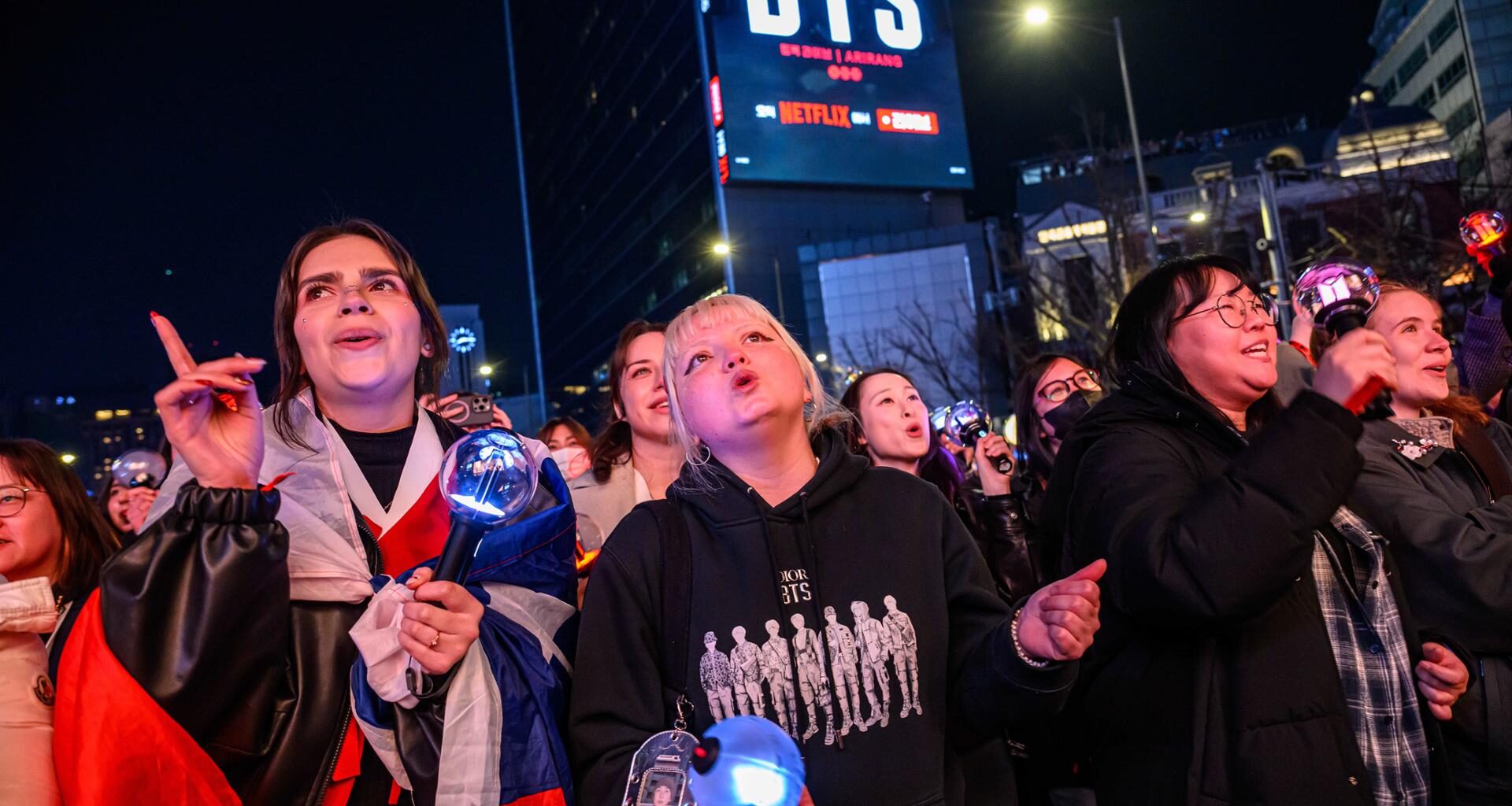
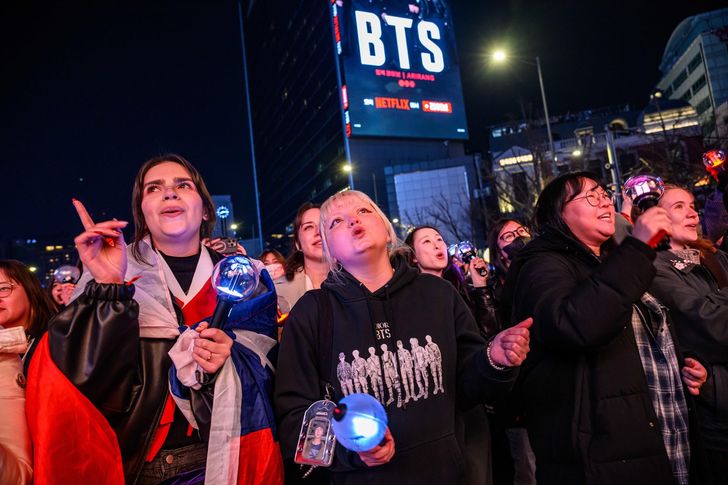
Members of BTS’ ARMY attend the group’s comeback concert in Seoul, Saturday. Korea Times photo by Shim Hyun-chul
Watching Saturday’s BTS concert in Seoul — and speaking with the group’s fandom, ARMY, who converged in the historic Gwanghwamun Square from across the globe — unexpectedly took me back to a decade ago, when being Korean abroad meant something different than it does today.
Between 2014 and 2015, I worked in Australia for a year to save money for travel. I spent another year traveling through 24 countries, mainly in Latin America.
Back then, few could have imagined people from around the world would fly to Seoul to see a Korean artist. Having crossed continents where the Korean wave was already a phenomenon and some where it was virtually unknown, I came to understand how a country’s cultural standing shapes what it means to be from there.
The Korean wave, or “hallyu,” had yet to make its mark in Australia at the time. Being Korean was hardly an advantage there. I still remember washing dishes when a coworker asked if my country ate dogs and if I had ever tried one. (Of course, I also remember all the Aussies who welcomed me, Brisbane’s blue skies and the outback sunsets of the Northern Territory.)
It was a different story in Latin America, where early K-pop acts such as Girls’ Generation and BIGBANG were already drawing fans. Korean dramas have likewise built a devoted following.
At a guesthouse in Havana, Cuba, the landlady, Miss Joaquina, watched the 2004 Korean drama, “Phoenix,” all the time. Even deep in the Bolivian countryside, where Quechua is spoken more widely than Spanish, a poster for the 2009 drama, “Boys Over Flowers,” hung on a wall. Across Latin America, many locals would light up upon learning I was Korean, eager to share what they knew about Korean culture.
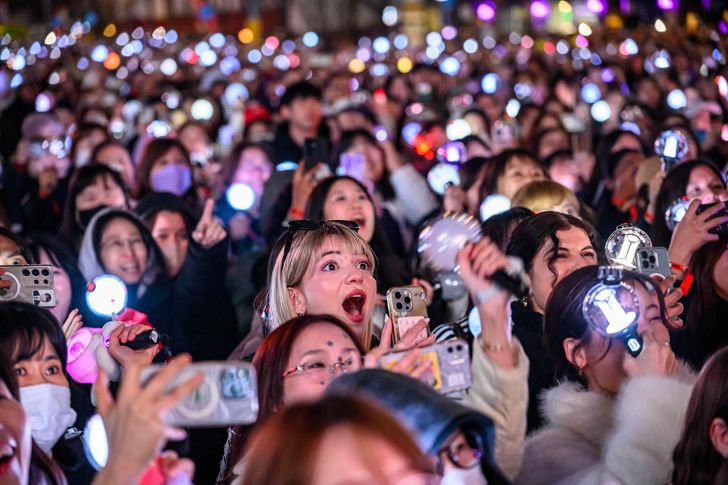
Fans excitedly watch BTS as it returns as a full group during its comeback concert in Seoul, Saturday. Korea Times photo by Shim Hyun-chul
Reporting from Gwanghwamun Square in the days leading up to BTS’ comeback concert, I found myself in a sea of people, where foreign visitors seemed to outnumber locals — a reminder of how far Korea’s cultural standing has gone since I traveled the world a decade ago.
The numbers back that up.
A Ministry of Culture, Sports and Tourism survey of 12,500 respondents across 25 countries last year found favorable views of Korea at 82.3 percent — the highest since the survey began in 2018. Gains were recorded across both genders and all age groups from teenagers to those in their 60s and older.
Among the factors seen as drivers for favorability, cultural content led at 77.4 percent, with K-pop topping free-association responses at 28.8 percent, followed by films and dramas at 23 percent.
The Korean wave’s global footprint has also expanded dramatically. According to the Korea Foundation, the number of members in Korean wave-related clubs worldwide reached 225 million in 2023, a 24-fold increase from 2012.
K-pop album exports hit a record 301 million dollars last year, Korea Customs Service data showed. Content industry exports also climbed to 14 billion dollars in 2024, another record high, according to the culture ministry.
What came to mind watching the BTS concert was Michael Jackson’s 1992 concert in Bucharest, Romania. When I was younger — and sometimes even now — I would watch that footage over and over, realizing that some artists could drive people from completely different cultures and languages into an absolute frenzy.
To watch that happen in Korea, in Seoul, was something else entirely.